Kiến thức
Describe your favorite season: 2 bài mẫu IELTS Speaking Part 2, từ vựng và câu hỏi Part 3
18 phút đọc
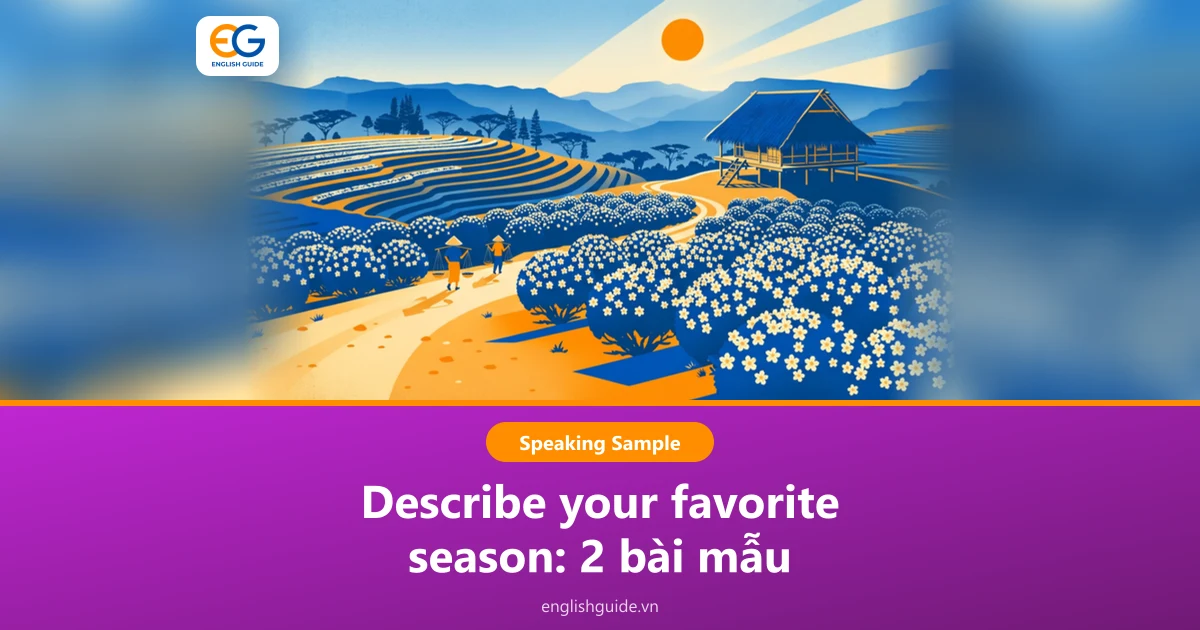
Describe your favorite season là đề IELTS Speaking Part 2 yêu cầu bạn nói khoảng 2 phút về mùa mình thích nhất: mùa đó rơi vào lúc nào, thời tiết ra sao, khác các mùa khác ở điểm gì và vì sao bạn thích nó. Cách làm chắc nhất là chọn một mùa gắn với kỷ niệm hoặc thói quen của chính bạn, tả thời tiết bằng vài hình ảnh cụ thể, rồi dành phần lớn thời gian cho lý do.
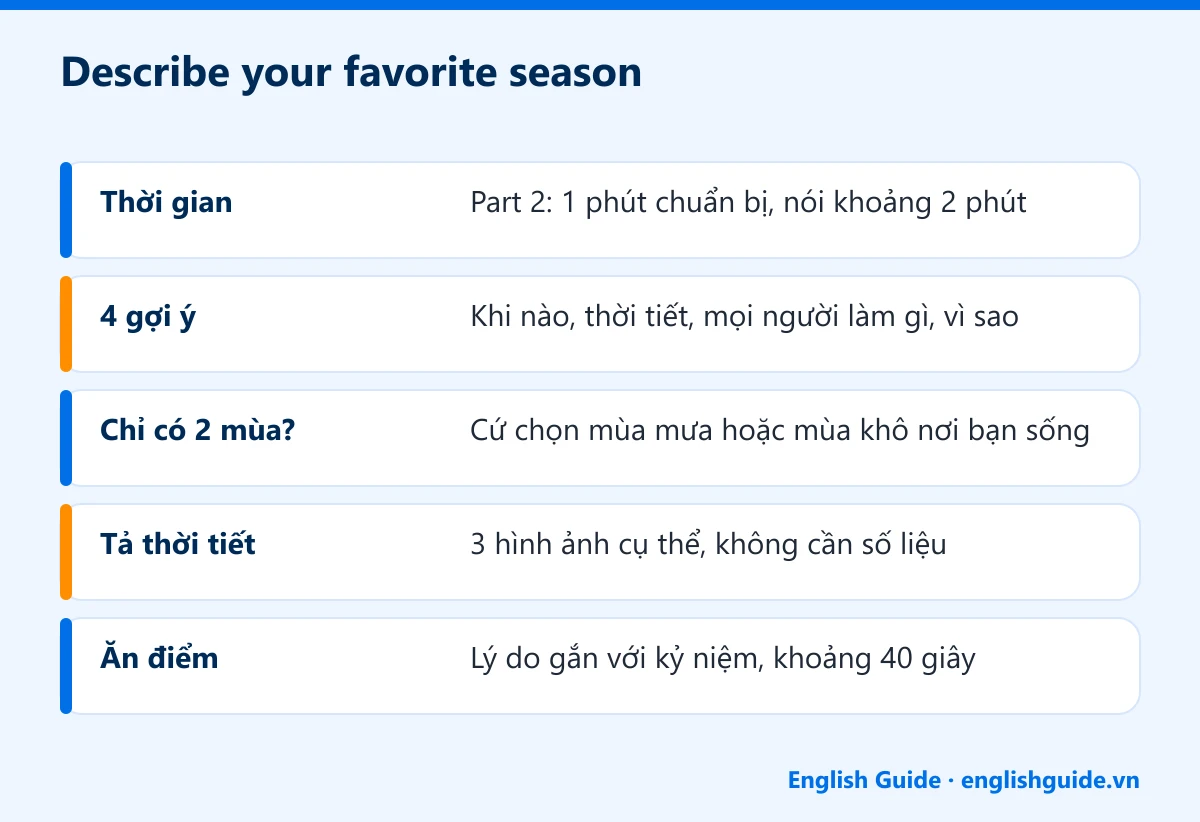
Tây Nguyên hay miền Nam chỉ có mùa mưa và mùa khô, nên nhiều bạn lúng túng với đề này. Bài viết gồm thẻ đề, cách chọn mùa, cách lên ý trong 1 phút, hai bài nói mẫu do English Guide tự soạn, từ vựng kèm nghĩa, 5 câu hỏi Part 3 có trả lời mẫu và lỗi hay gặp.
Cue card Describe your favorite season
Thẻ đề luyện tập (câu chữ trên thẻ thật có thể khác đôi chút, ví dụ thêm cụm in your country hoặc viết theo kiểu Anh là favourite):
Describe your favourite season.
You should say:
when it is
what the weather is like at that time
what people usually do during this season
and explain why it is your favourite season.
Ba dòng đầu là phần tả và kể, dòng cuối là phần giải thích, nơi bạn ghi điểm nhiều nhất. Một số thẻ thay dòng thứ ba bằng how it is different from other seasons, nên hãy chuẩn bị sẵn một hai câu so sánh với mùa khác. Thẻ ghi in your country thì nói về một mùa ở Việt Nam; không ghi thì có thể kể mùa ở nơi khác bạn đã thật sự trải qua.
Part 2 diễn ra thế nào?
Theo trang mô tả phần thi Speaking của IELTS, bài thi nói kéo dài 11–14 phút, gồm 3 phần. Part 2 mất 3–4 phút tính cả thời gian chuẩn bị: giám khảo đưa thẻ đề, phát giấy bút, bạn có 1 phút ghi chú rồi nói liên tục khoảng 2 phút. Sau đó giám khảo có thể hỏi thêm một hai câu cùng chủ đề. Part 3 kéo dài 4–5 phút, bàn các vấn đề liên quan theo hướng chung và trừu tượng hơn.
Bài nói được chấm theo 4 tiêu chí: Fluency and Coherence, Lexical Resource, Grammatical Range and Accuracy và Pronunciation. Cách ghi chú và giữ mạch cho mọi thẻ đề có ở bài IELTS Speaking Part 2: cách nói đủ 2 phút.
Nơi mình sống không có bốn mùa thì chọn mùa nào?
Bài thi chấm cách bạn dùng tiếng Anh để tả và giải thích, không chấm kiến thức khí hậu. Vì vậy, cứ chọn mùa có thật ở nơi bạn sống:
Nơi bạn sống | Có thể chọn | Câu mở gợi ý |
|---|---|---|
Tây Nguyên, miền Nam | Mùa khô hoặc mùa mưa | Where I live, there are really only two seasons, and my favourite is… |
Miền Bắc | Xuân, hạ, thu hoặc đông | Like most people in the north, I'd have to say autumn… |
Miền Trung | Mùa nắng hoặc những tháng mát đầu năm | The time of year I like best is… |
Vài nguyên tắc chọn mùa để nói dễ:
Mùa có kỷ niệm hoặc thói quen riêng: một chuyến đi, một món ăn, một dịp cả nhà quây quần. Lý do càng gắn với bạn, phần explain càng tự nhiên.
Mùa bạn tả được bằng giác quan: màu trời, gió, mùi hoa, tiếng mưa trên mái. Những chi tiết này giúp bạn dùng được tính từ và cụm từ hay.
Không cần số liệu: không nói nhiệt độ, lượng mưa hay tháng chính xác nếu không chắc. Dùng roughly, around, towards the end of the year là đủ.
Các câu Part 1 ngắn về thời tiết có ở bài IELTS Speaking Part 1 Weather; bài này tập trung vào cách kể dài 2 phút.
Các đề gần giống dùng lại được ý về mùa
Chuẩn bị kỹ một mùa, bạn xoay sở được cả nhóm đề dưới đây, chỉ cần đổi trọng tâm. Các đề trong bảng do English Guide soạn để luyện tập:
Cách hỏi khác | Điều cần nhấn mạnh | Dùng lại ý nào |
|---|---|---|
Describe your favourite time of the year. | Có thể là một dịp, không nhất thiết là cả mùa | Mùa thu Hà Nội (bài mẫu 2) |
Describe a type of weather you enjoy. | Kiểu trời và cảm giác của bạn | Trời trong, gió khô (bài mẫu 1) |
Describe a place that is best visited in a particular season. | Địa điểm, vì sao phải đi đúng mùa đó | Đồi cà phê nở hoa (bài mẫu 1) |
Describe an important festival in your country. | Nghi thức, không khí, ý nghĩa | Mùa xuân và Tết |
Describe a time when you experienced extreme weather. | Diễn biến, cảm xúc, hậu quả | Mùa mưa bão (cần câu chuyện khác) |
Nếu đề rơi vào lễ hội, xem thêm bài IELTS Speaking chủ đề Tết. Với đề về thời tiết khắc nghiệt hay thiên tai, có bài mẫu riêng ở Describe a natural disaster.
Cách lên ý trong 1 phút chuẩn bị
Chốt ngay một mùa trong 10 giây đầu. Chia giấy thành 4 dòng theo 4 gợi ý trên thẻ, mỗi dòng 2–4 từ khóa tiếng Anh.
Dòng weather: ghi 3 hình ảnh (bầu trời, gió hoặc mưa, một mùi hay âm thanh), không ghi số.
Dòng what people do: ghi một việc của mọi người và một việc của riêng bạn.
Dòng why: ghi 2 lý do, trong đó ít nhất một lý do gắn với kỷ niệm hoặc người thân.
Phân bổ thời gian khi nói:
Phần | Thời lượng gợi ý | Câu mở có thể dùng |
|---|---|---|
Mùa nào, rơi vào lúc nào | 15–20 giây | The season I'd like to talk about is… It usually starts around… |
Thời tiết lúc đó | 25–30 giây | What strikes you first is… |
Mọi người làm gì / khác mùa khác ra sao | 30–35 giây | It's also the time of year when… / Compared with… |
Vì sao bạn thích | 40–45 giây | The main reason I love it is… On top of that… |
Bài mẫu 1: mùa khô ở Buôn Ma Thuột
Bài mẫu tham khảo band 7.0+, người kể hư cấu, do English Guide tự soạn. Cách kể: chọn một mùa ít người nghĩ tới, thừa nhận điểm trừ (bụi), rồi dùng chi tiết riêng của Tây Nguyên và kỷ niệm gia đình để thuyết phục.
Ghi chú trong 1 phút
dry season · Central Highlands · only 2 seasons · end of year → rains return
cloudless sky · afternoon wind · chilly mornings · red dust
coffee flowers · white hills · sweet smell · people take photos
outdoors, no forecast · grandparents' farm · family weekend
Bài nói mẫu
I'd like to talk about the dry season here in Buon Ma Thuot, which, I have to admit, isn't what most people would choose. Up in the Central Highlands, we don't really get spring, summer, autumn and winter. Instead, the year is split into a rainy half and a dry half, and the dry season roughly runs from the end of the year until the rains return a few months later.
The weather during those months is almost the opposite of the rainy season. The sky stays a deep, cloudless blue for weeks on end, and a strong, dry wind picks up every afternoon. Mornings can be surprisingly chilly, so I often leave home in a jacket and come back carrying it. The one downside is the dust. A lot of the land around here is red soil, and after a windy day my motorbike looks as if someone has sprayed it orange.
What makes this season really special, though, is what happens on the coffee farms. Towards the end of the dry season, once the trees are given a proper watering, they burst into tiny white flowers almost overnight. Whole hillsides turn white, and the air smells sweet, a bit like jasmine. It doesn't last long, so people rush out of town with their cameras to catch it.
As for why it's my favourite, there are two main reasons. Firstly, it's simply the best time to be outdoors. My friends and I can go camping or cycling without checking the forecast every five minutes. Secondly, and more importantly, it reminds me of my grandparents, who grow coffee just outside the city. Every year, when the flowers come out, the whole family spends a weekend at their farm, and my grandmother cooks for everyone. So for me, the dry season isn't really about the weather. It's about being together, and that's why, whenever someone complains about the dust, I just tell them to wait for the flowers.
Vì sao bài này đạt band khá
Fluency and Coherence: mỗi gợi ý trên thẻ thành một đoạn, chuyển ý bằng các cụm tự nhiên (What makes this season really special, though…, As for why…, Firstly… Secondly, and more importantly…). Theo bảng mô tả band Speaking, band 7 nói dài được mà không thấy gắng sức và dùng linh hoạt từ nối.
Lexical Resource: cụm từ đúng ngữ cảnh: for weeks on end, the wind picks up, burst into flower, rush out… to catch it.
Grammatical Range and Accuracy: mệnh đề quan hệ không xác định (which, I have to admit, isn't…; who grow coffee…), câu bị động (once the trees are given a proper watering), as if để so sánh hình ảnh, whenever cho thói quen.
Phần explain có chiều sâu: lý do thứ hai chuyển từ thời tiết sang gia đình, câu chốt quay lại chi tiết bụi đỏ ở đầu bài.
Bài mẫu 2: mùa thu Hà Nội
Bài mẫu tham khảo band 7.0+, người kể hư cấu: một bạn lớn lên ở Tây Nguyên, ra Hà Nội học đại học. Cách kể: so sánh với hai mùa quê nhà, tả mùa thu bằng mùi, vị, màu sắc và nối với cảm giác dần coi thành phố mới là nhà.
Ghi chú trong 1 phút
autumn · Hanoi · grew up with 2 seasons · moved for uni
heat breaks · less humid · crisp breeze · golden light · yellow leaves
vs summer (sticky) · vs winter (damp, grey cold)
hoa sữa smell · cốm in lotus leaf · lake walks
why: city felt like home · new friends · smell brings it back
Bài nói mẫu
My favourite season is autumn, or more precisely, autumn in Hanoi. I grew up in the Central Highlands, where we only have a rainy and a dry season, so I'd never really experienced autumn until I moved to Hanoi for university a couple of years ago.
In the north, autumn comes after a long, sticky summer. At some point the heat just breaks: the humidity drops, and there's a crisp, light breeze in the air. The sunlight becomes softer, almost golden, and the leaves on some of the old trees along the streets turn yellow and start drifting down.
It feels completely different from the other seasons there. Summer is scorching and humid, and winter can be grey and damp, with the kind of cold that gets into your bones. Autumn sits comfortably in the middle: warm enough for a T-shirt in the afternoon, but cool enough for a light jacket at night.
There are also little things that only happen at this time of year. In the evenings, many streets are filled with the scent of a white flower called hoa sữa, which is so strong that some people actually find it a bit overpowering. Street vendors also start selling cốm, a kind of flattened young green rice wrapped in a lotus leaf. I got into the habit of buying a small packet on my way home and eating it by the lake.
The real reason I love this season, though, is that it was when Hanoi finally started to feel like home. I'd arrived in the middle of summer, homesick and worn out by the heat. Once the weather cooled down, I began walking everywhere, exploring old streets with my classmates and spending hours in tiny cafés. Even now, whenever I catch the smell of that flower, it brings back the feeling of making a new city my own.
Điểm đáng học trong bài mẫu 2
Mở bài bằng tương phản (I grew up… where we only have…) giải thích luôn vì sao mùa thu mới lạ với người kể, kèm quá khứ hoàn thành I'd never really experienced autumn until….
Phần so sánh gọn trong một đoạn, với hai vế song song warm enough for… but cool enough for….
Gặp từ thuần Việt (hoa sữa, cốm), người nói giữ nguyên tên rồi giải thích ngay bằng tiếng Anh (a white flower called…, a kind of… wrapped in…). Đây là cách paraphrase an toàn.
Câu chốt nối mùa với cảm giác thành phố mới đã thành nhà, nên phần explain không dừng ở because the weather is nice.
Từ vựng describe your favorite season
Tả thời tiết và cảnh vật
Từ / cụm | Nghĩa | Ví dụ ngắn |
|---|---|---|
a clear, cloudless sky | bầu trời trong, không gợn mây | We get clear, cloudless skies for weeks. |
for weeks on end | liên tục nhiều tuần liền | It can stay dry for weeks on end. |
the wind picks up | gió nổi lên, mạnh dần | The wind usually picks up after lunch. |
crisp (air, morning) | (không khí) mát lạnh, khô và trong | I love those crisp autumn mornings. |
the heat breaks | cái nóng dịu hẳn đi | One day the heat finally breaks. |
sticky / damp | oi nồng, dính nhớp / ẩm ướt | Summer is sticky; winter is cold and damp. |
a cold that gets into your bones | cái lạnh thấm vào xương | It's the kind of cold that gets into your bones. |
burst into flower / be in full bloom | nở bung / nở rộ | The trees burst into flower overnight. |
the leaves turn yellow / change colour | lá chuyển vàng / đổi màu | The leaves turn yellow and drift down. |
Hoạt động và cảm xúc theo mùa
Từ / cụm | Nghĩa |
|---|---|
my favourite time of (the) year | thời điểm tôi thích nhất trong năm |
make the most of (the weather) | tận dụng (thời tiết đẹp) |
seasonal fruit / seasonal dishes | trái cây theo mùa / món ăn theo mùa |
get into the habit of (+ V-ing) | dần có thói quen |
feel homesick | nhớ nhà |
bring back memories / the feeling of… | gợi lại kỷ niệm / cảm giác… |
worn out (by the heat) | mệt lả (vì nóng) |
Cấu trúc câu nên có
Cấu trúc | Ví dụ | Dùng để |
|---|---|---|
It's the time of year when… | It's the time of year when the coffee trees flower. | nói đặc trưng của mùa |
…, whereas… | Summer is sticky, whereas autumn is crisp and dry. | so sánh hai mùa |
… enough for…, but… enough for… | warm enough for a T-shirt, but cool enough for a jacket | tả mùa ở giữa hai thái cực |
as if + mệnh đề | It looks as if someone has sprayed it orange. | so sánh hình ảnh sinh động |
I'd never… until… | I'd never experienced autumn until I moved north. | trải nghiệm lần đầu |
whenever + hiện tại đơn | Whenever I smell that flower, it brings back… | thói quen, phản xạ cảm xúc |
Câu hỏi IELTS Speaking Part 3 về các mùa
Part 3 không hỏi về mùa của riêng bạn nữa mà mở rộng sang xã hội: mọi người thích mùa nào, mùa ảnh hưởng ăn uống, lễ hội, du lịch và lối sống ra sao. Mỗi câu nên trả lời 3–5 câu: nêu quan điểm, giải thích, cho ví dụ, có thể nhắc mặt còn lại. Các câu dưới đây do English Guide tự soạn theo chủ đề; cách mở rộng câu trả lời xem thêm ở bài IELTS Speaking Part 3.
Which season do people in your country like best?
It really depends on the region, because Vietnam is a long country and the climate varies a lot from north to south. In the north, I'd guess most people love autumn, since the weather is pleasant and the cities look beautiful. In the south and the highlands, where there are only two seasons, people tend to prefer the dry months, simply because it's easier to travel and work.
How do the seasons affect what people eat?
Quite a lot, at least traditionally. Every season has its own fruit and dishes. In the hot months people go for cooling things like sweet soups and fresh fruit, while in the cold months in the north, a steaming bowl of noodle soup on the street feels much more appealing. Having said that, supermarkets now sell almost everything all year round, so that link is getting weaker.
Are there any festivals connected with the seasons in your country?
Yes, several. The biggest one is Tet, the Lunar New Year, which is traditionally seen as the start of spring. That's why you see peach and apricot blossoms everywhere at that time. Then there's the Mid-Autumn Festival, which is mainly for children: they carry lanterns and eat mooncakes under the full moon. Many of these festivals originally had a lot to do with farming and harvests, although nowadays most people simply see them as a time for family.
How do the seasons affect tourism?
Enormously. Most tourist spots have a peak season and a quiet season, and the difference can be huge. Beach towns, for instance, can be packed in the summer holidays but almost empty in the stormy months. For travellers, though, going in the low season can be a smart choice, because it's cheaper and far less crowded, as long as you don't mind taking a chance on the weather.
Do people pay less attention to the seasons than in the past?
I think so, especially in cities. Many people spend most of the day in air-conditioned offices, so whether it's hot or cool outside hardly matters to them. In the past, people's lives were organised around the seasons: when to plant, when to harvest, when to fix the roof before the rains. Today, it's mainly people who work outdoors, like farmers or delivery drivers, who still plan around the weather. I find that a bit of a shame.
Lỗi thường gặp khi nói đề describe your favorite season
Đọc bản tin thời tiết: liệt kê nhiệt độ, lượng mưa, tháng bắt đầu và kết thúc. Hãy tả bằng hình ảnh và cảm nhận.
Lý do quá chung: because it's cool and comfortable ai cũng nói được. Hãy thêm một việc bạn chỉ làm vào mùa đó hoặc một kỷ niệm cụ thể.
So sánh quá dài: tả mùa khác chỉ nên chiếm 20–30 giây, kẻo lệch đề.
Sai giới từ: nói in (the) summer, in the rainy season, nhưng at this time of year (không phải in this time of year).
Sai phát âm từ khóa: season đọc /ˈsiːzn/ với âm /z/, không phải /s/; autumn đọc /ˈɔːtəm/, chữ n cuối câm.
Luyện Speaking cùng English Guide
Part 2 tiến bộ nhanh khi có người nghe, bấm giờ và chữa ngay. Lớp IELTS của English Guide có chấm Speaking chi tiết, sĩ số 8–15 học viên, học phí ghi rõ theo giờ:
Còn ngại mở miệng: khóa Speak Now luyện nghe nói căn bản tại cơ sở Buôn Ma Thuột (36 Trần Nhật Duật), 16 buổi – 32 giờ, 4.900.000đ (khoảng 153.000đ/giờ).
Đã có nền, muốn luyện đủ 4 kỹ năng: IELTS Master 5.0–5.5 tại trung tâm, 32 buổi – 80 giờ, 9.900.000đ (khoảng 124.000đ/giờ).
Muốn học từ xa: IELTS Online học trực tiếp cùng giáo viên qua mạng; IELTS Master 5.0–5.5 bản online là 7.140.000đ cho 80 giờ (khoảng 89.000đ/giờ).
Chưa rõ trình độ: làm bài kiểm tra trình độ miễn phí 70 phút, sau đó được tư vấn xếp lớp.
Câu hỏi thường gặp
Chỗ tôi chỉ có mùa mưa và mùa khô, nói về mùa mưa có được không?
Được. Chỉ cần mở đầu bằng một câu giải thích như Where I live, there are only two seasons, rồi tả mùa đó như mọi mùa khác.
Có cần nói chính xác mùa bắt đầu và kết thúc tháng nào không?
Không. Nói ước chừng là đủ và tự nhiên hơn: roughly from…, around the end of the year, a few months later. Bịa một con số chính xác không giúp bạn thêm điểm.
Tết có được tính là một mùa không?
Bạn có thể nói về mùa xuân và lấy Tết làm điểm nhấn: spring, especially the weeks around Tet. Nhưng hãy giữ trọng tâm là mùa, tức là thời tiết và cảnh vật, đừng biến bài nói thành bài kể về một lễ hội.