Kiến thức
Từ vựng IELTS chủ đề Transport: 5 nhóm từ, từ dễ nhầm, collocation, bài mẫu Writing và Speaking
18 phút đọc
Từ vựng IELTS chủ đề Transport gồm những từ nói về cách bạn đi lại hằng ngày, đường sá, giao thông công cộng, an toàn khi tham gia giao thông và xu hướng xe điện, xe tự lái. Chủ đề này gặp ở Speaking từ câu hỏi Part 1 kiểu “How do you get to school?” tới thảo luận Part 3, và ở nhiều đề Writing Task 2. Bài này chia hơn 40 từ và cụm từ thành 5 nhóm, mỗi mục có từ loại, nghĩa và câu ví dụ dùng lại được trong bài thi.
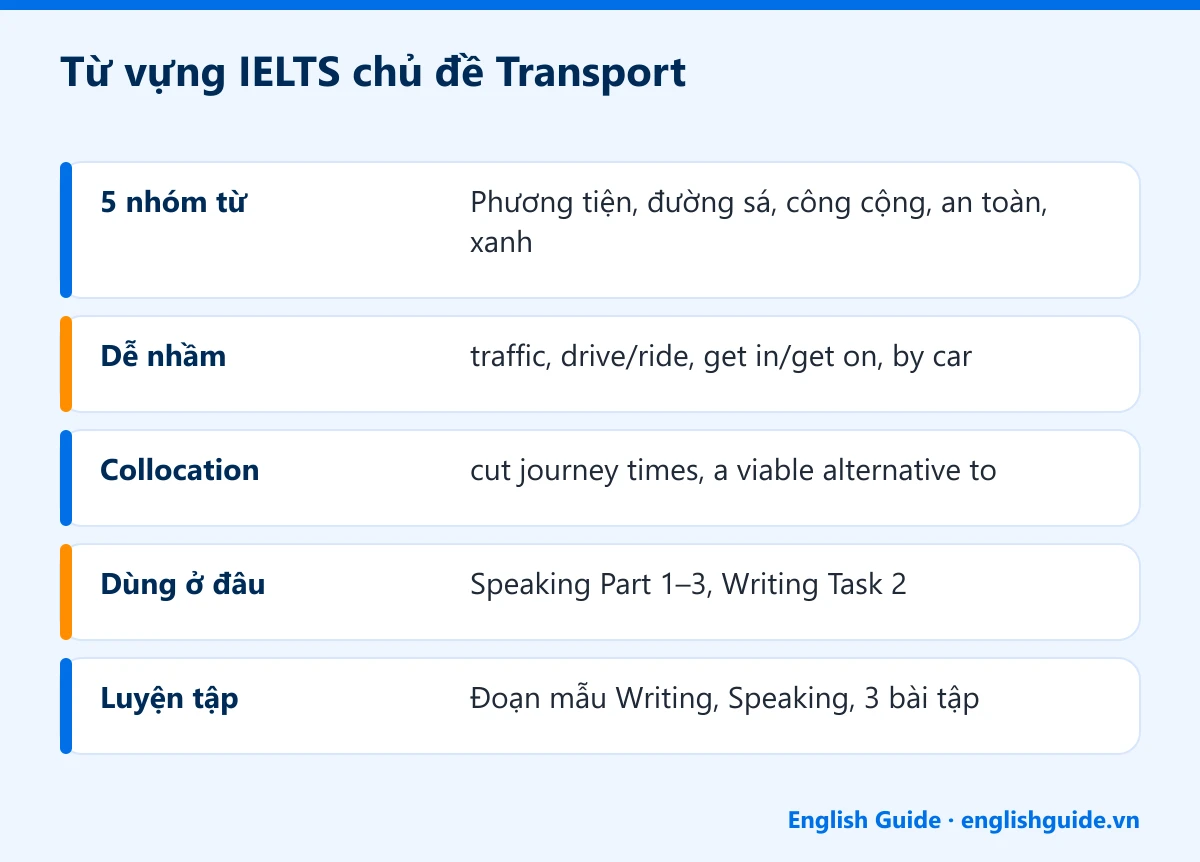
Sau bảng từ là phần phân biệt các cặp từ hay dùng sai, collocation, thành ngữ, đề Task 2 luyện tập, đoạn mẫu Writing, câu trả lời Speaking và bài tập có đáp án. Một số từ quen thuộc như ùn tắc, giờ cao điểm, người đi làm hằng ngày đã có ở bài từ vựng IELTS chủ đề City; từ về chuyến bay, quá cảnh, chỗ ở có ở bài từ vựng IELTS chủ đề Travel, nên ở đây không nhắc lại.
Chủ đề Transport xuất hiện ở đâu trong IELTS
Speaking Part 1 (4–5 phút, theo mô tả phần thi Speaking của IELTS): câu hỏi về thói quen đi lại, như bạn đến trường bằng gì, có hay đi xe buýt không, hồi nhỏ ai đưa đón bạn.
Speaking Part 2: kể về một chuyến đi đáng nhớ, một lần bị trễ xe, một phương tiện bạn thích. Bạn có 1 phút chuẩn bị rồi nói khoảng 2 phút. Bài mẫu chi tiết có ở bài Describe a journey you remember well.
Speaking Part 3 (4–5 phút): vì sao người ta vẫn chuộng xe riêng, giao thông tương lai sẽ ra sao, có nên đầu tư đường sắt tốc độ cao.
Writing Task 2: đề về an toàn giao thông, xe điện, xe tự lái, đầu tư đường sắt hay sân bay, trẻ em tự đi học.
Theo trang giải thích điểm của IELTS, Lexical Resource (vốn từ) là một trong bốn tiêu chí chấm Speaking và cũng là một trong bốn tiêu chí chấm mỗi bài Writing, các tiêu chí có trọng số ngang nhau. Vì vậy, thay vì chỉ có car, bus, road, bạn nên có sẵn những từ gọi đúng tên sự vật như junction, tailback, interchange, cùng các cụm đi liền nhau như cut journey times.
Từ vựng IELTS chủ đề Transport theo 5 nhóm
Ký hiệu từ loại trong bảng: (n) danh từ, (v) động từ, (adj) tính từ, (phr) cụm từ. Với những từ có hai cách viết, chữ (UK) là Anh-Anh, (US) là Anh-Mỹ; chọn một kiểu và dùng thống nhất trong bài.
Nhóm 1: Phương tiện và cách di chuyển
Từ, cụm từ | Từ loại | Nghĩa | Ví dụ |
|---|---|---|---|
means of transport | n | phương tiện đi lại (số ít và số nhiều cùng dạng) | For most families in the Central Highlands, the motorbike is still the main means of transport. |
private vehicle | n | phương tiện cá nhân | Private vehicles give people freedom, but they also take up a lot of road space. |
ride-hailing app | n | ứng dụng gọi xe | Ride-hailing apps have made it easier to get home late at night without driving. |
motorbike taxi | n | xe ôm | Some older residents still prefer a familiar motorbike taxi driver to an app. |
coach / intercity bus | n | xe khách đường dài | The coach to the coast leaves at dawn and arrives before lunch. |
metro line / light rail | n | tuyến metro / đường sắt nhẹ | A metro line can move thousands of people an hour without adding a single car to the road. |
e-bike / e-scooter | n | xe đạp điện / xe điện đứng | Many teenagers ride e-bikes to school because they are cheap to run. |
on foot | phr | đi bộ | My school is close enough to reach on foot, so I rarely need a lift. |
give someone a lift (UK) / a ride (US) | phr | chở ai đó một đoạn | My uncle gives me a lift to the bus station whenever I go back to university. |
Nhóm 2: Đường sá và tình trạng lưu thông
Từ, cụm từ | Từ loại | Nghĩa | Ví dụ |
|---|---|---|---|
road network | n | mạng lưới đường bộ | The province has upgraded its road network to connect remote districts with the city. |
junction / intersection | n | ngã ba, ngã tư | Busy junctions without traffic lights are especially risky at night. |
roundabout | n | vòng xuyến | Drivers entering a roundabout should give way to vehicles already on it. |
flyover (UK) / overpass (US) | n | cầu vượt | The new flyover lets lorries pass over the market area instead of through it. |
gridlock | n | tắc nghẽn hoàn toàn, xe không nhúc nhích | One broken-down truck on the bridge can cause gridlock across the whole district. |
tailback | n | hàng xe dài nối đuôi nhau | Roadworks created a tailback stretching several kilometres. |
pothole | n | ổ gà | Potholes on rural roads are particularly dangerous for motorcyclists after dark. |
pavement (UK) / sidewalk (US) | n | vỉa hè | When pavements become parking spaces, pedestrians are pushed onto the road. |
Nhóm 3: Giao thông công cộng
Từ, cụm từ | Từ loại | Nghĩa | Ví dụ |
|---|---|---|---|
bus route | n | tuyến xe buýt | The city has opened a bus route linking the university with the central market. |
frequent / frequency | adj / n | dày chuyến / tần suất chạy | People will only switch to buses if services are frequent. |
punctual / reliable | adj | đúng giờ / đáng tin cậy | Passengers care more about a reliable service than a brand-new bus. |
timetable (UK) / schedule (US) | n | lịch chạy xe | The timetable is posted at every stop and updated on the app. |
interchange | n | điểm trung chuyển, đổi tuyến | A well-designed interchange lets passengers change from train to bus in a few minutes. |
park-and-ride | n | gửi xe ở rìa thành phố rồi đi tiếp bằng xe buýt | Park-and-ride schemes keep thousands of cars out of the centre. |
subsidise | v | trợ giá | Local authorities often subsidise bus services in rural areas that would otherwise run at a loss. |
overcrowded | adj | quá tải, chật cứng | Overcrowded carriages put many people off travelling by train. |
Nhóm 4: An toàn giao thông và việc lái xe
Từ, cụm từ | Từ loại | Nghĩa | Ví dụ |
|---|---|---|---|
driving licence (UK) / driver's license (US) | n | bằng lái xe | She passed her test and got her driving licence at eighteen. |
driving test | n | kỳ sát hạch lái xe | The practical part of a driving test checks how candidates cope with real traffic. |
learner driver | n | người đang học lái | Learner drivers should practise on quiet roads before tackling busy ones. |
speed limit | n | giới hạn tốc độ | Lower speed limits near schools give drivers more time to react. |
speeding | n | chạy quá tốc độ | Speeding turns a small mistake into a serious crash. |
run a red light | phr | vượt đèn đỏ | Cameras at the junction catch drivers who run red lights. |
drink-driving (UK) / drunk driving (US) | n | lái xe khi đã uống rượu bia | Drink-driving puts everyone on the road at risk, not just the driver. |
reckless driving | n | lái xe ẩu, bất cẩn | Reckless driving among young motorcyclists is a common worry for parents. |
wear a helmet / a seatbelt | phr | đội mũ bảo hiểm / thắt dây an toàn | Wearing a helmet correctly can be the difference between a minor and a serious injury. |
road rage | n | cơn nóng giận khi lái xe | A tiny scratch can turn into road rage when both drivers are tired and late. |
hit-and-run | n | gây tai nạn rồi bỏ chạy | Police used camera footage to trace the hit-and-run driver. |
Nhóm 5: Giao thông xanh và giao thông tương lai
Từ, cụm từ | Từ loại | Nghĩa | Ví dụ |
|---|---|---|---|
electric vehicle (EV) | n | xe điện | Electric vehicles produce no tailpipe emissions, but the electricity still has to be generated somewhere. |
charging station | n | trạm sạc | More charging stations are needed along highways before long EV trips become easy. |
fuel-efficient | adj | tiết kiệm nhiên liệu | A fuel-efficient car is cheaper to run and pollutes less. |
carbon emissions | n | lượng khí thải carbon | Many governments aim to cut carbon emissions from transport. |
low-emission zone | n | khu vực hạn chế xe phát thải cao | Older lorries may have to pay a fee to enter a low-emission zone. |
carpooling / car-sharing | n | đi chung xe / thuê xe dùng chung | Carpooling with two colleagues cuts the cost of the daily drive by two thirds. |
self-driving / autonomous vehicle | n | xe tự lái | Self-driving vehicles raise hard questions about who is responsible in an accident. |
high-speed rail | n | đường sắt tốc độ cao | High-speed rail could become a serious rival to short domestic flights. |
active travel | n | đi lại chủ động (đi bộ, đạp xe) | Safe cycle paths encourage active travel among students. |
Những cặp từ chủ đề Transport hay dùng sai
Lỗi ở chủ đề giao thông thường không nằm ở từ khó mà ở những từ rất quen. Bảng dưới gom các cặp mà học viên hay nhầm khi nói và viết:
Từ dễ nhầm | Cách dùng đúng | Ví dụ |
|---|---|---|
transport / transportation | Anh-Anh thường dùng transport, Anh-Mỹ thường dùng transportation; khi chỉ hệ thống đi lại, cả hai là danh từ không đếm được | Public transport in my town has improved a lot recently. |
traffic | Danh từ không đếm được, chỉ lượng xe trên đường; không viết traffics, a traffic | There was heavy traffic on the way to the station. |
vehicle / means of transport | Vehicle là một chiếc xe cụ thể; means of transport là loại hình đi lại | Buses are a cheap means of transport, and each vehicle carries dozens of people. |
drive / ride | Drive dùng cho ô tô, xe tải, xe buýt; ride dùng cho xe máy, xe đạp, ngựa | My father drives a truck, but I ride a motorbike. |
get in / get on | Get in(to) cho ô tô, taxi; get on cho xe buýt, tàu, máy bay, xe máy | We got on the bus at the second stop. |
by car / in my car | By + phương tiện không có mạo từ; khi có mạo từ hay tính từ sở hữu thì dùng in, on | I came by car. I came in my brother's car. |
miss / lose | Miss the bus là lỡ chuyến xe; lose dùng cho việc làm mất đồ | I missed the last bus and had to book a ride. |
Mẹo nhỏ: khi kể về thói quen ở Việt Nam, hãy nói rõ motorbike thay vì bike. Với người bản xứ, bike thường được hiểu là xe đạp.
Collocation và thành ngữ chủ đề Transport
Collocation là những từ thường đi với nhau. Học cả cụm giúp câu của bạn tự nhiên hơn hẳn so với ghép từng chữ theo tiếng Việt. Bài collocation trong IELTS giải thích cách học loại cụm từ này.
Collocation | Nghĩa | Ví dụ |
|---|---|---|
cut journey times | rút ngắn thời gian đi lại | The new bridge has cut journey times between the two districts. |
reduce reliance on private cars | giảm phụ thuộc vào xe cá nhân | Cheap, frequent buses help reduce reliance on private cars. |
a viable alternative to | lựa chọn thay thế khả thi | For many rural families, the bus is not yet a viable alternative to the motorbike. |
encourage people to switch to | khuyến khích người dân chuyển sang | Lower ticket prices could encourage people to switch to trains. |
upgrade the road network | nâng cấp mạng lưới đường | Upgrading the road network helps farmers get their produce to market faster. |
impose stricter penalties on | áp dụng mức phạt nặng hơn với | Authorities could impose stricter penalties on repeat offenders. |
raise public awareness of | nâng cao nhận thức của người dân về | TV campaigns can raise public awareness of the dangers of drink-driving. |
Thành ngữ dưới đây hợp với Speaking, giúp câu trả lời tự nhiên. Không nên dùng chúng trong Writing Task 2.
Thành ngữ | Nghĩa | Ví dụ |
|---|---|---|
hit the road | lên đường | We hit the road at five to avoid the midday heat. |
a backseat driver | người ngồi cạnh hay ngồi sau mà cứ chỉ đạo người lái | My mum is a real backseat driver; she comments on every turn I make. |
pave the way for | mở đường cho | Cheaper batteries could pave the way for electric motorbikes in the countryside. |
at a crossroads | đứng trước ngã rẽ quan trọng | After graduating, I was at a crossroads: stay in my home town or move to the city. |
miss the boat | lỡ mất cơ hội | If you wait too long to register, you might miss the boat. |
Đề Writing Task 2 chủ đề Transport hay gặp
Các đề dưới đây do English Guide tự diễn đạt để luyện tập, bám theo những hướng ra đề phổ biến về giao thông:
Dạng đề | Đề luyện tập |
|---|---|
Agree/disagree | The best way to make roads safer is to impose much heavier fines on drivers who break traffic laws. To what extent do you agree or disagree? |
Advantages/disadvantages | In the future, self-driving vehicles may replace most human drivers. Do the advantages of this outweigh the disadvantages? |
Discussion | Some people think governments should invest in high-speed railways, while others believe expanding airports is a better use of money. Discuss both views and give your opinion. |
Problem/solution | Electric vehicles are becoming more popular, but many towns do not have enough charging stations. What problems does this cause, and how can they be solved? |
Two-part question | Fewer children walk or cycle to school today than in the past. Why is this happening? What can be done to reverse this trend? |
Hai bài mẫu hoàn chỉnh về tắc đường và đi làm quá xa, kèm dàn ý và phân tích 4 tiêu chí, có ở bài IELTS Writing Task 2 chủ đề Transport.
Đoạn mẫu Writing Task 2 dùng từ vựng Transport
Đề: đề agree/disagree về phạt nặng ở bảng trên. Đoạn thân bài dưới đây đi theo hướng đồng ý một phần; từ vựng của bài được in đậm.
There is little doubt that heavier fines can change behaviour in the short term. A driver who knows that running a red light or speeding past a school will cost a week's wages is likely to think twice. However, penalties only work when offenders expect to be caught, and traffic police cannot be present at every junction. Fines should therefore be combined with cameras and with education that starts early. If children learn to wear a helmet properly and understand why speed limits exist, they are less likely to become reckless drivers as adults. Road design matters too: well-lit intersections, proper pavements and lower limits in residential streets reduce the chance that a single mistake becomes a tragedy. Heavier fines, in other words, are a useful tool, but they are not the best solution on their own.
Đoạn văn mở bằng ý nhượng bộ có ví dụ cụ thể, chuyển hướng bằng However, rồi đưa hai giải pháp bổ sung (giáo dục, thiết kế đường). Câu cuối trả lời thẳng vào chữ “the best way” trong đề, giúp lập trường rõ ràng.
Câu trả lời Speaking mẫu chủ đề Transport
Part 1
How do you usually get around your town?
Mostly by motorbike, like most people where I live. Buon Ma Thuot doesn't have a metro, and buses don't come past my neighbourhood very often, so riding is simply the most practical option. At weekends, though, I sometimes walk to the coffee shop near my house. It's only ten minutes on foot, and it's a nice change.
Did you use public transport when you were a child?
Not really. My parents gave me a lift to primary school every morning, and the only time I took a bus was on school trips. I remember being excited just because it was different. These days I'd actually like to use buses more, but the timetable would have to be a lot more reliable first.
Part 3
Why do many people still prefer private vehicles to public transport?
I think it comes down to convenience and control. With your own motorbike you can leave whenever you like and go door to door, whereas a bus might come every half hour and drop you a long walk from where you need to be. Until services are frequent and punctual, public transport won't be a viable alternative for most people, however cheap the tickets are.
Will self-driving cars become common in your country?
Eventually, perhaps, but not any time soon. Self-driving systems are designed for roads with clear lanes and fairly predictable traffic, and our streets are full of motorbikes weaving in and out. There's also the question of responsibility: if an autonomous vehicle hits someone, who's to blame? I suspect we'll see electric motorbikes and better buses long before we see cars without drivers.
Các câu Part 1 trả lời thẳng rồi thêm một chi tiết đời thường; các câu Part 3 nêu quan điểm, giải thích lý do và thêm một ví dụ hoặc dự đoán. Từ vựng không cần hiếm, chỉ cần đúng chỗ như go door to door, a viable alternative.
Bài tập từ vựng Transport có đáp án
Bài 1: Điền từ thích hợp
Từ gợi ý: gridlock, punctual, pothole, charging station, learner driver, interchange
The tyre burst after the car hit a deep ___ on the country road.
Passengers will not trust a bus service that is rarely ___.
A ___ should always practise with an experienced driver beside them.
An accident on the main bridge caused total ___ for three hours.
We had to drive another thirty kilometres to find a ___ for our electric car.
At the new ___, passengers can change from the train to a city bus without going outside.
Bài 2: Nối động từ với cụm danh từ phù hợp
Động từ | Cụm danh từ |
|---|---|
1. cut | a. stricter penalties |
2. impose | b. journey times |
3. run | c. public transport |
4. prioritise | d. a red light |
5. wear | e. a helmet |
Bài 3: Chọn từ đúng
There was a lot of (traffic / traffics) on the way home.
I usually go to work (by / on) bus.
She (drives / rides) a motorbike to school every day.
Quick, (get on / get in) the taxi before the driver leaves!
Cheaper fares could encourage drivers to switch (to / for) trains.
Đáp án
Bài 1: 1. pothole · 2. punctual · 3. learner driver · 4. gridlock · 5. charging station · 6. interchange
Bài 2: 1-b · 2-a · 3-d · 4-c · 5-e
Bài 3: 1. traffic · 2. by · 3. rides · 4. get in · 5. to
Học và dùng từ vựng Transport sao cho nhớ lâu
Chủ đề này dễ học vì bạn tham gia giao thông mỗi ngày. Hãy biến quãng đường đi học, đi làm thành tư liệu: mỗi tối chọn 5–6 từ trong bài, nói khoảng một phút về chuyến đi hôm đó (đi bằng gì, gặp đoạn nào kẹt, đường có ổ gà không) rồi ghi âm và nghe lại. Cuối tuần, viết một đoạn ngắn trả lời một đề trong bảng Task 2 ở trên. Cách ôn lặp lại để nhớ lâu có ở bài cách học từ vựng IELTS.
Nếu muốn có giáo viên sửa cách dùng từ trong bài viết và bài nói, khóa IELTS Master 5.0–5.5 của English Guide có 80 giờ học, lớp 8–15 học viên, chấm Writing và Speaking chi tiết. Học tại Cơ sở Buôn Ma Thuột (36 Trần Nhật Duật) học phí 9.900.000đ (khoảng 124.000đ/giờ); học online trực tiếp cùng giáo viên 7.140.000đ (khoảng 89.000đ/giờ). Giữa các buổi, học viên ôn từ vựng trên nền tảng EG LMS. Chưa rõ trình độ, bạn có thể bắt đầu bằng bài kiểm tra trình độ miễn phí.
Câu hỏi thường gặp
Transport và transportation khác nhau thế nào?
Nghĩa gần như giống nhau. Transport phổ biến trong tiếng Anh-Anh (public transport), transportation phổ biến trong tiếng Anh-Mỹ (public transportation). Dùng từ nào cũng được, miễn thống nhất trong cả bài.
Traffic có đếm được không?
Không. Viết heavy traffic, a lot of traffic, không viết many traffics hay a traffic. Khi cần nói về một vụ kẹt xe cụ thể, dùng a traffic jam.
Nói “by my car” có đúng không?
Không. By đi với phương tiện không có mạo từ: by car, by bus, by train. Khi có từ sở hữu, dùng in my car, on my motorbike. Riêng đi bộ là on foot.
Có nên dùng thành ngữ như hit the road trong Writing không?
Không nên. Thành ngữ hợp với Speaking. Trong Writing Task 2, hãy dùng các cụm trung tính như reduce reliance on private cars, impose stricter penalties, a viable alternative to.