Kiến thức
Từ vựng IELTS chủ đề Travel: 5 nhóm từ, collocation, đoạn mẫu Writing và Speaking
16 phút đọc
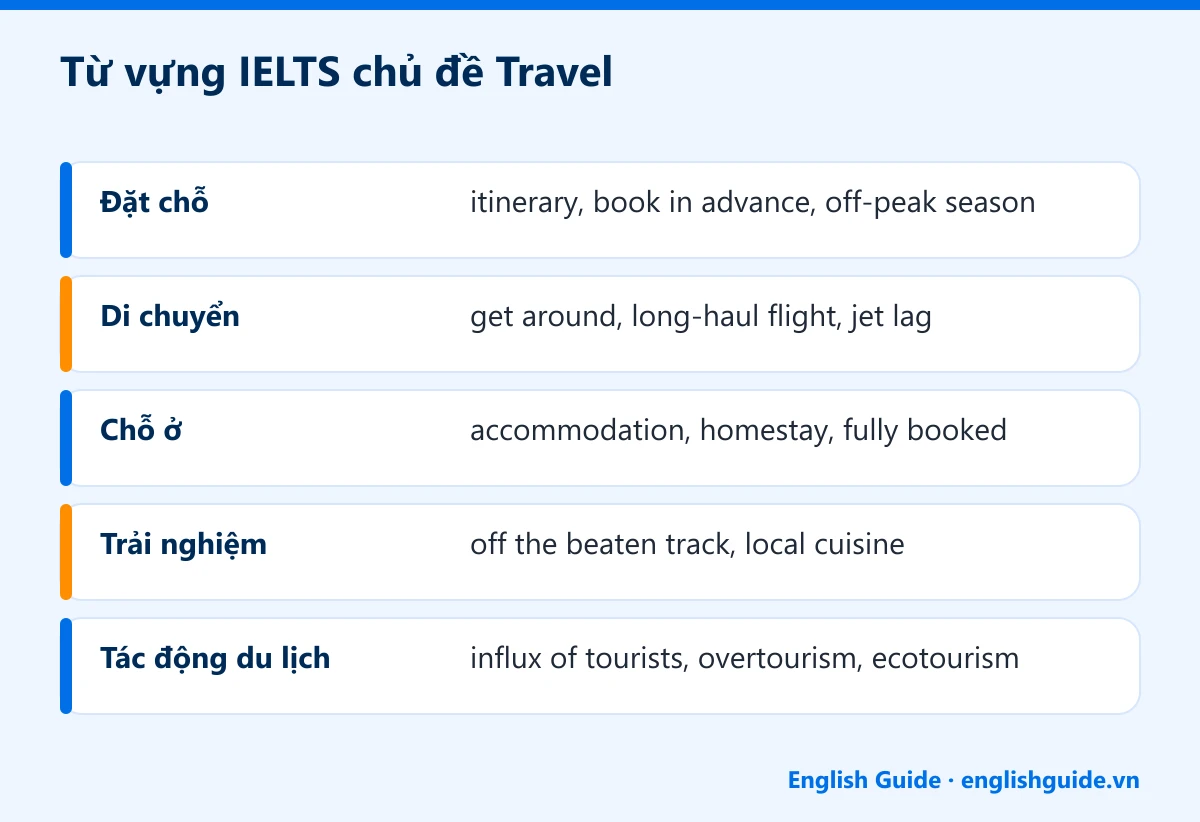
Từ vựng IELTS chủ đề Travel xoay quanh 5 nhóm ý: lên kế hoạch và đặt chỗ, phương tiện di chuyển, chỗ ở, trải nghiệm và tham quan, và du lịch bền vững cùng tác động của du lịch. Travel là chủ đề rất gần gũi nên hay xuất hiện ở Speaking (kỳ nghỉ, phương tiện, một nơi bạn từng đến) và ở Writing Task 2 (du lịch quốc tế, quá tải du lịch, du lịch sinh thái). Bài này gom những từ, cụm từ dùng được ngay, mỗi mục có từ loại, nghĩa và ví dụ đặt trong ngữ cảnh bài thi.
Cuối bài có collocation, đề Task 2 hay gặp, đoạn mẫu Writing, câu trả lời Speaking và bài tập có đáp án.
Chủ đề Travel xuất hiện ở đâu trong IELTS
Speaking Part 1 (4–5 phút, theo mô tả phần thi Speaking của IELTS): câu hỏi ngắn về sở thích đi du lịch, phương tiện bạn hay dùng, kỳ nghỉ gần nhất.
Speaking Part 2: mô tả một nơi bạn từng đến, một chuyến đi đáng nhớ, một nơi bạn muốn quay lại; có 1 phút chuẩn bị và nói khoảng 2 phút.
Speaking Part 3 (4–5 phút): bàn rộng hơn, ví dụ du lịch ảnh hưởng tới cộng đồng địa phương thế nào, cách người ta đi du lịch đã thay đổi ra sao.
Writing Task 2: đề về lợi ích và tác hại của du lịch quốc tế, quá tải ở các điểm nổi tiếng, du lịch một mình, du lịch đến vùng thiên nhiên hoang sơ.
Vốn từ được chấm qua tiêu chí Lexical Resource. Bảng mô tả band Writing ghi band 7 cần dùng được một số từ ít phổ biến và cho thấy ý thức về văn phong và collocation. Vì vậy, với chủ đề quen như Travel, cái tạo khác biệt là cụm từ chính xác (an influx of tourists, put pressure on local infrastructure) chứ không phải từ hiếm.
Từ vựng IELTS chủ đề Travel theo 5 nhóm
Ký hiệu từ loại: (n) danh từ, (v) động từ, (adj) tính từ, (phr) cụm từ. Ví dụ được viết theo kiểu câu có thể dùng lại trong bài thi.
Nhóm 1: Lên kế hoạch và đặt chỗ
Từ, cụm từ | Từ loại | Nghĩa | Ví dụ |
|---|---|---|---|
itinerary | n | lịch trình chi tiết | We drew up a detailed itinerary so that we could visit three provinces in five days. |
book (something) in advance | phr | đặt trước | Flights are much cheaper if you book them well in advance. |
peak season / off-peak season | n | mùa cao điểm / mùa thấp điểm | Travelling in the off-peak season means fewer crowds and lower prices. |
package holiday | n | tour trọn gói | Package holidays suit people who do not want to organise anything themselves. |
travel on a tight budget | phr | đi du lịch tiết kiệm | As students, we travelled on a tight budget and stayed in hostels. |
travel insurance | n | bảo hiểm du lịch | It is sensible to buy travel insurance before going abroad. |
apply for a visa | phr | xin thị thực | Applying for a visa can take several weeks, so it is best to start early. |
last-minute deal | n | ưu đãi phút chót | I found a last-minute deal on a beach resort at half the usual price. |
Nhóm 2: Phương tiện và di chuyển
Từ, cụm từ | Từ loại | Nghĩa | Ví dụ |
|---|---|---|---|
get around | phr | đi lại (trong một nơi) | The easiest way to get around the old town is on foot. |
long-haul flight | n | chuyến bay đường dài | Long-haul flights can be exhausting, especially with young children. |
layover / stopover | n | chặng dừng quá cảnh | We had a long layover, so we explored the airport for a few hours. |
jet lag | n | mệt do lệch múi giờ | It took me three days to recover from jet lag after flying to Europe. |
sleeper bus | n | xe khách giường nằm | Many backpackers take sleeper buses to save the cost of a night's accommodation. |
public transport network | n | mạng lưới giao thông công cộng | A good public transport network makes a city far more attractive to visitors. |
scenic route | n | cung đường đẹp | We took the scenic route through the mountains instead of the main highway. |
delayed / cancelled | adj | bị hoãn / bị hủy | Our flight was delayed by three hours because of a storm. |
Nhóm 3: Chỗ ở
Từ, cụm từ | Từ loại | Nghĩa | Ví dụ |
|---|---|---|---|
accommodation | n | chỗ ở (không đếm được trong tiếng Anh-Anh) | Cheap accommodation is hard to find near the beach in summer. |
homestay | n | ở nhà dân | Staying in a homestay is a great way to learn about local customs. |
hostel / budget hotel | n | nhà nghỉ tập thể / khách sạn giá rẻ | Hostels are popular with backpackers because they are cheap and sociable. |
check in / check out | phr | nhận phòng / trả phòng | We checked in late at night and checked out early the next morning. |
fully booked | adj | kín phòng, hết chỗ | Every hotel in town was fully booked during the festival. |
amenities | n | tiện nghi | The resort has excellent amenities, including a pool and a gym. |
all-inclusive resort | n | khu nghỉ dưỡng trọn gói ăn ở | All-inclusive resorts are convenient, but guests rarely explore the local area. |
Nhóm 4: Trải nghiệm và tham quan
Từ, cụm từ | Từ loại | Nghĩa | Ví dụ |
|---|---|---|---|
go sightseeing | phr | đi tham quan | We spent the first day sightseeing in the city centre. |
tourist attraction | n | điểm tham quan | The waterfall has become a popular tourist attraction in recent years. |
off the beaten track | phr | nơi ít người biết, xa tuyến du lịch quen | I prefer villages off the beaten track to crowded resorts. |
breathtaking scenery | n | cảnh đẹp ngoạn mục | The drive through the highlands offers breathtaking scenery. |
local cuisine | n | ẩm thực địa phương | Trying the local cuisine is the best part of any trip for me. |
immerse oneself in | phr | hòa mình vào | Staying with a local family let me immerse myself in their daily life. |
broaden one's horizons | phr | mở mang tầm nhìn | Travelling abroad can broaden young people's horizons. |
solo travel / backpacking | n | du lịch một mình / du lịch bụi | Solo travel teaches you to solve problems on your own. |
get away from it all | phr | thoát khỏi nhịp sống thường ngày | A weekend in the countryside is a chance to get away from it all. |
souvenir | n | quà lưu niệm | I always buy small handmade souvenirs from local craftspeople. |
Nhóm 5: Du lịch bền vững và tác động của du lịch
Từ, cụm từ | Từ loại | Nghĩa | Ví dụ |
|---|---|---|---|
mass tourism | n | du lịch đại trà | Mass tourism can turn quiet fishing villages into crowded resorts. |
overtourism | n | tình trạng quá tải du lịch | Some famous cities have introduced entry fees to tackle overtourism. |
an influx of tourists | phr | lượng khách đổ về ồ ạt | A sudden influx of tourists can push up rents for local residents. |
put pressure on | phr | gây áp lực lên | Large numbers of visitors put pressure on water supplies and waste services. |
generate revenue | phr | tạo nguồn thu | Tourism generates revenue that can be used to restore historic buildings. |
boost the local economy | phr | thúc đẩy kinh tế địa phương | Small homestays boost the local economy because the money stays in the village. |
ecotourism | n | du lịch sinh thái | Well-managed ecotourism can help protect forests and wildlife. |
carbon footprint | n | lượng khí thải carbon (của một người, một hoạt động) | Taking the train instead of flying can reduce your carbon footprint. |
preserve cultural heritage | phr | bảo tồn di sản văn hóa | Entrance fees can help preserve cultural heritage sites. |
commercialisation | n | sự thương mại hóa | The commercialisation of traditional festivals may strip them of their original meaning. |
cost of living | n | chi phí sinh hoạt | Tourism can raise the cost of living for people who live in popular destinations. |
Collocation và thành ngữ chủ đề Travel
Collocation là những từ thường đi với nhau. Học theo cụm giúp câu tự nhiên hơn hẳn so với dịch từng chữ từ tiếng Việt.
Collocation | Nghĩa | Ví dụ |
|---|---|---|
embark on a journey | bắt đầu một hành trình | Every year, millions of people embark on journeys to places they have only seen online. |
a once-in-a-lifetime experience | trải nghiệm có một không hai | Watching the sunrise from the summit was a once-in-a-lifetime experience. |
soak up the atmosphere | tận hưởng bầu không khí | We sat in a small café to soak up the atmosphere of the old quarter. |
respect local customs | tôn trọng phong tục địa phương | Visitors should dress modestly and respect local customs at religious sites. |
cultural exchange | giao lưu văn hóa | Homestays encourage genuine cultural exchange between hosts and guests. |
attract foreign visitors | thu hút du khách nước ngoài | The province hopes to attract more foreign visitors with its coffee culture. |
strike a balance between … and … | cân bằng giữa … và … | Governments must strike a balance between tourism and conservation. |
have a negative impact on | có tác động tiêu cực tới | Cruise ships can have a negative impact on marine life. |
Vài thành ngữ hợp với Speaking, không nên đưa vào Writing:
have itchy feet: thấy bứt rứt, muốn đi đâu đó. After a few months at home, I start to get itchy feet.
catch the travel bug: "mắc bệnh" mê du lịch. I caught the travel bug on my first trip to the coast.
travel light: đi gọn nhẹ, mang ít đồ. I always travel light, with just a backpack.
hit the road: lên đường. We hit the road at five in the morning to avoid the traffic.
Đề Writing Task 2 chủ đề Travel và Tourism hay gặp
Các đề dưới đây do EG tự diễn đạt để luyện tập, bám theo những hướng ra đề phổ biến về du lịch:
Dạng đề | Đề luyện tập |
|---|---|
Agree/disagree | International tourism brings more harm than good to the places that tourists visit. To what extent do you agree or disagree? |
Advantages/disadvantages | More and more travellers choose to visit remote natural areas such as forests and mountains. Do the advantages of this outweigh the disadvantages? |
Discussion | Some people think travelling abroad is the best way to understand another culture, while others believe books, films and the internet are enough. Discuss both views and give your opinion. |
Problem/solution | Many popular tourist destinations are becoming overcrowded. What problems does this cause, and how can they be solved? |
Two-part question | Many people now prefer to travel alone rather than in a group. Why is this? Is it a positive or negative development? |
Cách phân tích đề và dựng dàn bài cho từng dạng có ở bài cách viết IELTS Writing Task 2.
Đoạn mẫu Writing Task 2 dùng từ vựng Travel
Đề: đề problem/solution về quá tải du lịch ở bảng trên. Đoạn thân bài dưới đây nêu một vấn đề chính rồi đưa giải pháp; từ vựng của bài được in đậm.
One of the most visible problems of overcrowding is the strain it places on local services. When a small town receives a sudden influx of tourists during the peak season, roads become congested, water supplies run short and rubbish piles up faster than it can be collected. Overtourism can also push up the cost of living, as landlords turn family homes into short-term rentals for visitors. To tackle these problems, local authorities could spread visitor numbers more evenly by promoting off-peak travel and lesser-known tourist attractions. In addition, a modest tourist tax could generate revenue to upgrade waste services and preserve cultural heritage sites, so that tourism benefits residents rather than simply crowding them out.
Đoạn văn đi theo trình tự vấn đề, ví dụ cụ thể, rồi giải pháp. Từ vựng không cần hiếm; điều quan trọng là collocation đúng (an influx of tourists, generate revenue) và mỗi giải pháp gắn với một vấn đề đã nêu.
Câu trả lời Speaking mẫu chủ đề Travel
Part 1
Do you like travelling?
Yes, very much, although I don't get to do it as often as I'd like. I'm not really into luxury trips. I'd rather go somewhere off the beaten track, stay in a homestay and try the local cuisine. Even a weekend trip to a waterfall near my hometown helps me get away from it all.
Do you prefer travelling alone or with other people?
With friends, mostly. It's cheaper, because we can share accommodation and transport, and it's more fun to have someone to share the memories with. That said, I'd love to try solo travel at some point, since I think it would make me more independent.
Câu hỏi Part 2 về một nơi bạn từng đến có bài mẫu riêng ở bài Describe a place you visited; cách trả lời Part 1 tự nhiên có ở bài IELTS Speaking Part 1.
Part 3
Does tourism do more harm than good to local communities?
I think it depends largely on how it's managed. In parts of the Central Highlands, for instance, tourism has given some villages a new source of income. Families run homestays or sell handmade crafts, so young people don't always have to leave for the city to find work. But when a place becomes popular too quickly, you see the downside: crowds, rubbish on the trails, and traditional festivals turning into shows for visitors. So the key is to strike a balance, perhaps by limiting visitor numbers at fragile sites.
How has the way people travel changed in recent years?
Planning has become much easier. Most people now put together their own itinerary on their phones, compare prices online and book in advance, sometimes only a few hours before they leave. I've also noticed more young people travelling on a tight budget, taking sleeper buses and staying in hostels, partly because social media makes even small, quiet places look exciting.
Để ý cách mỗi câu trả lời Part 3 nêu quan điểm, đưa ví dụ rồi cân nhắc mặt còn lại. Cụm strike a balance hay book in advance được dùng trong câu tự nhiên chứ không chèn vào cho có.
Bài tập từ vựng Travel có đáp án
Bài 1: Điền từ thích hợp
Từ gợi ý: itinerary, fully booked, off the beaten track, influx, jet lag, homestay
We couldn't find a room anywhere because every hotel was ___.
After a fourteen-hour flight, I suffered from terrible ___ for days.
Staying in a ___ allowed us to cook and eat with a local family.
Our guide gave us an ___ listing every stop and meal time.
The village has struggled to cope with the sudden ___ of visitors.
I prefer small towns ___ to famous, crowded destinations.
Bài 2: Chọn trip, journey, travel hoặc tour
How was your business (trip / travel) to Hanoi?
The (journey / travel) through the mountains took longer than we expected.
(Travel / Trip) broadens the mind.
We joined a guided (tour / journey) of the old quarter.
Air (trip / travel) has become far more affordable than it used to be.
Bài 3: Nối cụm từ với cụm gần nghĩa
Cụm từ | Gần nghĩa với |
|---|---|
1. boost the local economy | a. place a strain on |
2. off the beaten track | b. learn about the wider world |
3. get away from it all | c. bring money into the area |
4. broaden your horizons | d. escape your daily routine |
5. put pressure on | e. in a place few tourists visit |
Đáp án
Bài 1: 1. fully booked · 2. jet lag · 3. homestay · 4. itinerary · 5. influx · 6. off the beaten track
Bài 2: 1. trip · 2. journey · 3. Travel · 4. tour · 5. travel
Bài 3: 1-c · 2-e · 3-d · 4-b · 5-a
Học và dùng từ vựng Travel sao cho nhớ lâu
Đừng cố học hết các bảng trong một ngày. Mỗi ngày học một nhóm 6–8 từ, đặt câu về chính những chuyến đi của bạn (một lần về quê, một buổi dã ngoại, một nơi bạn muốn đến), rồi dùng lại trong một câu trả lời Speaking có ghi âm. Cách ôn lặp lại có ở bài cách học từ vựng IELTS. Nhóm từ về du lịch bền vững hay đi cặp với từ vựng IELTS chủ đề Environment, nên học hai chủ đề này cạnh nhau sẽ tiết kiệm thời gian.
Nếu muốn có giáo viên chữa lỗi dùng từ trong bài viết và bài nói, khóa IELTS Master 5.0–5.5 của EG có 80 giờ học, lớp 8–15 học viên, chấm Writing và Speaking chi tiết. Học tại Cơ sở Buôn Ma Thuột (36 Trần Nhật Duật) học phí 9.900.000đ (khoảng 124.000đ/giờ); học online cùng giáo viên 7.140.000đ (khoảng 89.000đ/giờ). Học viên ôn từ vựng giữa các buổi trên nền tảng EG LMS. Chưa rõ trình độ, bạn có thể bắt đầu bằng bài kiểm tra trình độ miễn phí.
Câu hỏi thường gặp
Travel, trip, journey và tour khác nhau thế nào?
Travel là việc đi lại nói chung, thường dùng như danh từ không đếm được hoặc động từ. Trip là một chuyến đi cụ thể, có đi có về. Journey nhấn mạnh quãng đường di chuyển từ nơi này tới nơi khác. Tour là chuyến tham quan theo lịch trình, thường có hướng dẫn viên.
Accommodation có thêm s không?
Trong tiếng Anh-Anh, accommodation thường là danh từ không đếm được: cheap accommodation, không viết a cheap accommodation. Tiếng Anh-Mỹ hay dùng accommodations. Trong bài thi, chọn một cách và dùng thống nhất.
Tourism và travel dùng khác nhau ra sao trong Writing?
Tourism là du lịch như một ngành, một hoạt động kinh tế, hợp với đề về tác động tới kinh tế, môi trường. Travel là hành động đi lại của mỗi người, hợp với đề về lợi ích của việc đi đây đi đó.
Có nên dùng thành ngữ như itchy feet trong Writing?
Không nên. Những thành ngữ này mang giọng thân mật, hợp với Speaking. Trong Writing Task 2, ưu tiên cụm trung tính như an influx of tourists, preserve cultural heritage, boost the local economy.