Kiến thức
IELTS Speaking Tet Holiday: câu hỏi Part 1, bài mẫu Part 2, Part 3 về Tết kèm từ vựng
19 phút đọc
IELTS Speaking Tet Holiday là nhóm câu hỏi về Tết Nguyên Đán và các dịp lễ lớn mà bạn có thể gặp ở cả ba phần của bài thi Speaking. Giám khảo có thể không nhắc chữ "Tết" mà hỏi chung về lễ hội, ngày nghỉ hay dịp sum họp gia đình; khi đó Tết là chất liệu dễ nói nhất với người Việt. Cách trả lời tốt: giới thiệu Tết bằng một cụm tiếng Anh ngắn, rồi kể chuyện của chính nhà bạn thay vì liệt kê phong tục như sách giáo khoa.
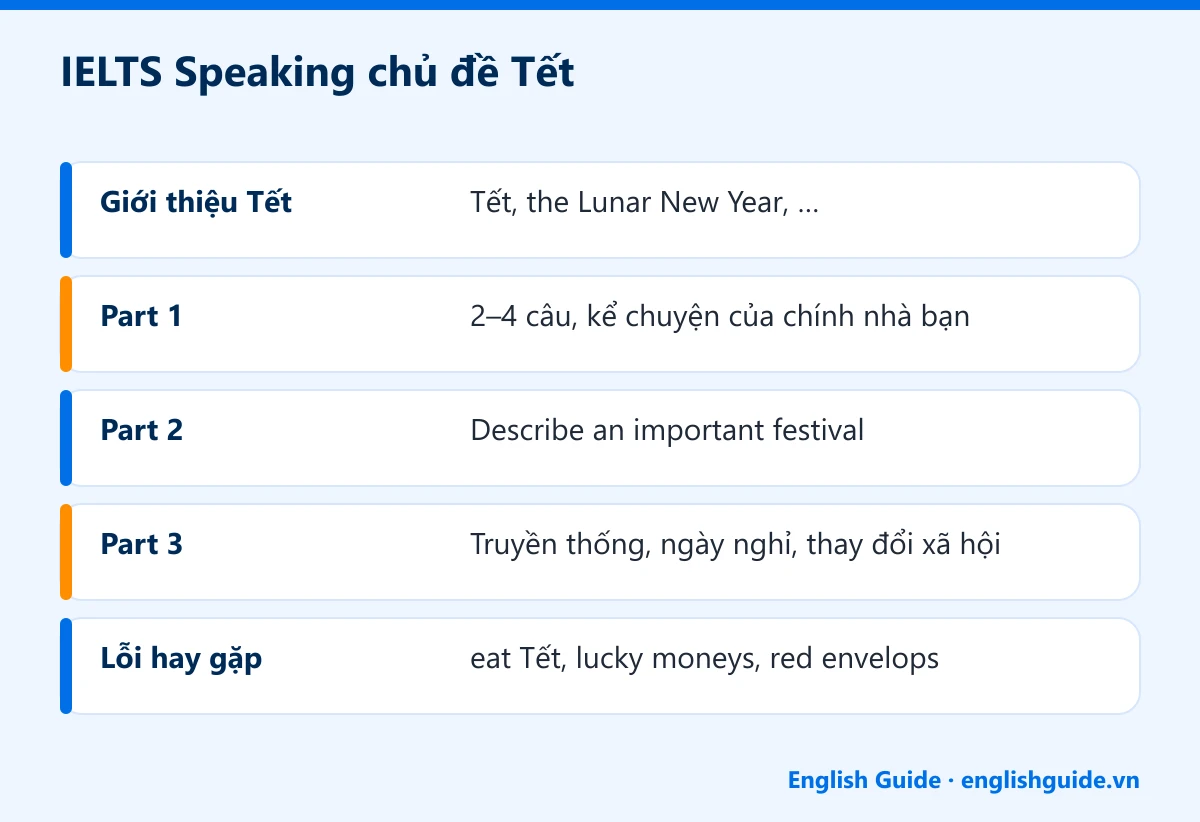
Bài này gồm cách giới thiệu Tết bằng tiếng Anh, 6 câu hỏi Part 1 kèm câu trả lời mẫu, một bài nói Part 2 khoảng 2 phút, 4 câu hỏi Part 3, từ vựng theo nhóm có nghĩa tiếng Việt và những lỗi người Việt hay mắc. Nếu chưa nắm rõ ba phần của bài thi, bạn nên đọc trước bài cấu trúc bài thi IELTS Speaking.
Chủ đề Tết xuất hiện ở đâu trong IELTS Speaking
Theo mô tả phần thi Speaking trên ielts.org, bài nói kéo dài 11–14 phút, được ghi âm và gồm 3 phần. Tết có thể xuất hiện ở phần nào cũng được, nhưng mỗi phần cần một kiểu trả lời khác:
Phần | Thời lượng (theo ielts.org) | Câu hỏi về Tết có thể gặp | Bạn cần làm gì |
|---|---|---|---|
Part 1 | 4–5 phút | Do you like public holidays? How do you celebrate the New Year? | Trả lời 2–4 câu về chính bạn, có một chi tiết thật |
Part 2 | 1 phút chuẩn bị, nói đến 2 phút; cả phần 3–4 phút | Describe an important festival in your country. | Kể có trình tự, đi đủ các ý trên thẻ đề |
Part 3 | 4–5 phút | Why do people travel home for Tết? Are festivals becoming too commercial? | Bàn chuyện chung của xã hội, có lý do và ví dụ |
Ở Part 3, hướng dẫn Part 3 của IDP cho biết câu hỏi luôn liên quan tới chủ đề Part 2 nhưng chuyển sang hướng chung và trừu tượng hơn. Vì vậy, nếu Part 2 hỏi về một lễ hội, Part 3 dễ xoay quanh truyền thống, ngày nghỉ, gia đình và những thay đổi trong xã hội.
Giới thiệu Tết bằng tiếng Anh trong một câu
Giám khảo có thể chưa biết Tết là gì. Lần đầu nhắc tới, bạn chỉ cần kèm một cụm giải thích ngắn rồi nói tiếp, không cần dừng lại giảng giải. Vài cách nói gọn:
Tết, the Lunar New Year, is the biggest holiday of the year in Vietnam.
Tết usually falls in late January or February, because it follows the lunar calendar.
It's a bit like Christmas and New Year rolled into one: everyone goes home, eats far too much and visits relatives.
Bánh chưng, a square cake made of sticky rice, mung beans and pork, is the dish everyone links with Tết.
Sau câu giới thiệu, hãy dùng các khung câu dưới đây để chuyển sang chuyện của bạn. Chúng hợp với cả Part 1, Part 2 lẫn Part 3:
Mục đích | Khung câu | Ví dụ |
|---|---|---|
Nói thời điểm | It usually falls in… / It lasts… | Tết usually falls in late January or February. |
Nói điều bạn thích nhất | What I love most about it is… | What I love most about Tết is that the whole family is under one roof. |
So sánh trước và nay | It used to…, but these days… | Tết used to mean days of cooking, but these days many families buy food ready-made. |
Giải thích phong tục | People believe that…, so… | People believe the first visitor brings luck for the whole year, so families choose that person carefully. |
IELTS Speaking Tet Holiday Part 1: 6 câu hỏi và câu trả lời mẫu
Các câu trả lời dưới đây là bài mẫu tham khảo band 7.0+ do English Guide tự soạn, theo lời một sinh viên năm hai sống ở Buôn Ma Thuột (nhân vật hư cấu), có ông bà ở một ngôi làng cách thành phố khoảng một giờ đi xe. Đừng học thuộc nguyên câu: hãy xem cách triển khai ý rồi thay bằng chuyện nhà bạn, vì giám khảo dễ nhận ra câu trả lời học thuộc.
1. What's your favourite public holiday?
Tết, without a doubt. It's the Lunar New Year, and it's the only time of year when my whole family is under one roof. My uncle works in Ho Chi Minh City and my cousin studies in Hanoi, so for most of the year our house feels half empty. During Tết it's suddenly noisy again, and I love that.
Điểm hay: trả lời ngay, giải thích Tết bằng một cụm, rồi đưa lý do có hình ảnh (half empty, noisy again). Under one roof nghĩa là cả nhà quây quần một chỗ.
2. How do people in your country celebrate the New Year?
It depends on which New Year you mean. On the first of January, young people might go out to count down with friends, but it's usually just a day off. The Lunar New Year is the real celebration. People go back to their hometowns, visit relatives, give lucky money to children and go to the pagoda to pray for a good year.
Điểm hay: tách Tết dương lịch và Tết âm lịch là cách mở rộng có sẵn; chuỗi hoạt động được nói gọn bằng các động từ go back, visit, give, pray.
3. What do you usually do to get ready for Tết?
Mostly cleaning, to be honest. About a week before, my mum declares war on dust and everyone gets a job. Mine is polishing the altar and washing all the curtains. We also buy a pot of yellow apricot blossoms for the living room. It's hard work, but once the house is spotless and the flowers are out, it finally feels like Tết.
Điểm hay: declares war on dust là cách nói vui, tự nhiên; từ cụ thể như altar (bàn thờ), spotless (sạch bóng) giúp câu trả lời có hình ảnh; câu cuối chốt bằng cảm xúc.
4. What food do people eat during Tết?
The classic dish is bánh chưng, a square cake made of sticky rice, mung beans and pork, wrapped in leaves and boiled for hours. In the south, and in many families here in the Central Highlands, people also make bánh tét, which is the same idea but shaped like a log. Honestly, by the third day everyone is sick of sticky rice, so we usually sneak out for a bowl of noodles.
Điểm hay: giải thích món ăn bằng nguyên liệu và hình dạng; chi tiết hài hước ở cuối (sick of, sneak out) cho thấy đây là câu trả lời thật chứ không phải bài thuộc lòng.
5. Did you enjoy Tết more when you were a child?
In some ways, yes. As a kid, Tết meant new clothes, sweets and no homework, so it was pure excitement. These days I appreciate it differently. I notice how tired my mum gets from all the cooking, so I help out more, and I enjoy the quiet moments, like chatting with my grandparents over tea, more than the noise.
Điểm hay: In some ways, yes là cách trả lời có chừng mực; thì quá khứ cho hồi nhỏ (meant, was), hiện tại cho bây giờ (appreciate, notice).
6. Would you rather spend Tết at home or travel somewhere?
At home, definitely. I know more families now take a trip during the holiday, since it's one of the few long breaks in the year, and I can see the appeal. But for me, Tết without the family meal on New Year's Eve wouldn't feel like Tết at all. Maybe I'll change my mind when I'm older and have to do all the cooking myself.
Điểm hay: câu hỏi lựa chọn thì chọn ngay (At home, definitely), thừa nhận phía bên kia (I can see the appeal), rồi kết bằng một câu đùa nhẹ.
Vì sao các câu trả lời này ở mức 7.0+?
Bảng mô tả band Speaking của IELTS chấm 4 tiêu chí: Fluency and Coherence, Lexical Resource, Grammatical Range and Accuracy và Pronunciation. Ở band 7, thí sinh nói dài được mà không thấy gắng sức, dùng linh hoạt các từ nối trong văn nói; có một số từ ít phổ biến, thành ngữ và cho thấy ý thức về collocation; dùng hiệu quả cả câu đơn lẫn câu phức dù còn vài lỗi. Bảng cũng ghi rõ điểm tính theo phần thể hiện trung bình qua cả 3 phần. Các câu mẫu trên trả lời thẳng ngay câu đầu, có chi tiết riêng, cụm tự nhiên (under one roof, sick of, I can see the appeal) và đổi thì đúng theo câu hỏi. Phát âm không thể hiện trên giấy, vì vậy hãy tự ghi âm khi luyện.
Từ vựng IELTS Speaking chủ đề Tết theo nhóm
Các bảng dưới đây gom những từ, cụm từ bạn thật sự cần khi kể về Tết. Ví dụ được viết theo kiểu câu nói, dùng lại được trong bài thi. Những từ chung hơn như custom, tradition, heritage có ở bài từ vựng IELTS chủ đề Culture.
Thời điểm và nghi lễ
Từ, cụm từ | Nghĩa | Ví dụ |
|---|---|---|
the lunar calendar | âm lịch | Tết moves every year because it follows the lunar calendar. |
the Kitchen Gods' Day | ngày ông Công ông Táo (23 tháng Chạp) | On the Kitchen Gods' Day, many families release carp into a lake. |
a year-end family meal | bữa cơm tất niên | Our year-end family meal is the one night nobody looks at their phone. |
New Year's Eve | đêm giao thừa | We stay up on New Year's Eve and make offerings at midnight. |
make offerings to (our) ancestors | cúng tổ tiên | My dad makes offerings to our ancestors on the first morning. |
the first visitor of the year | người xông đất | My aunt asked a cheerful neighbour to be her first visitor of the year. |
Món ăn ngày Tết
Từ, cụm từ | Nghĩa | Ví dụ |
|---|---|---|
square sticky rice cake | bánh chưng | Square sticky rice cakes take a whole night to boil. |
log-shaped sticky rice cake | bánh tét | My grandma slices the log-shaped sticky rice cake with a piece of thread. |
candied fruit | mứt | There's always a tray of candied fruit on the table for guests. |
roasted watermelon seeds | hạt dưa | Cracking roasted watermelon seeds is a skill every Vietnamese kid learns. |
a five-fruit tray | mâm ngũ quả | The five-fruit tray on the altar shows the family's wishes for the year. |
Hoạt động
Từ, cụm từ | Nghĩa | Ví dụ |
|---|---|---|
give the house a thorough clean | dọn dẹp nhà cửa kỹ lưỡng | We give the house a thorough clean a week before Tết. |
wrap sticky rice cakes | gói bánh | Wrapping sticky rice cakes together keeps the whole family busy. |
pay a New Year visit | đi chúc Tết | We pay New Year visits to relatives on the first two days. |
hand out lucky money | lì xì | My grandparents hand out lucky money as soon as we arrive. |
head back to one's hometown | về quê | Buses are packed as everyone heads back to their hometown. |
Hoa, cây và đồ trang trí
Từ, cụm từ | Nghĩa | Ví dụ |
|---|---|---|
apricot blossom | hoa mai (vàng) | Yellow apricot blossom is the Tết flower in the south and central regions. |
peach blossom | hoa đào | In the north, people prefer branches of pink peach blossom. |
a kumquat tree | cây quất | A kumquat tree full of fruit is meant to bring a fruitful year. |
red envelopes | bao lì xì | The red envelopes are often more beautiful than what's inside. |
the family altar | bàn thờ gia tiên | The family altar is the centre of the house during Tết. |
Mẹo học: mỗi ngày chọn một bảng, đặt 2–3 câu về chính gia đình bạn, rồi nói to và ghi âm. Câu về nhà mình luôn dễ nhớ hơn câu trong sách.
Bài mẫu Part 2: Describe an important festival in your country
Theo ielts.org, ở Part 2 bạn có 1 phút chuẩn bị, được phát bút và giấy để ghi chú, rồi nói đến 2 phút; sau đó giám khảo có thể hỏi thêm một hai câu cùng chủ đề. Thẻ đề dưới đây do English Guide soạn theo dạng đề hay gặp:
Describe an important festival in your country.
You should say: what the festival is; when it takes place; what people do during it; and explain why it is important to you.
Ghi chú trong 1 phút chỉ cần vài từ khóa cho mỗi ý:
What: Tết · Lunar New Year · biggest holiday
When: late Jan/Feb · lunar calendar
What people do: clean · Kitchen Gods · year-end meal · midnight offering · visits · lucky money
Why important: whole family together · grandparents' village · wrapping bánh tét in the yard
Bài nói mẫu tham khảo band 7.0+ (English Guide tự soạn, khoảng 2 phút):
The festival I'd like to talk about is Tết, the Lunar New Year, which is by far the most important celebration in Vietnam. Because it follows the lunar calendar, the date changes every year, but it usually falls in late January or February.
In the weeks before Tết, everyone is busy. Families give their houses a thorough clean, and on the twenty-third day of the last lunar month, many people release carp into a lake or river to send the Kitchen Gods off to heaven. Then on New Year's Eve, there's a big family meal, and at midnight we make offerings to our ancestors while, in many cities, fireworks light up the sky.
The first few days of the new year are all about visiting. We start with my grandparents in their village, then go round to other relatives. Children receive lucky money in red envelopes, and every house offers tea, candied fruit and far too much food.
As for why it matters to me, the main reason is that it's the only time my whole family is together. My uncle works in Ho Chi Minh City and my cousin studies in Hanoi, so during the year we mostly see each other on a screen. My favourite moment is the afternoon before New Year's Eve, when we sit in my grandparents' yard wrapping bánh tét. Nobody is in a hurry, and the adults tell old stories while the kids practise with the worst leaves. For me, that afternoon is what Tết really is: not the food or the money, but time together.
Vì sao bài nói hiệu quả: đi đủ 4 ý của thẻ đề theo trình tự trước, trong và sau Tết; mỗi đoạn mở bằng một cụm dẫn rõ (In the weeks before…, The first few days…, As for why…); phần giải thích dành thời gian nhiều nhất và có một khoảnh khắc riêng (gói bánh tét ở sân nhà ông bà) thay vì những câu chung chung như Tết is very meaningful.
Một câu chuyện Tết bạn đã chuẩn bị kỹ còn dùng được cho nhiều đề khác, chỉ cần đổi phần nhấn mạnh. Các đề dưới đây do English Guide soạn theo các dạng hay gặp:
Đề Part 2 | Dùng phần nào của câu chuyện Tết |
|---|---|
Describe a holiday you enjoyed. | Tết năm gần nhất, kể theo trình tự, nhấn vào cảm xúc |
Describe a time you visited relatives. | Chuyến về làng ông bà ngày mùng Một |
Describe a traditional food in your country. | Bánh chưng, bánh tét: nguyên liệu, ai gói, nấu bao lâu |
Describe a time you received money as a gift. | Tiền lì xì: ai cho, lời chúc đi kèm, bạn dùng vào việc gì |
Muốn xem thêm hai bài mẫu về lễ hội khác (lễ hội cà phê ở Buôn Ma Thuột, đêm Trung thu), bạn đọc bài Describe an event. Cách lên ý trong 1 phút chuẩn bị có ở bài IELTS Speaking Part 2.
Câu hỏi IELTS Speaking Part 3 về Tết và truyền thống
Theo hướng dẫn của IDP, Part 3 kiểm tra khả năng nêu và bảo vệ quan điểm, phân tích, bàn luận và suy đoán; bạn nên nói về tình hình chung ở nước mình thay vì chỉ kể chuyện gia đình. Dưới đây là 4 câu hỏi và gợi ý trả lời do English Guide tự soạn:
Why do so many people travel back to their hometowns for Tết, even though the journey is tiring?
Mainly because Tết is seen as a family duty as much as a holiday. For people who have moved to big cities for work, it's the one time of year they're expected to come home, and missing it can feel like letting their parents down. There's an emotional side too. After a year of noise and traffic, going back to a quiet village and familiar food is a way to recharge before starting again.
How has the way people celebrate Tết changed in recent years?
Quite a lot on the practical side. People used to spend days making everything from scratch, but now many families order sticky rice cakes or buy ready-made dishes, simply because both parents work. Greetings have changed as well: lots of people send New Year wishes by message instead of visiting everyone in person. That said, the core of it, getting together and remembering your ancestors, seems pretty stable to me.
Is it important for children to learn about traditional festivals?
I think so, because festivals are one of the easiest ways for children to understand where they come from. A child who helps wrap sticky rice cakes learns about family roles, patience and even a little history without opening a textbook. However, it shouldn't feel like a lesson. If traditions are forced on children, they're more likely to reject them when they grow up.
Do you think traditional festivals are becoming too commercial?
To some extent, yes. In the run-up to Tết, adverts push the idea that you need new clothes, expensive gift baskets and an enormous feast, and some families feel pressure to spend more than they can afford. But I wouldn't blame the festival itself. Commercial pressure is everywhere now, and it's up to each family to decide what really matters to them.
Để ý cách mỗi câu trả lời nêu quan điểm ngay, đưa lý do hoặc ví dụ, rồi cân nhắc mặt còn lại. Gặp câu hỏi khó hơn, kiểu so sánh hay dự đoán tương lai, bạn xem bài cách trả lời câu hỏi khó IELTS Speaking Part 3.
Những lỗi thường gặp khi nói về Tết
Lỗi | Ví dụ chưa đúng | Nên nói |
|---|---|---|
Dịch từng chữ "ăn Tết" | We eat Tết at my grandparents' house. | We celebrate Tết / spend Tết at my grandparents' house. |
Thêm s cho lucky money | I got a lot of lucky moneys. | I got a lot of lucky money. |
Sai giới từ | On Tết, we visit our relatives. | At Tết / During Tết, we visit our relatives. |
Nhầm envelop và envelope | red envelops | red envelopes (envelope là danh từ, envelop là động từ) |
Nêu tên món mà không giải thích | We eat bánh chưng and giò. | We eat bánh chưng, a square sticky rice cake, and giò, a kind of pork sausage. |
Sai thì khi kể Tết vừa qua | Last Tết, I go to my grandparents' village. | Last Tết, I went to my grandparents' village. |
Kể như sách giáo khoa | Tết has many customs. Firstly… Secondly… Thirdly… | Chọn 1–2 phong tục và kể chuyện nhà bạn |
Lỗi cuối là lỗi khiến nhiều bài nói về Tết nghe giống hệt nhau. Giám khảo không chấm bạn hiểu phong tục nhiều đến đâu mà chấm cách bạn dùng tiếng Anh, nên một câu chuyện nhỏ có chi tiết thật luôn tốt hơn một danh sách dài.
Luyện Speaking cùng English Guide
Câu hỏi về Tết dễ vì quen thuộc, nhưng cũng vì quen nên nhiều bạn nói đều đều, thiếu chi tiết. Ở English Guide, mọi lớp có 8–15 học viên; lớp IELTS tại trung tâm và các khóa online IELTS Master, IELTS Advanced có chấm Speaking chi tiết; học phí ghi rõ theo giờ:
Học tại cơ sở Buôn Ma Thuột (36 Trần Nhật Duật): khóa IELTS Master 5.0–5.5, 80 giờ, 9.900.000đ (khoảng 124.000đ/giờ).
Ở xa hoặc bận đi lại: khóa IELTS Master 5.0–5.5 Online, học trực tiếp cùng giáo viên qua mạng, 80 giờ, 7.140.000đ (khoảng 89.000đ/giờ).
Chưa rõ trình độ: làm bài kiểm tra trình độ miễn phí 70 phút, sau đó được tư vấn xếp lớp.
Câu hỏi thường gặp
Có được dùng chữ "Tết" trong bài thi không?
Được, vì đó là tên riêng. Lần đầu nhắc, bạn thêm một cụm giải thích như Tết, the Lunar New Year để giám khảo hiểu ngay, những lần sau cứ nói Tết bình thường.
Nhà tôi ăn Tết đơn giản hoặc đi du lịch thì kể thế nào?
Cứ kể thật. Một cái Tết đi du lịch, một cái Tết xa nhà hay một cái Tết chỉ có bốn người vẫn là câu chuyện tốt, miễn là bạn có chi tiết cụ thể và giải thích được cảm nhận của mình.
Part 2 hỏi về lễ hội, có nên luôn chọn Tết không?
Tết là lựa chọn an toàn vì bạn có nhiều chất liệu. Nhưng vì rất nhiều thí sinh chọn Tết, hãy kể một khoảnh khắc riêng của nhà bạn. Nếu bạn có chuyện hay hơn về Trung thu hay một lễ hội ở địa phương, cứ chọn lễ hội đó.