Kiến thức
IELTS Speaking Part 1 Accommodation: 14 câu hỏi về chỗ ở, câu trả lời mẫu, từ vựng và gợi ý Part 2, Part 3
19 phút đọc
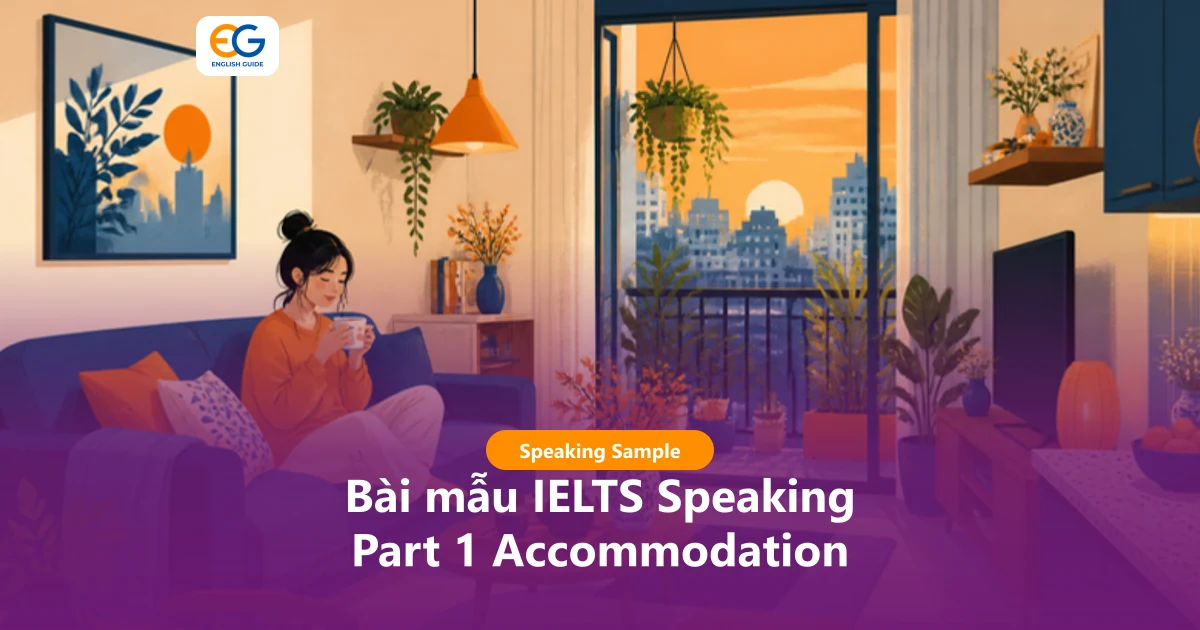
IELTS Speaking Part 1 Accommodation là nhóm câu hỏi ngắn về chỗ ở của bạn: bạn sống trong nhà riêng, căn hộ hay phòng trọ, sống cùng ai, ở đó bao lâu, thích góc nào và muốn sống ở đâu sau này. Cách trả lời hiệu quả: nói thẳng bạn đang ở đâu, thêm một chi tiết thật về không gian hoặc cảm nhận, rồi dừng sau 2–4 câu. Bài này có 14 câu hỏi hay gặp kèm câu trả lời mẫu tự soạn, cách gọi đúng tên các kiểu chỗ ở, từ vựng có nghĩa tiếng Việt, lỗi người Việt hay mắc và gợi ý cho Part 2, Part 3.
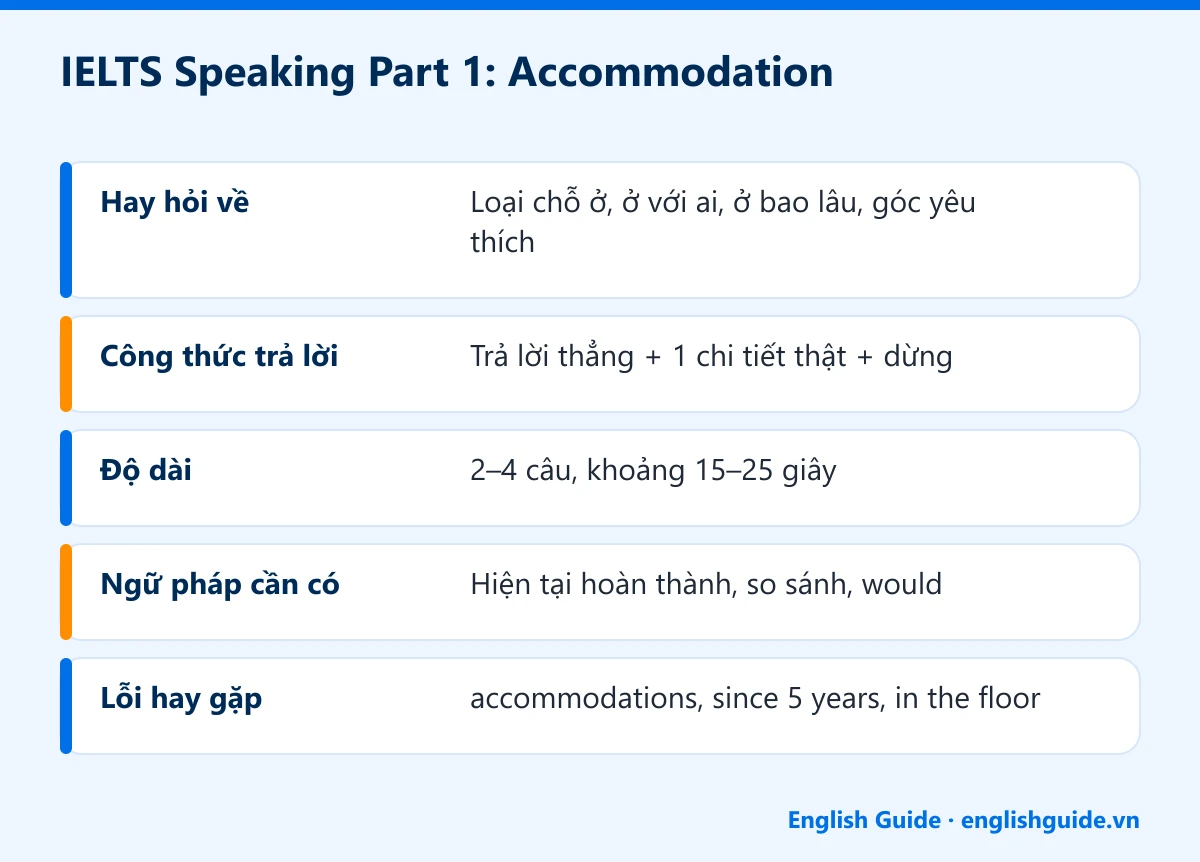
Nếu chưa nắm Part 1 diễn ra thế nào, bạn nên đọc trước bài IELTS Speaking Part 1: kiểu câu hỏi và cách trả lời. Chủ đề này hay đi liền với hometown (quê quán, thành phố bạn sống), còn đề Part 2 tả ngôi nhà có bài riêng: Describe your house.
Chủ đề accommodation trong IELTS Speaking Part 1
Theo mô tả phần thi Speaking trên ielts.org, bài nói kéo dài 11–14 phút, được ghi âm và gồm 3 phần. Part 1 dài 4–5 phút: giám khảo giới thiệu, kiểm tra danh tính rồi hỏi các câu chung về chủ đề quen thuộc, và "home" (nhà ở) đứng đầu danh sách ví dụ của ielts.org. Bài hướng dẫn Part 1 của IDP còn đưa một đoạn hỏi mẫu mở đầu bằng câu Let's move on to talk about accommodation, hỏi về loại chỗ ở bạn đang sống, bạn ở đó bao lâu, bạn thích gì ở đó và muốn sống ở kiểu chỗ ở nào nhất.
Câu hỏi về chỗ ở thường đi theo 5 hướng:
Hướng hỏi | Ví dụ câu hỏi (tự soạn) | Bạn cần nói được |
|---|---|---|
Loại chỗ ở, ai sống cùng | Do you live in a house or a flat? Who do you live with? | Kiểu nhà, ở với ai, thuê hay nhà của gia đình |
Tả không gian | Can you describe your room? Which part of your home do you like most? | 2–3 chi tiết cụ thể, một góc bạn thích |
Thời gian và thay đổi | How long have you lived there? How is it different from your old home? | Hiện tại hoàn thành, so sánh trước và nay |
Khu xung quanh | Is it convenient to get around from your home? | Đi lại, chợ, trường gần nhà |
Tương lai và ý kiến | Would you like to move? Is it important to live somewhere comfortable? | Dùng would, I'd like to; quan điểm kèm lý do |
Accommodation khác hometown ở phạm vi: accommodation là chính chỗ bạn ở (căn nhà, căn phòng, con hẻm ngay quanh đó), còn hometown là cả thành phố hay vùng quê. Nghe kỹ từ khóa để không trả lời câu What's your home like? bằng chuyện cà phê và thác nước của cả tỉnh.
14 câu hỏi IELTS Speaking Part 1 accommodation và câu trả lời mẫu
Các câu trả lời dưới đây là bài mẫu tham khảo band 7.0+ do English Guide tự soạn, theo lời một sinh viên năm hai 20 tuổi (nhân vật hư cấu): nhà ở một vùng quê trồng cà phê cách Buôn Ma Thuột khoảng một giờ đi xe, hiện thuê phòng trọ gần trường cùng chị họ. Đừng học thuộc: hướng dẫn của IDP nhắc thí sinh không đưa ra câu trả lời học sẵn và nên tự thêm thông tin trước khi giám khảo phải hỏi why. Mỗi câu chỉ cần trả lời thẳng rồi chọn 1–2 hướng mở rộng: ở với ai, ở bao lâu, gần những gì, thích gì, khác gì chỗ cũ. Hãy thay bằng chỗ ở thật của bạn.
1. What kind of accommodation do you live in?
At the moment I'm renting a room in a small block of rented rooms near my university in Buon Ma Thuot. It's nothing fancy, just one room with a tiny bathroom and a balcony barely big enough for a clothes rack. My real home, though, is my parents' wooden house in the countryside, and I go back most weekends.
Điểm hay: tách ngay chỗ ở hiện tại và nhà gia đình; nothing fancy (không có gì sang) tả đúng phòng trọ.
2. Who do you live with?
I share the room with my cousin, who's two years older than me and goes to the same university. Living with family is a big plus, because my parents worry less, and we split the rent and the bills. The only downside is that she's a night owl and I'm not.
Điểm hay: mệnh đề quan hệ who's... giới thiệu người ở cùng; thêm một nhược điểm nhỏ cho chân thật.
3. How long have you lived there?
Just over a year now. I moved in at the start of my first year, so it was the first time I'd ever lived away from my parents. The first few weeks were tough, but I've settled in and it really feels like my own place now.
Điểm hay: trả lời mốc thời gian ngắn rồi kể bằng quá khứ đơn; settle in là quen dần với chỗ mới.
4. Can you describe the room you live in?
It's compact but surprisingly well organised. There are two narrow beds against the side walls, a desk we share under the window and a small fridge in the corner. We've stuck some photos above the desk, so it doesn't feel as bare as it did when we first moved in.
Điểm hay: tả theo vị trí (against, under, in the corner) thay vì liệt kê; compact là cách nói tích cực cho phòng nhỏ.
5. Which part of your home do you like the most?
Definitely the desk by the window. It looks out onto a little garden where our landlady grows bananas and herbs, so when I'm revising I can look up and see something green instead of a wall. It's also the only spot with decent natural light.
Điểm hay: một chỗ, hai lý do; look out onto là nhìn ra, landlady là bà chủ nhà.
6. What do you usually do at home?
On weekdays it's mostly studying and cooking simple meals on a small electric stove. Some evenings my cousin and I watch a series on her laptop while we eat. When I'm back at my parents' place, it's a different story: I help out on the family coffee farm or just hang out with my little brother.
Điểm hay: chia hai bối cảnh; it's a different story nghĩa là hoàn toàn khác.
7. Which room does your family spend the most time in?
At my parents' house, it's the big room at the front. It's where we eat, watch TV and welcome guests, and in the evening my dad usually makes a pot of tea and everyone drifts in to chat. The bedrooms are really just for sleeping.
Điểm hay: drift in (lần lượt kéo vào) sinh động hơn come.
8. Is it convenient to get around from where you live?
Very, and that's the main reason I chose the place. The campus is a ten-minute walk away, and there's a small market and a couple of print shops on the same street. The city centre isn't exactly close, but it's only fifteen minutes by motorbike, so I can't really complain.
Điểm hay: trả lời Very rồi đưa bằng chứng; not exactly close là cách nói giảm nhẹ tự nhiên.
9. How is your current home different from where you lived before?
They're almost opposites. Back home we have a big yard, chickens wandering around and complete silence at night. Here I've got a fraction of the space and I can hear the neighbours' TV through the wall. But my room is close to everything, so I suppose I've traded space for convenience.
Điểm hay: hai vế so sánh rõ (Back home... Here...), chốt bằng I've traded space for convenience.
10. Is there anything you would like to change about your home?
If I could change one thing, it'd be the walls. They're so thin that when the student next door practises the guitar, it feels like he's in our room. Apart from that, I'm pretty happy with it, especially considering how reasonable the rent is.
Điểm hay: câu điều kiện loại 2 hợp với câu hỏi giả định; so... that... nêu hệ quả.
11. Do you prefer living in a house or an apartment?
A house, without a doubt, probably because I grew up in one. I like having some outdoor space and being able to see the sky from the yard. That said, I can see why people in big cities go for apartments: they're often closer to work and come with a lift, parking and security.
Điểm hay: chọn kèm lý do, rồi That said để nhìn nhận mặt còn lại; go for là chọn.
12. Do you plan to live there for a long time?
Probably only until I graduate. After that, it depends on where I find a job. If I end up working in Buon Ma Thuot, I might rent a slightly bigger place with a proper kitchen, but I wouldn't want to stay in a student room forever.
Điểm hay: kế hoạch thì dùng might, would, it depends on; end up doing là cuối cùng thì làm gì.
13. What kind of home would you like to live in in the future?
Something simple but bright. I'd love a small house with big windows and a little garden, ideally on the edge of the city so it's quiet but not too far from work. I'm not bothered about having lots of rooms. I'd rather have a few that are actually comfortable.
Điểm hay: mở bằng cụm danh từ ngắn như văn nói; I'm not bothered about là không quan trọng chuyện.
14. Is it important to live in a comfortable place?
I think so, because your home affects your mood more than people realise. If a place is cramped or noisy, you never really switch off, and that spills over into your work or studies. But comfortable doesn't have to mean expensive. Good light and a bit of order go a long way.
Điểm hay: quan điểm, lý do, rồi một ý mở rộng; spill over into là lan sang, go a long way là giúp ích nhiều.
Vì sao các câu trả lời này ở mức 7.0+?
Bảng mô tả band Speaking của IELTS chấm 4 tiêu chí: Fluency and Coherence, Lexical Resource, Grammatical Range and Accuracy và Pronunciation. Ở band 7, thí sinh nói dài được mà không thấy gắng sức, dùng linh hoạt từ nối, có một số từ ít phổ biến và có ý thức về collocation, dùng hiệu quả cả câu đơn lẫn câu phức. Các câu mẫu trên trả lời thẳng ngay câu đầu, dùng từ đúng ngữ cảnh nhà ở (settle in, landlady, cramped), đổi thì theo câu hỏi (hiện tại hoàn thành cho How long, câu điều kiện cho If you could) và có từ nối như That said, Apart from that. Phát âm thì không thể hiện được trên giấy, nên hãy tự ghi âm khi luyện.
Gọi đúng tên chỗ ở bằng tiếng Anh
Nhiều bạn bí ngay câu đầu vì không biết "phòng trọ" hay "ký túc xá" nói thế nào. Bạn không cần từ dịch sát, chỉ cần một cách nói tự nhiên:
Bạn đang ở | Nói tự nhiên | Lưu ý |
|---|---|---|
Nhà của gia đình | my family home, my parents' house (place) | Dùng my parents' place khi bạn đã ra ở riêng |
Phòng trọ | a rented room near my school, a room I rent | Boarding house thường là nhà trọ có kèm bữa ăn, nghĩa hơi khác |
Ký túc xá | a dorm, student accommodation, halls (Anh-Anh) | I live in the university dorm / in halls |
Căn hộ chung cư | an apartment (Mỹ), a flat (Anh) | Chọn một cách gọi và dùng thống nhất |
Nhà ống | a tube house, a narrow townhouse | Giải thích thêm: narrow at the front but long |
Ở nhờ nhà người thân | I'm staying with my aunt for now | Stay mang nghĩa tạm thời; chỗ ở lâu dài dùng live |
Trong tiếng Anh-Anh, accommodation là danh từ không đếm được: nói a lot of student accommodation, không nói accommodations. Dạng số nhiều có dùng trong tiếng Anh-Mỹ, chủ yếu cho chỗ lưu trú như khách sạn, nên khi nói về nhà mình, dùng accommodation hoặc đơn giản my place, my home là an toàn nhất.
Từ vựng hay cho chủ đề accommodation
Bảng dưới tập trung vào chuyện ở: thuê, ở chung, đi lại, cảm nhận. Từ tả kiểu nhà, các phòng và đồ đạc đã có ở bài Describe your house nhắc ở trên.
Thuê nhà, ở chung và tiện ích quanh nhà
Từ, cụm từ | Nghĩa | Ví dụ ngắn |
|---|---|---|
landlord / landlady | chủ nhà (nam / nữ) | Our landlady lives downstairs. |
share a room with | ở chung phòng với | I share a room with my cousin. |
split the bills | chia tiền điện nước | We split the bills fifty-fifty. |
move in / move out | dọn đến / dọn đi | I moved in last September. |
settle in | quen dần với chỗ ở mới | It took me a month to settle in. |
handy for | tiện cho việc đi đâu | The flat is handy for the bus station. |
a stone's throw from | rất gần, cách vài bước | We live a stone's throw from the market. |
local amenities | tiện ích quanh nhà (chợ, trường, trạm y tế) | There are plenty of local amenities. |
a lively / sleepy neighbourhood | khu phố sôi động / yên ắng | It's a sleepy neighbourhood after 9 p.m. |
Tính từ tả chỗ ở
Từ, cụm từ | Nghĩa | Ví dụ ngắn |
|---|---|---|
compact / cramped | nhỏ gọn (tích cực) / chật chội (tiêu cực) | It's compact, not cramped. |
well-equipped | đầy đủ tiện nghi | The kitchen is small but well-equipped. |
paper-thin walls | tường mỏng, cách âm kém | The walls are paper-thin. |
reasonable / steep rent | tiền thuê phải chăng / quá đắt | The rent is reasonable for the area. |
Những lỗi thường gặp khi nói về chỗ ở
Lỗi | Ví dụ sai | Nên nói |
|---|---|---|
Thêm s cho accommodation | I have lived in many accommodations. | I've lived in quite a few different places. |
Thiếu mạo từ | I live in apartment near school. | I live in an apartment near my school. |
Sai since / for | I have lived here since five years. | I've lived here for five years. |
Dịch sát "gần nhà có..." | Near my house have a market. | There's a market near my house. |
Sai giới từ chỉ tầng | My room is in the fifth floor. | My room is on the fifth floor. |
Dùng stay cho nhà lâu dài | I stay in Buon Ma Thuot with my parents. | I live in Buon Ma Thuot with my parents. |
Về lỗi cuối: stay vẫn được dùng như vậy ở một số vùng nói tiếng Anh, nhưng trong IELTS, live rõ nghĩa hơn cho chỗ ở lâu dài; giữ stay cho chuyện tạm thời như I'm staying with my aunt this month.
Gợi ý Part 2: Describe a time you moved to a new home
Chỗ ở cũng hay xuất hiện ở Part 2. Theo ielts.org, bạn có 1 phút chuẩn bị rồi nói khoảng 2 phút; cả Part 2 dài 3–4 phút. Đề tả ngôi nhà đang ở và ngôi nhà mơ ước đã có bài mẫu ở bài Describe your house, nên ở đây là một biến thể kể chuyện. Thẻ đề luyện tập (EG tự soạn):
Describe a time you moved to a new home. You should say: when it was; where you moved from and to; what happened on the day; and explain how you felt about the move.
Ghi chú trong 1 phút chỉ cần vài từ khóa:
When: just over a year ago · a week before uni
From/to: parents' wooden house → rented room, Buon Ma Thuot
The day: Mum's huge bags · Dad's motorbike · noodles · headlights
Feelings: excited + homesick · now independent
Bài nói mẫu tham khảo (EG tự soạn, khoảng 2 phút):
I'm going to talk about the day I left my parents' house in the countryside and moved into a rented room in Buon Ma Thuot. It was just over a year ago, about a week before my first semester started. My mum filled two enormous bags with rice, dried fish and a jar of chilli salt, as if there were no shops in the city. My dad strapped everything onto the back of his motorbike, and my cousin, who'd already been renting the room for a year, met us at the gate. The room itself was a bit of a shock. It was much smaller than my bedroom at home, and the only view was the wall of the house opposite. In the evening my parents took us out for a bowl of noodles, and then they rode home. I remember standing at the gate watching their headlights disappear and feeling very grown-up and very lonely at the same time. As for how I felt about the move, it was a real mix of excitement and homesickness. But gradually I got used to cooking for myself and managing my money, and now I'd say moving out was one of the best decisions I've made, because it forced me to become independent.
Bài mẫu đi đủ 4 ý của thẻ đề theo trình tự thời gian, có chi tiết thật (túi đồ của mẹ, ánh đèn xe của bố mẹ) và từ chuyển ý rõ (The room itself..., In the evening..., As for how I felt...). Chú ý cách dùng quá khứ đơn cho các việc nối tiếp nhau và quá khứ hoàn thành tiếp diễn (who'd already been renting) cho việc đã kéo dài trước thời điểm kể.
Câu hỏi Part 3 về nhà ở có thể gặp
Ở Part 3 (4–5 phút theo ielts.org), giám khảo hỏi những câu chung hơn, cần trả lời dài hơn Part 1 và có lý do. Các câu thuê hay mua nhà, nhà riêng hay chung cư đã có gợi ý ở bài Describe your house. Dưới đây là 3 câu khác, gợi ý trả lời do EG tự soạn:
Is it easy for students to find somewhere to live in your country?
It depends on the city. Near big universities there are usually plenty of rented rooms, but the good ones go quickly at the start of the school year, so students who leave it late often end up far from campus. In smaller cities it's generally easier and cheaper, although the choice is more limited.
At what age should young people move out of their parents' home?
I don't think there's a right age. In Vietnam, many people live with their parents until they get married, and that's seen as perfectly normal. Moving out earlier for study or work can make young people more independent, but what matters more is whether they learn to take responsibility for themselves.
Are neighbours closer in the countryside than in the city?
Generally, yes. In villages, families have often known each other for generations, so people drop in on each other and help out at busy times like the harvest. In cities, people move more often and work long hours, so it's common not to know the person next door, although some older neighbourhoods still have a strong community feel.
Muốn luyện thêm cách trả lời dài và có lập luận, bạn xem bài IELTS Speaking Part 3.
Luyện Speaking cùng English Guide
Muốn nói trôi chảy, bạn cần được hỏi bất ngờ và chữa lỗi thường xuyên. Mọi lớp ở English Guide có 8–15 học viên, lớp IELTS tại trung tâm có chấm Speaking chi tiết, học phí ghi rõ theo giờ:
Còn ngại mở miệng: khóa Speak Now luyện nghe nói căn bản tại cơ sở Buôn Ma Thuột (36 Trần Nhật Duật), 16 buổi – 32 giờ, 4.900.000đ (khoảng 153.000đ/giờ).
Đã có nền, nhắm 5.0–5.5: khóa IELTS Master 5.0–5.5 tại cơ sở Buôn Ma Thuột, 80 giờ, 9.900.000đ (khoảng 124.000đ/giờ); hoặc học IELTS Online trực tiếp cùng giáo viên qua mạng, bản Master 80 giờ, 7.140.000đ (khoảng 89.000đ/giờ), cũng có chấm Speaking chi tiết.
Chưa rõ trình độ: làm bài kiểm tra trình độ miễn phí 70 phút, sau đó được tư vấn xếp lớp.
Câu hỏi thường gặp
Accommodation và hometown khác nhau thế nào?
Accommodation hỏi về chính chỗ bạn ở: căn nhà, căn phòng, người sống cùng, khu phố ngay quanh đó. Hometown hỏi về cả thành phố hay vùng quê. Có thể dùng chung vài ý, nhưng hãy giữ đúng phạm vi câu hỏi.
Đang ở trọ hoặc ký túc xá thì trả lời thế nào?
Cứ nói thật: I'm renting a room near my university hoặc I live in the university dorm. Chỗ ở tạm còn dễ kể vì có nhiều chi tiết thật: ở chung với ai, chỗ nào chật, góc nào bạn thích.
Có cần nói diện tích hay địa chỉ chính xác không?
Không. Giám khảo chỉ nghe cách bạn dùng tiếng Anh. Một chi tiết dễ hình dung như a ten-minute walk from campus có giá trị hơn số mét vuông hay số nhà.
Mỗi câu trả lời về chỗ ở nên dài bao nhiêu?
Khoảng 2–4 câu, chừng 15–25 giây: trả lời thẳng rồi thêm một chi tiết hoặc lý do. Nói dài hơn dễ lạc ý và giám khảo có thể chuyển câu để giữ thời gian.