
Kiến thức
Từ vựng IELTS chủ đề Crime: 5 nhóm từ, collocation, đoạn mẫu Writing và Speaking
19 phút đọc

Từ vựng IELTS chủ đề Crime xoay quanh 5 nhóm ý: các loại hành vi phạm tội, nguyên nhân dẫn đến phạm tội, những người và bước trong quá trình xét xử, hình phạt và cải tạo, và cách phòng ngừa tội phạm. Chủ đề này gặp nhiều nhất ở Writing Task 2 và Speaking Part 3, nơi bạn bàn về nguyên nhân và giải pháp chứ không kể chi tiết vụ án. Bài này gom những từ, cụm từ dùng được ngay, mỗi mục có từ loại, nghĩa và ví dụ đặt trong ngữ cảnh bài thi.
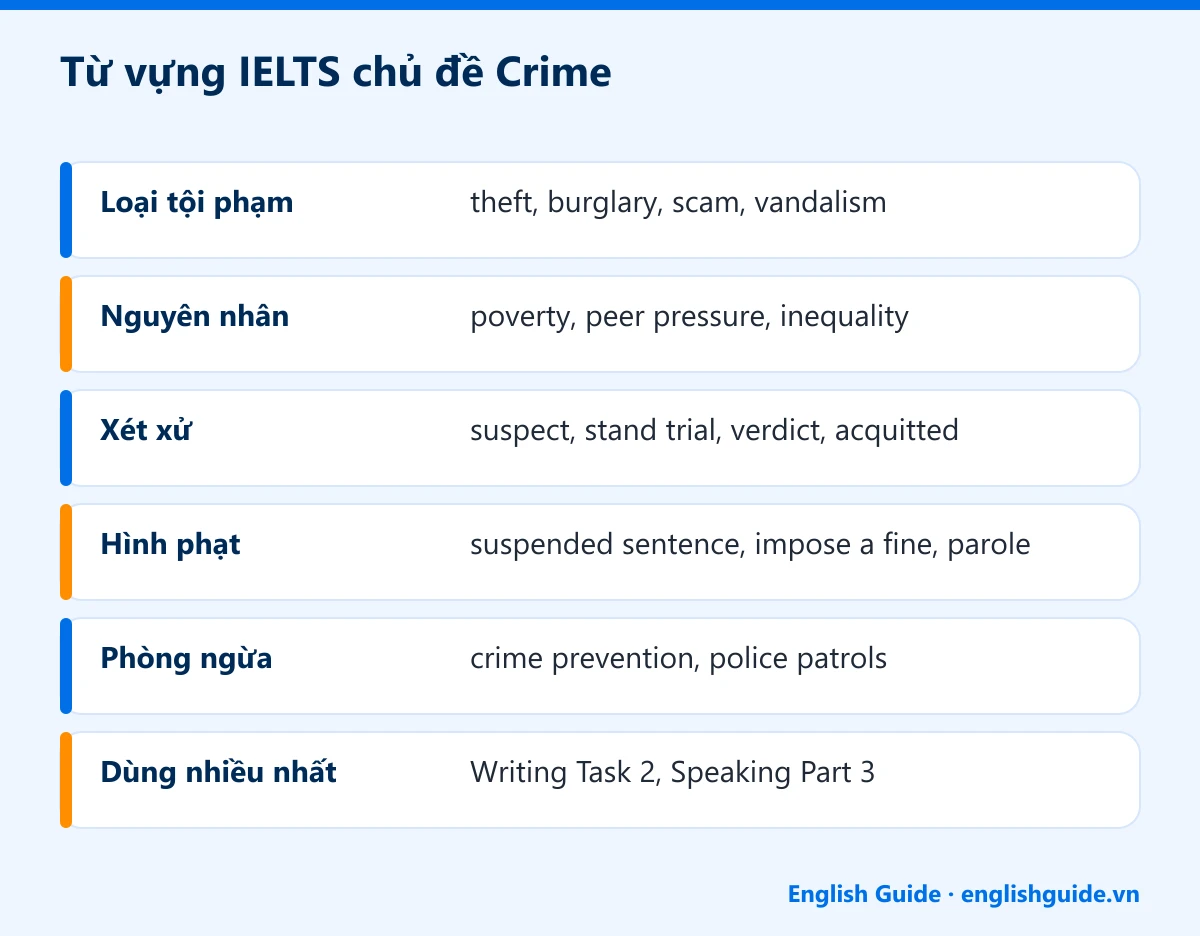
Cuối bài có collocation, những cặp từ hay nhầm, đề Task 2 hay gặp, đoạn mẫu Writing, câu trả lời Speaking và bài tập có đáp án.
Chủ đề Crime xuất hiện ở đâu trong IELTS
Speaking Part 1 (4–5 phút, theo mô tả phần thi Speaking của IELTS): câu hỏi nhẹ nhàng như khu bạn sống có an toàn không, bạn từng bị mất đồ chưa.
Speaking Part 2: có thể gặp đề mô tả một luật lệ bạn thấy hợp lý, một lần bạn thấy ai đó vi phạm quy định, hay một lần bạn bị mất đồ quan trọng.
Speaking Part 3 (4–5 phút): vì sao người trẻ vi phạm pháp luật, nhà tù có hiệu quả không, truyền thông đưa tin về tội phạm ra sao.
Writing Task 2: đề về hình phạt, cải tạo, tội phạm vị thành niên, an ninh đô thị, lừa đảo qua mạng.
Theo trang giải thích điểm của IELTS, vốn từ được chấm qua tiêu chí Lexical Resource, một trong bốn tiêu chí có trọng số ngang nhau ở Speaking và ở mỗi bài Writing. Bảng mô tả band Writing ghi ở band 7, vốn từ đủ để diễn đạt khá linh hoạt và chính xác, có dùng một số từ ít phổ biến và cho thấy ý thức về văn phong và collocation. Với chủ đề Crime, điều đó nghĩa là gọi đúng tên hành vi (burglary chứ không chỉ steal), dùng đúng động từ đi kèm (impose a fine, serve time) và giữ giọng văn trung lập.
Bài IELTS Writing Task 2 Crime: 2 bài mẫu đã có bảng 15 từ cốt lõi như offender, deterrent, rehabilitation, reoffend, criminal record, community service. Bài này không lặp lại các từ đó mà mở rộng sang những nhóm từ còn thiếu, nên bạn có thể học hai bài nối tiếp nhau.
Từ vựng IELTS chủ đề Crime theo 5 nhóm
Ký hiệu từ loại trong bảng: (n) danh từ, (v) động từ, (adj) tính từ, (phr) cụm từ. Các ví dụ được viết theo kiểu câu có thể dùng lại trong bài thi.
Nhóm 1: Các loại hành vi phạm tội
Từ, cụm từ | Từ loại | Nghĩa | Ví dụ |
|---|---|---|---|
theft | n | tội trộm cắp (nói chung) | Bicycle theft is a common problem near schools and markets. |
burglary / burglar | n | trộm đột nhập nhà / kẻ trộm đột nhập | Burglaries tend to increase when many families travel during the holidays. |
shoplifting | n | trộm đồ trong cửa hàng | Security tags on clothes help shops reduce shoplifting. |
pickpocketing | n | móc túi | Pickpocketing is a risk in crowded bus stations and night markets. |
vandalism | n | phá hoại tài sản công | Vandalism of bus shelters wastes money that could be spent on better services. |
scam / scammer | n | trò lừa đảo / kẻ lừa đảo | Phone scams often target elderly people who live alone. |
identity theft | n | đánh cắp danh tính, thông tin cá nhân | Posting photos of your ID card online can lead to identity theft. |
drink-driving | n | lái xe sau khi uống rượu bia | Heavier fines can make drink-driving far less socially acceptable. |
white-collar crime | n | tội phạm kinh tế, gian lận tài chính | White-collar crime can harm thousands of people without any violence at all. |
organised crime | n | tội phạm có tổ chức | Organised crime often operates across national borders. |
Nhóm 2: Nguyên nhân dẫn đến phạm tội
Từ, cụm từ | Từ loại | Nghĩa | Ví dụ |
|---|---|---|---|
poverty / unemployment | n | nghèo đói / thất nghiệp | Poverty and unemployment are often linked to theft and other property crime. |
struggle to make ends meet | phr | chật vật kiếm sống | People who struggle to make ends meet may be tempted to steal. |
deprived area | phr | khu vực khó khăn, thiếu thốn | Crime is often concentrated in deprived areas with few job opportunities. |
social inequality | n | bất bình đẳng xã hội | A wide gap between rich and poor creates social inequality that can fuel resentment. |
inadequate social welfare | phr | phúc lợi xã hội không đủ | Inadequate social welfare leaves some families with nowhere to turn. |
peer pressure | n | áp lực từ bạn bè cùng trang lứa | Peer pressure can push teenagers into breaking rules they would normally respect. |
lack of parental supervision | phr | thiếu sự quản lý của cha mẹ | A lack of parental supervision leaves some teenagers with too much free time. |
stem from | v | bắt nguồn từ | Many minor offences stem from boredom rather than bad character. |
greed | n | lòng tham | Not all crime is caused by need; some fraud is driven purely by greed. |
Nhóm 3: Người và quá trình xét xử
Từ, cụm từ | Từ loại | Nghĩa | Ví dụ |
|---|---|---|---|
suspect | n | nghi phạm | The police released the suspect because of a lack of evidence. |
victim / witness | n | nạn nhân / nhân chứng | Victims and witnesses are sometimes afraid to come forward. |
arrest | v / n | bắt giữ / sự bắt giữ | Two men were arrested after a series of burglaries in the area. |
charge somebody with | phr | buộc tội ai về tội gì | She was charged with fraud after the investigation. |
stand trial | phr | ra hầu tòa | He will stand trial next month. |
plead guilty / not guilty | phr | nhận tội / không nhận tội | Defendants who plead guilty sometimes receive a reduced sentence. |
be convicted of | phr | bị kết tội | He was convicted of drink-driving and lost his licence for a year. |
be acquitted | phr | được tuyên trắng án | The man was acquitted when new evidence emerged. |
verdict | n | phán quyết | The jury took two days to reach a verdict. |
jury | n | bồi thẩm đoàn (có ở một số nước như Anh, Mỹ) | In some countries, ordinary citizens serve on a jury. |
Nhóm 4: Hình phạt và cải tạo
Từ, cụm từ | Từ loại | Nghĩa | Ví dụ |
|---|---|---|---|
sentence somebody to | v | tuyên án ai (mức án) | The court sentenced him to two years in prison. |
impose a fine | phr | áp dụng hình phạt tiền | Authorities can impose heavy fines on companies that cheat customers. |
a suspended sentence | n | án treo | First-time offenders may receive a suspended sentence instead of going to prison. |
a lenient / harsh sentence | phr | án nhẹ / án nặng | Many people felt the sentence was too lenient for such a serious offence. |
serve time | phr | chấp hành án tù | People who serve time for minor offences often find it hard to get a job afterwards. |
inmate | n | phạm nhân | Inmates who study during their sentence are better prepared for release. |
overcrowded prisons | phr | nhà tù quá tải | Overcrowded prisons make it difficult to run education programmes. |
vocational training | n | đào tạo nghề | Vocational training gives inmates a skill they can rely on after release. |
be released on parole | phr | được tha tù trước thời hạn có điều kiện | Prisoners who behave well may be released on parole. |
ex-offender | n | người từng phạm tội, đã chấp hành xong án | Employers are often reluctant to hire ex-offenders. |
recidivism | n | tình trạng tái phạm (từ trang trọng) | Education in prison is widely seen as a way to reduce recidivism. |
Nhóm 5: Phòng ngừa tội phạm và an ninh cộng đồng
Từ, cụm từ | Từ loại | Nghĩa | Ví dụ |
|---|---|---|---|
crime prevention | n | phòng ngừa tội phạm | Crime prevention is usually cheaper than punishment. |
crime rate | n | tỉ lệ tội phạm | A falling crime rate does not always make people feel safer. |
police presence / police patrols | n | sự hiện diện của cảnh sát / tuần tra | A visible police presence makes residents feel safer at night. |
neighbourhood watch | n | nhóm cư dân tự quản về an ninh | Our street set up a neighbourhood watch to keep an eye on empty houses during Tet. |
street lighting | n | đèn đường | Better street lighting can make dark alleys less attractive to thieves. |
youth programmes | n | chương trình, sân chơi cho thanh thiếu niên | Sports clubs and youth programmes keep teenagers busy after school. |
raise public awareness of | phr | nâng cao nhận thức của người dân về | Banks run campaigns to raise public awareness of online scams. |
international cooperation | n | hợp tác quốc tế | Tackling scams run from abroad requires international cooperation. |
report a crime (to the police) | phr | trình báo (với công an, cảnh sát) | Many victims of small thefts never report the crime to the police. |
Collocation chủ đề Crime nên dùng
Collocation là những từ thường đi với nhau. Học theo cụm giúp bạn tránh lỗi dịch từng chữ, ví dụ nói make a crime thay vì commit a crime. Cách học collocation hiệu quả có ở bài collocation trong IELTS.
Collocation | Nghĩa | Ví dụ |
|---|---|---|
crime rates soar / fall | tỉ lệ tội phạm tăng vọt / giảm | Crime rates can soar when a large factory closes and jobs disappear. |
curb / tackle crime | kiềm chế / giải quyết tội phạm | Governments need long-term strategies to tackle crime. |
be tough on crime | cứng rắn với tội phạm | Politicians like to appear tough on crime before elections. |
set an example (to others) | làm gương, răn đe người khác | Harsh sentences are sometimes intended to set an example to others. |
make the punishment fit the crime | hình phạt tương xứng với tội | A fair legal system tries to make the punishment fit the crime. |
pay one's debt to society | đã trả giá cho xã hội (chấp hành xong án) | Once ex-offenders have paid their debt to society, they deserve a fair chance. |
give someone a second chance | cho ai cơ hội làm lại | Vocational courses give young offenders a second chance. |
take the law into one's own hands | tự xử, không thông qua pháp luật | Residents should report thieves rather than take the law into their own hands. |
a slap on the wrist | hình phạt quá nhẹ, chỉ như “phạt cho có” | A small fine is just a slap on the wrist for a large company. |
crime doesn't pay | phạm tội chẳng được lợi gì (thành ngữ) | Films often end with the message that crime doesn't pay. |
Lưu ý văn phong: a slap on the wrist và crime doesn't pay hợp với Speaking. Trong Writing Task 2, nên ưu tiên cụm trung tính như tackle crime, set an example, make the punishment fit the crime.
Những cặp từ hay nhầm trong chủ đề Crime
Cặp từ | Khác nhau thế nào | Ví dụ đúng |
|---|---|---|
theft / burglary / robbery | theft: trộm nói chung; burglary: đột nhập vào nhà, cửa hàng để trộm; robbery: cướp, dùng vũ lực hoặc đe dọa | There was a burglary next door while the family was away. |
steal / rob | steal + đồ vật (from someone); rob + người hoặc nơi chốn (of something) | Someone stole my phone. / Two men robbed a bank. |
prison / jail | Anh – Anh: jail là cách nói thân mật của prison; Anh – Mỹ: jail thường là nơi giam ngắn hạn. Trong Writing, dùng prison an toàn hơn | Prison should not be the only option for minor offences. |
punishment / sentence / penalty | punishment: hình phạt nói chung; sentence: mức án tòa tuyên; penalty: hình phạt cho vi phạm luật lệ, hay dùng với phạt tiền | The penalty for drink-driving has become much stricter. |
accuse of / charge with | accuse somebody of: cáo buộc (ai cũng có thể cáo buộc); charge somebody with: chính thức buộc tội | He was charged with theft and will stand trial. |
the police | luôn đi với động từ số nhiều; muốn nói một người thì dùng a police officer | The police are investigating the case. |
Cách phân biệt crime, criminal và offence có trong phần mẹo ở bài mẫu Writing Task 2 chủ đề Crime đã nhắc ở trên.
Đề Writing Task 2 chủ đề Crime hay gặp
Các đề dưới đây do EG tự soạn để luyện tập, bám theo những hướng ra đề phổ biến về tội phạm:
Dạng đề | Đề luyện tập |
|---|---|
Agree/disagree | Parents should be held legally responsible for minor crimes committed by their teenage children. To what extent do you agree or disagree? |
Discussion | Some people think the police should focus only on serious crimes, while others believe minor offences such as vandalism deserve equal attention. Discuss both views and give your opinion. |
Advantages/disadvantages | In some countries, people who commit minor offences are fined rather than sent to prison. Do the advantages of this outweigh the disadvantages? |
Problem/solution | Scams targeting elderly people are becoming more common. What are the causes of this problem, and what can be done to solve it? |
Two-part question | Crime rates are often higher in cities than in the countryside. Why is this the case? What can be done to make cities safer? |
Hai bài mẫu hoàn chỉnh (án tù hay dạy nghề, camera giám sát nơi công cộng), kèm dàn ý và phân tích theo 4 tiêu chí, có ở bài bài mẫu IELTS Writing Task 2 chủ đề Crime.
Đoạn mẫu Writing Task 2 dùng từ vựng Crime
Đề: câu hỏi hai phần về tội phạm ở thành phố trong bảng trên. Đoạn thân bài dưới đây trả lời câu hỏi thứ nhất (vì sao); từ vựng của bài được in đậm.
One reason why cities tend to have higher crime rates is that wealth and poverty exist side by side. In large urban areas, people who struggle to make ends meet live only a few streets away from expensive shops and cars, and this visible social inequality may tempt some of them to break the law. Cities also offer a degree of anonymity that villages do not. In a small community, neighbours know one another, so a stranger behaving suspiciously is quickly noticed, whereas in a crowded city a pickpocket or a burglar can simply disappear. Finally, teenagers in deprived areas often have little to do after school, and without youth programmes or proper parental supervision, peer pressure can draw them into vandalism or shoplifting. For these reasons, crime prevention in cities must address social conditions, not just police presence.
Đoạn văn có câu chủ đề rõ, đưa ba nguyên nhân nối bằng One reason…, also…, Finally…, và câu cuối dẫn sang câu hỏi thứ hai về giải pháp. Từ vựng không cần hiếm; điều quan trọng là dùng đúng tên hành vi (pickpocket, burglar, vandalism) và đúng collocation (struggle to make ends meet, address social conditions).
Câu trả lời Speaking mẫu chủ đề Crime
Part 1
Is the area where you live safe?
Generally, yes. I live in a fairly quiet neighbourhood where most people know each other, so I don't feel nervous walking home in the evening. The main thing people worry about is motorbike theft, so we always lock our bikes, even if we're only popping into a shop for a minute.
Have you ever lost something or had something stolen?
Once, when I was in grade ten. I left my phone on a café table for literally a minute, and when I came back, it was gone. I didn't report it to the police because it was quite an old phone, but since then I've been much more careful in crowded places.
Part 3
Why do some young people break the law?
I don't think there's a single reason. For some, it's peer pressure: they want to fit in with a group, so they do things they'd never do on their own. For others, it's simply boredom, especially if there are no sports clubs or youth programmes nearby. A lack of parental supervision plays a part too, because many parents work long hours. That's why I think prevention should start in schools and local communities rather than in courtrooms.
Is prison the best way to deal with people who commit minor offences?
Not really, in my opinion. Sending someone to prison for shoplifting, say, can do more harm than good, because they may come out with fewer job prospects than before. A fine, a suspended sentence or a course of vocational training is often more sensible. Some people would call that a slap on the wrist, but if it stops the person from offending again, it's better for everyone, including taxpayers who have to pay for overcrowded prisons.
Does the news make people more afraid of crime than they should be?
To some extent, yes. News outlets tend to focus on shocking cases because they attract viewers, so people can get the impression that crime is everywhere, even when the crime rate in their area is quite low. On the other hand, reports about new types of scams are genuinely useful, because they raise public awareness and help people protect themselves. So I'd say it depends on what kind of crime news we're talking about.
Để ý cách mỗi câu trả lời Part 3 nêu quan điểm, đưa lý do hoặc ví dụ rồi cân nhắc mặt còn lại. Cách triển khai chi tiết có ở bài IELTS Speaking Part 3.
Bài tập từ vựng Crime có đáp án
Bài 1: Điền từ thích hợp
Từ gợi ý: peer pressure, acquitted, neighbourhood watch, shoplifting, suspended sentence, make ends meet
Teenagers sometimes give in to ___ and do things they know are wrong.
After the trial, the jury found the man not guilty, and he was ___.
Residents set up a ___ to keep an eye on empty houses during the holidays.
Security cameras and tags on products help supermarkets reduce ___.
Instead of going to prison, the first-time offender received a ___.
Families who struggle to ___ need support, not just warnings.
Bài 2: Nối động từ với danh từ phù hợp
Động từ | Danh từ |
|---|---|
1. plead | a. time |
2. impose | b. guilty |
3. serve | c. public awareness |
4. tackle | d. a fine |
5. raise | e. crime |
Bài 3: Chọn từ đúng
Someone (stole / robbed) my bicycle outside the library.
The police (is / are) looking into a series of burglaries in the area.
Two men were arrested for (robbing / stealing) a bank.
He was (charged / accused) with fraud last month.
The judge gave her a (lenient / tolerant) sentence because it was her first offence.
Đáp án
Bài 1: 1. peer pressure · 2. acquitted · 3. neighbourhood watch · 4. shoplifting · 5. suspended sentence · 6. make ends meet
Bài 2: 1-b · 2-d · 3-a · 4-e · 5-c
Bài 3: 1. stole · 2. are · 3. robbing · 4. charged · 5. lenient
Học và dùng từ vựng Crime sao cho nhớ lâu
Đừng học hết 5 bảng trong một ngày. Mỗi ngày học một nhóm, đặt 2–3 câu gắn với đời sống quanh bạn (một tin lừa đảo qua điện thoại bạn từng nghe, chuyện mất xe ở trường, cách khu phố bạn giữ an ninh dịp Tết), rồi dùng lại trong một câu trả lời Speaking có ghi âm. Khi viết, chủ đề Crime dùng câu bị động rất nhiều (be arrested, be charged with, be sentenced to), nên ôn thêm bài câu bị động trong IELTS. Phương pháp ôn lặp lại có ở bài cách học từ vựng IELTS.
Nếu muốn có giáo viên chữa lỗi dùng từ trong bài viết và bài nói, khóa IELTS Master 5.0–5.5 của EG có 80 giờ học, lớp 8–15 học viên, chấm Writing và Speaking chi tiết. Học tại Cơ sở Buôn Ma Thuột học phí 9.900.000đ (khoảng 124.000đ/giờ); học online cùng giáo viên 7.140.000đ (khoảng 89.000đ/giờ). Đã có 5.0–5.5, bạn có thể học tiếp IELTS Advanced 6.0+ (60 giờ, 7.400.000đ tại trung tâm, khoảng 123.000đ/giờ; 5.940.000đ online, khoảng 99.000đ/giờ). Học viên ôn từ vựng giữa các buổi trên nền tảng EG LMS. Chưa rõ trình độ, bạn có thể bắt đầu bằng bài kiểm tra trình độ miễn phí.
Câu hỏi thường gặp
Crime là danh từ đếm được hay không đếm được?
Cả hai. Khi nói tội phạm nói chung, crime không đếm được: Crime has fallen in many cities. Khi nói một hành vi cụ thể, crime đếm được: He committed a serious crime, hoặc số nhiều crimes.
Có cần dùng thuật ngữ pháp lý trong Writing không?
Không cần. Giám khảo chấm cách bạn dùng tiếng Anh, không chấm hiểu biết luật. Những từ như suspect, trial, sentence là đủ; tránh dùng từ chuyên ngành mà bạn không chắc nghĩa, ví dụ gọi nhầm judge là jury.
Có nên đưa ví dụ về vụ án có thật không?
Không nên. Ví dụ chung chung nhưng hợp lý (trộm xe ở khu đông người, cuộc gọi lừa đảo nhắm vào người lớn tuổi) đã đủ thuyết phục, và bạn không lo nhớ sai chi tiết. Cũng không nên bịa số liệu kiểu crime fell by 40%.
Nói về chủ đề tội phạm có cần tránh từ ngữ quá nặng không?
Nên giữ giọng trung lập: gọi là offenders, people who break the law, và tập trung vào nguyên nhân, giải pháp. Không cần mô tả chi tiết hành vi bạo lực; điều đó không giúp tăng điểm mà còn làm bài kém khách quan.