Kiến thức
Từ vựng IELTS chủ đề Education: 5 nhóm từ, collocation, đoạn mẫu Writing và Speaking
16 phút đọc
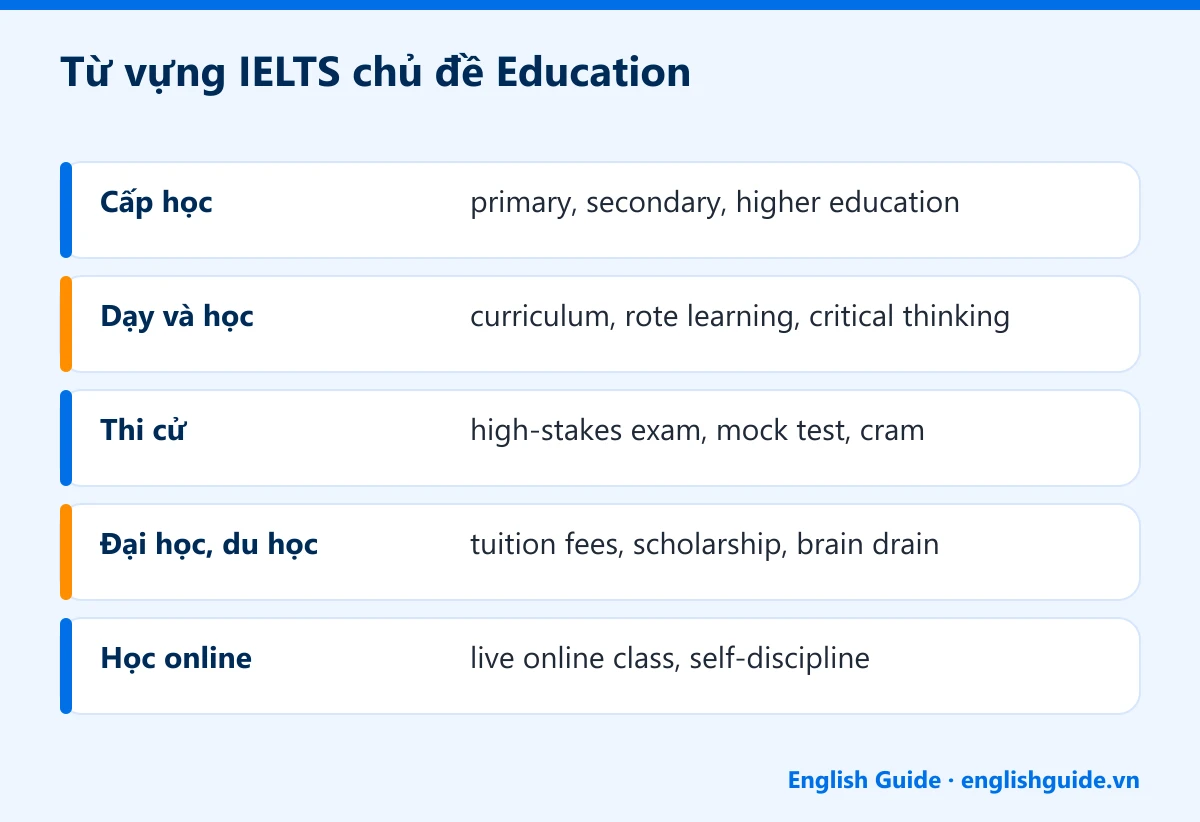
Từ vựng IELTS chủ đề Education gồm năm nhóm chính: hệ thống giáo dục và cấp học, dạy và học, thi cử và đánh giá, đại học và du học, giáo dục trực tuyến. Giáo dục là chủ đề rất quen thuộc trong bài thi: Speaking Part 1 hỏi về việc học của chính bạn, Part 3 bàn về trường học và thi cử, còn Writing Task 2 có cả một nhóm đề riêng về giáo dục. Bài này gom những từ, cụm từ dùng được ngay, mỗi mục có từ loại, nghĩa và ví dụ đặt trong ngữ cảnh bài thi.
Cuối bài có collocation, vài thành ngữ cho Speaking, đề Task 2 hay gặp, đoạn mẫu Writing, câu trả lời Speaking và bài tập có đáp án.
Chủ đề Education xuất hiện ở đâu trong IELTS
Speaking Part 1 (4–5 phút, theo mô tả phần thi Speaking của IELTS): câu hỏi về việc học hay công việc của bạn, môn học yêu thích hồi phổ thông, thói quen học nhóm.
Speaking Part 2: mô tả một thầy cô ảnh hưởng tới bạn, một khóa học bạn từng tham gia, một kỹ năng bạn mới học; có 1 phút chuẩn bị rồi nói khoảng 2 phút.
Speaking Part 3 (4–5 phút): thi cử có phản ánh đúng năng lực không, có nên miễn học phí đại học, học online có thay được lớp học truyền thống.
Writing Task 2: chương trình học, đại học hay học nghề, du học, áp lực thi cử, vai trò của giáo viên và công nghệ.
Theo trang giải thích điểm của IELTS, vốn từ được chấm qua tiêu chí Lexical Resource, một trong bốn tiêu chí có trọng số ngang nhau ở Speaking và ở mỗi bài Writing. Bảng mô tả band Writing ghi band 7 cần có khả năng dùng một số từ ít phổ biến hoặc thành ngữ và cho thấy ý thức về văn phong và collocation. Vì vậy, nên học cả cụm từ đi liền nhau thay vì từng từ rời.
Từ vựng IELTS chủ đề Education theo 5 nhóm
Ký hiệu từ loại trong bảng: (n) danh từ, (v) động từ, (adj) tính từ, (phr) cụm từ. Các ví dụ được viết theo kiểu câu có thể dùng lại trong bài thi.
Nhóm 1: Hệ thống giáo dục và cấp học
Từ, cụm từ | Từ loại | Nghĩa | Ví dụ |
|---|---|---|---|
kindergarten / preschool | n | mẫu giáo, mầm non | Many working parents send their children to kindergarten at the age of three. |
primary school | n | trường tiểu học | My younger brother has just started primary school. |
lower secondary school | n | trường THCS | Most students in Vietnam finish lower secondary school at around fifteen. |
upper secondary school / high school | n | trường THPT | I'm in my final year of high school, so most of my time goes on revision. |
state school / private school | n | trường công / trường tư | Private schools often have smaller classes but charge much higher fees. |
boarding school | n | trường nội trú | Some students from remote villages attend boarding schools in the provincial capital. |
single-sex school / mixed (co-educational) school | n | trường chỉ dành cho nam hoặc nữ / trường học chung | Supporters of single-sex schools claim that students are less distracted in class. |
vocational training | n | đào tạo nghề | Vocational training can lead to well-paid jobs without a university degree. |
educational inequality | n | bất bình đẳng trong giáo dục | Educational inequality between cities and rural areas remains a serious issue. |
Nhóm 2: Dạy và học
Từ, cụm từ | Từ loại | Nghĩa | Ví dụ |
|---|---|---|---|
curriculum | n | chương trình học (toàn bộ) | The national curriculum is often criticised for being overloaded. |
syllabus | n | đề cương của một môn, một khóa | The teacher handed out the syllabus on the first day of the course. |
rote learning | n | học vẹt, học thuộc lòng | Rote learning may help students pass tests, but they soon forget what they memorised. |
critical thinking | n | tư duy phản biện | Class debates are a simple way to encourage critical thinking. |
hands-on learning | n | học qua thực hành | Science lessons work best when there is plenty of hands-on learning in the lab. |
student-centred | adj | lấy người học làm trung tâm | In a student-centred classroom, learners spend more time discussing than listening. |
extracurricular activities | n | hoạt động ngoại khóa | Extracurricular activities such as sports clubs help teenagers develop teamwork. |
extra classes / private tutoring | n | học thêm / dạy kèm | Many parents pay for extra classes in the evenings and at weekends. |
attention span | n | khả năng tập trung | Young children have a short attention span, so lessons should be varied. |
truancy / play truant | n / phr | trốn học | Truancy is often a sign that a student is struggling at home or at school. |
Nhóm 3: Thi cử và đánh giá
Từ, cụm từ | Từ loại | Nghĩa | Ví dụ |
|---|---|---|---|
assessment / assess | n / v | sự đánh giá / đánh giá | Teachers assess students through projects as well as written tests. |
continuous assessment | n | đánh giá thường xuyên trong cả quá trình | Continuous assessment reduces the pressure of a single final exam. |
high-stakes exam | n | kỳ thi mang tính quyết định | The national high school graduation exam is a high-stakes exam because many universities use its results for admission. |
sit / take an exam | phr | dự thi | I'm planning to sit the IELTS test in December. |
revise (for) | v | ôn bài (Anh–Anh; Anh–Mỹ dùng review) | I usually revise for exams in the library because it is quiet. |
cram (for) | v | học nhồi, học dồn | Cramming the night before an exam rarely leads to long-term learning. |
mock test | n | bài thi thử | Taking a mock test helps you get used to the time pressure. |
academic performance | n | kết quả học tập | Lack of sleep can seriously affect academic performance. |
academic pressure | n | áp lực học tập | Academic pressure is one reason why some teenagers feel anxious. |
plagiarism | n | đạo văn | Plagiarism is treated very seriously at universities. |
Nhóm 4: Đại học và du học
Từ, cụm từ | Từ loại | Nghĩa | Ví dụ |
|---|---|---|---|
higher education / tertiary education | n | giáo dục đại học, cao đẳng | Access to higher education has expanded rapidly in recent decades. |
undergraduate / postgraduate | n | sinh viên đại học / học viên sau đại học | Most undergraduates spend four years on a bachelor's degree. |
major in | v | học chuyên ngành | He is majoring in software engineering. |
tuition fees | n | học phí | Rising tuition fees put higher education out of reach for some families. |
scholarship | n | học bổng | She won a full scholarship to study in Japan. |
drop out (of) | phr | bỏ học giữa chừng | He dropped out of university to start his own business. |
gap year | n | năm tạm nghỉ trước hoặc sau đại học | A gap year can give students time to decide what they really want to study. |
study abroad / international student | phr / n | du học / du học sinh | International students often experience culture shock in their first months. |
employability | n | khả năng được tuyển dụng | Internships improve graduates' employability. |
brain drain | n | chảy máu chất xám | Brain drain happens when talented graduates stay abroad after their studies. |
Nhóm 5: Giáo dục trực tuyến
Từ, cụm từ | Từ loại | Nghĩa | Ví dụ |
|---|---|---|---|
online learning / e-learning | n | học trực tuyến | Online learning allows students in rural areas to join classes with experienced teachers. |
live online class | n | lớp trực tuyến học trực tiếp với giáo viên | In a live online class, students can ask questions in real time. |
pre-recorded lesson | n | bài giảng quay sẵn | Pre-recorded lessons are flexible, but nobody checks whether you have understood. |
learning platform | n | nền tảng học tập | Our school uses a learning platform where students submit homework. |
self-paced | adj | tự điều chỉnh tốc độ học | Self-paced courses suit adults with busy schedules. |
self-discipline | n | tính tự giác | Studying from home requires a great deal of self-discipline. |
blended learning | n | học kết hợp trực tiếp và trực tuyến | Blended learning combines classroom lessons with online practice. |
face-to-face interaction | n | tương tác trực tiếp | The main drawback of online courses is the lack of face-to-face interaction. |
lifelong learning | n | học tập suốt đời | The internet has made lifelong learning easier than ever. |
Collocation chủ đề Education nên dùng
Collocation là những từ thường đi với nhau. Dùng đúng cặp từ giúp câu tự nhiên hơn hẳn so với dịch từng chữ từ tiếng Việt.
Collocation | Nghĩa | Ví dụ |
|---|---|---|
acquire knowledge / skills | tiếp thu kiến thức, kỹ năng | Students acquire practical skills much faster through internships. |
broaden one's horizons | mở mang tầm nhìn | Living in another country broadens young people's horizons. |
meet the entry requirements | đáp ứng điều kiện đầu vào | Applicants must meet the entry requirements, including a minimum IELTS score. |
fall behind (with) | bị tụt lại | Students who miss classes often fall behind with their coursework. |
keep up with | theo kịp | It can be hard to keep up with classmates in a large class. |
pursue higher education | học lên cao | More young women now choose to pursue higher education. |
place too much emphasis on | quá chú trọng vào | Some schools place too much emphasis on test scores. |
foster creativity | nuôi dưỡng sự sáng tạo | Art and music lessons help foster creativity. |
bridge the gap between theory and practice | thu hẹp khoảng cách giữa lý thuyết và thực hành | Work placements bridge the gap between theory and practice. |
obtain a degree | lấy bằng | She obtained a master's degree in public health. |
Thành ngữ dùng được trong Speaking
hit the books: bắt tay vào học chăm chỉ. I need to hit the books this weekend because my test is on Monday.
burn the midnight oil: thức khuya làm việc, học bài. I burned the midnight oil before every exam in high school.
learn something by heart: học thuộc lòng. We had to learn whole poems by heart at primary school.
pass with flying colours: đỗ với kết quả rất tốt. My sister passed her driving test with flying colours.
learn the ropes: học những điều cơ bản của một việc mới. It took me a few weeks to learn the ropes at university.
Thành ngữ hợp với Speaking hơn Writing. Dùng một, hai lần trong cả bài nói là đủ; dùng dày đặc nghe sẽ thiếu tự nhiên.
Đề Writing Task 2 chủ đề Education hay gặp
Các đề dưới đây do EG tự diễn đạt để luyện tập, bám theo những hướng ra đề phổ biến về giáo dục:
Dạng đề | Đề luyện tập |
|---|---|
Agree/disagree | Some people think schools should teach practical skills, such as managing money, instead of academic subjects like history. To what extent do you agree or disagree? |
Advantages/disadvantages | More and more school leavers take a gap year before starting university. Do the advantages of this outweigh the disadvantages? |
Discussion | Some people believe students learn better in single-sex schools, while others think mixed schools are more beneficial. Discuss both views and give your opinion. |
Problem/solution | In many countries, students are under increasing academic pressure. What problems does this cause, and what can be done to reduce it? |
Two-part question | More young people are choosing to study abroad. Why is this happening? Is it a positive or negative development? |
Bài mẫu hoàn chỉnh cho hai đề giáo dục khác, kèm dàn ý và phân tích theo 4 tiêu chí, có ở bài bài mẫu IELTS Writing Task 2 chủ đề Education.
Đoạn mẫu Writing Task 2 dùng từ vựng Education
Đề: đề two-part question về du học ở bảng trên. Đoạn thân bài dưới đây trả lời câu hỏi thứ nhất và chuyển sang mặt trái ở cuối đoạn; từ vựng của bài được in đậm.
There are several reasons why more young people now choose to study abroad. Firstly, a degree from a well-known foreign university is widely seen as a way to improve employability, especially for jobs in multinational companies. Secondly, scholarships and part-time work have made the cost more manageable for middle-income families, who once considered tuition fees abroad far beyond their means. Perhaps most importantly, living independently in another culture broadens students' horizons in ways that a classroom cannot. However, this trend also has a downside for the home country. If too many talented graduates decide to stay overseas, the result may be a brain drain, depriving local industries of the skilled workers they need.
Đoạn văn liệt kê lý do bằng Firstly, Secondly, Perhaps most importantly, mỗi lý do có giải thích ngắn, rồi chuyển hướng bằng However. Từ vựng không cần hiếm; điều quan trọng là dùng đúng cụm (improve employability, broaden students' horizons) và đúng ngữ cảnh.
Câu trả lời Speaking mẫu chủ đề Education
Part 1
What was your favourite subject at school?
Geography, without a doubt. Our teacher used to bring in maps and photos from her own trips, so it never felt like rote learning. I think that's also why I still love visiting the places we studied, like the national parks in the Central Highlands.
Do you prefer studying alone or with other people?
It depends on what I'm doing. When I need to revise for a test, I prefer working alone because I can concentrate better. But for speaking practice, a study group is much more useful, since we can correct each other's mistakes. It also stops me from putting things off.
Câu hỏi mở đầu Part 1 thường là Do you work or are you a student?; câu trả lời mẫu cho cả người đi học và đi làm có ở bài IELTS Speaking Part 1 chủ đề work or study.
Part 3
Do exams really show how much students know?
Only partly, I'd say. An exam shows what you can remember under time pressure, but it doesn't tell you much about critical thinking or teamwork. Some students cram the night before, get good marks, and then forget everything a week later. I think continuous assessment, like projects and presentations throughout the year, gives a fairer picture, although it means more work for teachers.
Should university education be free for everyone?
In an ideal world, yes, because talented students from poor families shouldn't miss out on higher education just because of tuition fees. But someone has to pay, and that usually means taxpayers. A more realistic option might be generous scholarships and low-interest loans, so that money is not a barrier for those who genuinely want to study.
Để ý cách mỗi câu trả lời Part 3 nêu quan điểm, đưa ví dụ rồi cân nhắc mặt còn lại. Cách triển khai chi tiết có ở bài IELTS Speaking Part 3.
Bài tập từ vựng Education có đáp án
Bài 1: Điền từ thích hợp
Từ gợi ý: mock test, scholarship, dropped out, self-discipline, curriculum, extracurricular
Taking a ___ a month before the real exam helps you manage your time.
She won a full ___ that covers both tuition and accommodation.
He ___ of university in his second year to help with the family business.
Online courses require a lot of ___ because nobody checks whether you are studying.
Many people believe the school ___ should include first aid and cooking.
___ activities such as debate clubs help students build confidence.
Bài 2: Nối động từ với cụm phù hợp
Động từ | Cụm từ |
|---|---|
1. broaden | a. behind |
2. meet | b. creativity |
3. foster | c. one's horizons |
4. fall | d. the entry requirements |
5. pursue | e. higher education |
Bài 3: Chọn từ đúng
(Education / Educational) inequality remains a problem in many rural areas.
Good teachers know how to keep students (motivated / motivation).
He graduated (from / in) university last year.
She is majoring (in / on) economics.
Đáp án
Bài 1: 1. mock test · 2. scholarship · 3. dropped out · 4. self-discipline · 5. curriculum · 6. Extracurricular
Bài 2: 1-c · 2-d · 3-b · 4-a · 5-e
Bài 3: 1. Educational · 2. motivated · 3. from · 4. in
Học và dùng từ vựng Education sao cho nhớ lâu
Đừng cố học hết các bảng trong một ngày. Mỗi ngày học một nhóm 6–8 từ, đặt một câu về chính việc học của bạn (ngôi trường cũ, môn bạn thích, kỳ thi sắp tới), rồi dùng lại trong một câu trả lời Speaking có ghi âm. Cách ôn lặp lại theo chu kỳ có ở bài cách học từ vựng IELTS.
Nếu muốn có giáo viên chữa lỗi dùng từ trong bài viết và bài nói, khóa IELTS Master 5.0–5.5 của EG có 80 giờ học, lớp 8–15 học viên, chấm Writing và Speaking chi tiết. Học tại Cơ sở Buôn Ma Thuột (36 Trần Nhật Duật) học phí 9.900.000đ (khoảng 124.000đ/giờ); học online cùng giáo viên, lớp dạy trực tiếp chứ không phải video quay sẵn, 7.140.000đ (khoảng 89.000đ/giờ). Học viên ôn từ vựng giữa các buổi trên nền tảng EG LMS. Chưa rõ trình độ, bạn có thể bắt đầu bằng bài kiểm tra trình độ miễn phí.
Câu hỏi thường gặp
Learn và study khác nhau thế nào?
Study nói về quá trình học có chủ đích, thường với sách vở, ở trường lớp: I study English at a language centre. Learn nhấn vào kết quả, tức là tiếp thu được điều gì đó, kể cả ngoài lớp học: I learned a lot from my classmates.
Pupil và student khác nhau ra sao?
Trong tiếng Anh–Anh, pupil thường dùng cho học sinh nhỏ tuổi ở trường phổ thông, còn student dùng cho sinh viên và ngày càng phổ biến cho cả học sinh cấp trên. Tiếng Anh–Mỹ dùng student cho mọi cấp. Trong bài thi, dùng student là an toàn.
Go to school hay go to the school?
Nói go to school (không có the) khi đi học với mục đích học tập. Dùng the khi nói về tòa nhà cụ thể với mục đích khác: My mother went to the school to meet my teacher. Quy tắc mạo từ chi tiết có ở bài mạo từ trong IELTS.
Có nên dùng thành ngữ trong Writing không?
Không nên. Writing Task 2 cần văn phong trang trọng, nên ưu tiên collocation trung tính như pursue higher education, place too much emphasis on. Để thành ngữ như hit the books cho Speaking.