Kiến thức
IELTS Speaking Part 1 Childhood: 12 câu hỏi về tuổi thơ, câu trả lời mẫu, từ vựng và gợi ý Part 2, Part 3
20 phút đọc
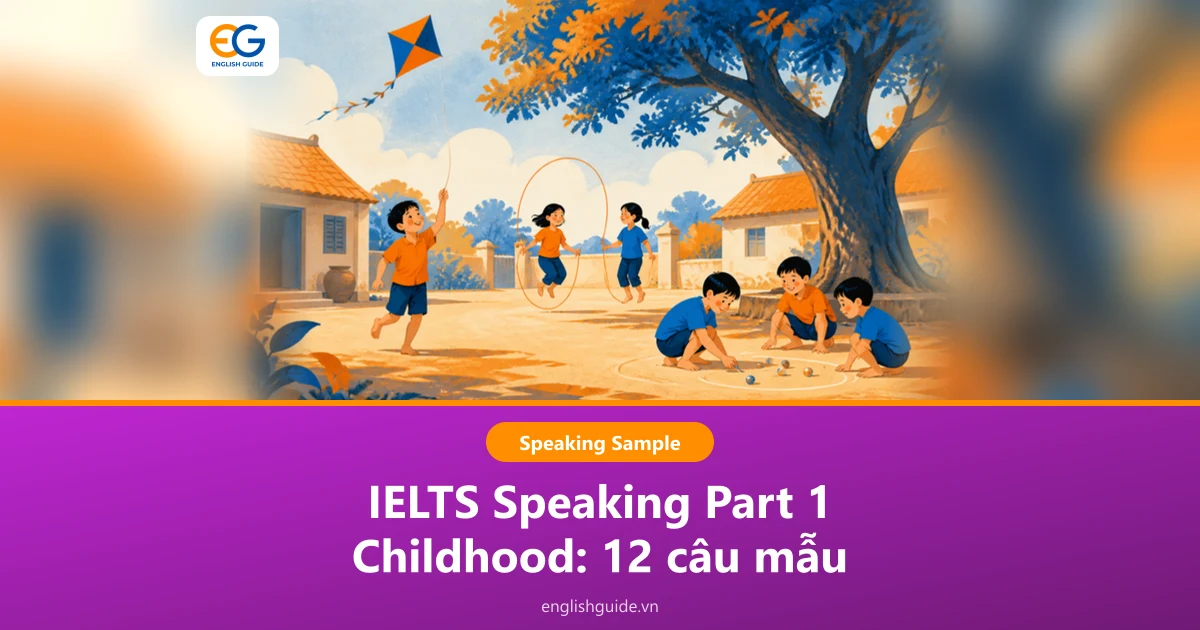
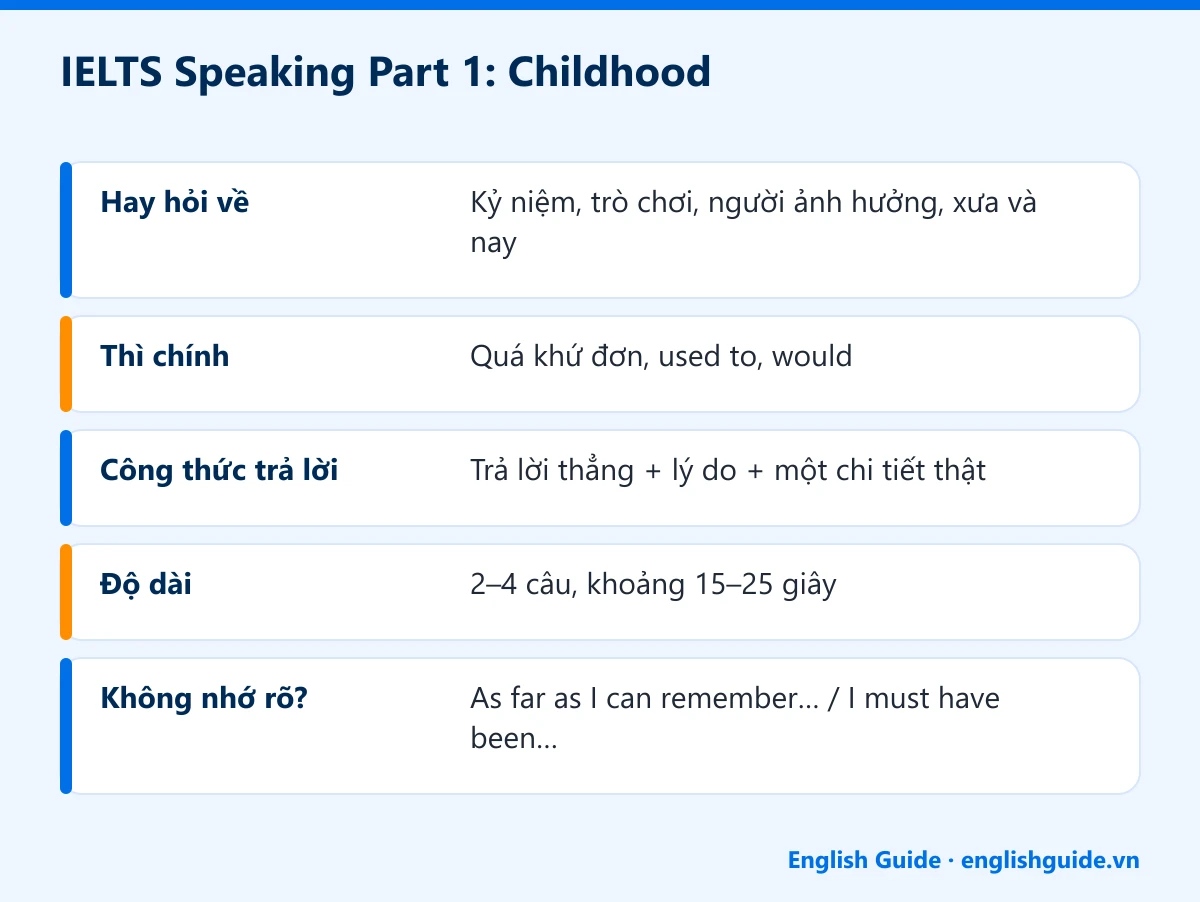
IELTS Speaking Part 1 Childhood là nhóm câu hỏi ngắn về tuổi thơ của bạn, ví dụ Did you have a happy childhood?, What did you often do as a child? hay Who had the most influence on you when you were young?. Cách trả lời tốt: dùng đúng thì quá khứ, kể một chi tiết thật (một trò chơi, một người, một nơi chốn) và dừng sau 2–4 câu. Bài này gồm 12 câu hỏi hay gặp kèm câu trả lời mẫu tự soạn, cách chọn thì, từ vựng có nghĩa tiếng Việt, lỗi người Việt hay mắc và gợi ý cho Part 2, Part 3.
Nếu chưa rõ Part 1 diễn ra thế nào, bạn nên đọc trước bài IELTS Speaking Part 1: kiểu câu hỏi và cách trả lời. Chủ đề tuổi thơ cũng hay xuất hiện ở Part 2 qua đề Describe a toy you liked in your childhood, nên học hai bài cùng lúc sẽ dùng lại được nhiều ý.
Chủ đề childhood trong IELTS Speaking Part 1
Theo mô tả phần thi Speaking trên ielts.org, bài nói kéo dài 11–14 phút, được ghi âm và gồm 3 phần. Part 1 dài 4–5 phút: giám khảo hỏi những câu chung về các chủ đề quen thuộc như nhà ở, gia đình, công việc, việc học hay sở thích. Tuổi thơ là chủ đề rất tự nhiên để giám khảo chuyển sang sau khi hỏi về gia đình hoặc quê nhà, nên đáng chuẩn bị trước.
Câu hỏi về tuổi thơ thường đi theo 5 hướng:
Hướng hỏi | Ví dụ câu hỏi | Bạn cần nói được |
|---|---|---|
Cảm nhận chung | Did you have a happy childhood? What is your earliest memory? | Tuổi thơ vui hay buồn, một ký ức rõ nhất |
Hoạt động, trò chơi | What did you often do as a child? Indoors or outdoors? | Tên trò chơi, chơi ở đâu, với ai |
Con người | Who influenced you most? Do you keep in touch with childhood friends? | Một người cụ thể và họ ảnh hưởng bạn thế nào |
Học hành, ước mơ | Did you take extra classes? What did you want to be? | Việc học thêm, ước mơ nghề nghiệp hồi nhỏ |
Xưa và nay | Is there anything you miss? Do kids today have a better childhood? | So sánh, nêu quan điểm, có lý do |
Gần như mọi câu ở chủ đề này đều hỏi về quá khứ, nên dùng đúng thì là điều giám khảo nghe thấy ngay.
Dùng thì nào khi nói về tuổi thơ?
Hướng dẫn Part 1 của IDP nhắc thí sinh nghe kỹ thì của câu hỏi và trả lời bằng đúng thì đó. Với chủ đề tuổi thơ, bảng sau gần như đủ dùng:
Kiểu câu hỏi | Thì nên dùng | Ví dụ |
|---|---|---|
Did you…? / Where did you…? | Quá khứ đơn | I lived with my grandparents until I was seven. |
What did you often / usually do? | used to + V hoặc would + V | We used to play outside every afternoon. / We'd run to the river after school. |
Do you still…? / Is there anything you miss? | Hiện tại đơn | I still miss those long afternoons. |
Have you changed since…? / Do you keep in touch? | Hiện tại hoàn thành | Most of my friends have moved away. |
Do kids today… than in the past? | Hiện tại đơn + so sánh với quá khứ | Kids today have more opportunities than we did. |
Lưu ý quan trọng: would chỉ dùng cho hành động lặp lại, không dùng cho trạng thái. Nói I used to live near a river, không nói I would live near a river. Ôn lại cách chia và phát âm đuôi -ed ở bài thì quá khứ đơn trong IELTS.
12 câu hỏi IELTS Speaking Part 1 Childhood và câu trả lời mẫu
Các câu trả lời dưới đây là bài mẫu tham khảo band 7.0+ do English Guide tự soạn, theo lời một sinh viên năm ba (nhân vật hư cấu) lớn lên ở một xã trồng cà phê gần Buôn Ma Thuột, ở với bà nhiều vì bố mẹ bận việc vườn. Đừng học thuộc nguyên câu: IDP khuyên tránh câu trả lời thuộc lòng và tự thêm lý do trước khi giám khảo phải hỏi why. Hãy xem cách triển khai ý rồi thay bằng tuổi thơ thật của bạn.
1. Did you have a happy childhood?
Yes, on the whole I did. I grew up in a small village just outside Buon Ma Thuot, surrounded by coffee farms, so I spent most of my time outdoors with the other kids on my street. We didn't have much money, but I honestly can't remember ever feeling bored.
Điểm hay: on the whole (nhìn chung) mở câu tự nhiên; câu cuối I can't remember ever feeling bored nói được ý "rất vui" mà không cần very fun.
2. What is your earliest childhood memory?
I think it's sitting on my dad's motorbike, squeezed between him and my mum, on the way to my grandparents' house. I must have been about three. I don't remember where we were going exactly, only the wind on my face and the smell of coffee flowers along the road.
Điểm hay: must have been (chắc hẳn là) dùng khi không nhớ chính xác tuổi; chi tiết cảm giác (gió, mùi hoa cà phê) làm câu trả lời sống động.
3. What did you often do when you were a child?
Pretty much the same thing every day. After school, I'd drop my bag at home and run straight out to play hide-and-seek between the rows of coffee trees, or skip rope with the girls next door. In the dry season, we used to catch crickets and keep them in matchboxes.
Điểm hay: dùng cả would ('d drop) và used to cho thói quen; nêu 2–3 trò chơi cụ thể thay vì I played many games.
4. Who had the most influence on you when you were a child?
Definitely my grandmother. My parents worked long hours on the farm, especially at harvest time, so she was the one who looked after me. She was strict about manners, like greeting older people properly, but she was also the one who taught me to read before I started school.
Điểm hay: Definitely trả lời thẳng; có lý do (bố mẹ bận mùa thu hoạch) và hai ví dụ về ảnh hưởng (lễ phép, dạy đọc).
5. Did you prefer playing indoors or outdoors?
Outdoors, without a doubt. Our house was tiny and quite dark, so staying inside felt like a punishment. The only exception was the rainy season, when afternoon storms kept us in, and we'd play cards on the floor until the rain stopped.
Điểm hay: chỉ ra một ngoại lệ (The only exception was…) là cách mở rộng gọn mà vẫn đúng trọng tâm.
6. What kind of child were you?
A bit of a handful, according to my mum. I was curious about everything and kept asking "why", and once I took our radio apart to see where the voices came from. I never managed to put it back together, so you can imagine how that ended.
Điểm hay: according to my mum kể qua lời người khác nghe tự nhiên; a bit of a handful (đứa trẻ hiếu động, khó bảo); câu kết hài hước nhẹ.
7. Do you still keep in touch with your childhood friends?
With a couple of them, yes. Most of the kids I grew up with have moved to Ho Chi Minh City for work, so we mainly chat online now. But whenever we're all back home for Tet, we meet up at the same little noodle stall near our old primary school.
Điểm hay: With a couple of them trả lời có giới hạn; hiện tại hoàn thành (have moved) nói thay đổi đến nay; chi tiết dịp Tết gần gũi.
8. Did you take any extra classes when you were young?
Only from about grade six. Before that, my parents thought children should just play after school. Later on, I had extra maths and English classes three evenings a week, mainly because they were worried I'd fall behind my classmates. I didn't enjoy them much at the time, but the English ones definitely paid off.
Điểm hay: fall behind (bị tụt lại so với bạn) và pay off (đem lại kết quả); thừa nhận cảm xúc thật (didn't enjoy them much) nghe đáng tin hơn.
9. What did you want to be when you grew up?
It changed almost every year. At one point I wanted to be a bus driver, because driving a huge vehicle all day seemed like the coolest job in the world. Later I set my heart on becoming a vet, since we always had dogs and chickens around the house. Now I'm studying business, so neither dream came true.
Điểm hay: It changed almost every year mở đường cho hai mốc; set my heart on (quyết tâm muốn); câu cuối nối về hiện tại bằng thì hiện tại tiếp diễn.
10. Is there anything you miss about your childhood?
Mostly the freedom. As a kid, my biggest worry was whether it would rain before we finished a game. Now I've got deadlines, a part-time job and exams, so I really miss having whole afternoons with nothing planned.
Điểm hay: câu trả lời so sánh xưa và nay; my biggest worry was whether… là cấu trúc nhấn mạnh dễ dùng lại.
11. Is it better for children to grow up in the countryside or in a city?
Each has its advantages. Kids in the countryside get fresh air, space and a lot of freedom, which I was lucky to have. On the other hand, children in big cities usually have better schools and more chances to try things like music or swimming lessons. If I had to choose, I'd still pick the countryside, at least for the early years.
Điểm hay: câu hỏi ý kiến thì nêu hai mặt rồi chốt bằng If I had to choose, I'd… (câu điều kiện loại 2).
12. Do you think children today have a better childhood than you did?
In some ways, yes, and in other ways, no. They have far more opportunities to learn and much easier access to information. But I feel a bit sorry for kids who spend most of their free time on a screen. Plenty of them have never climbed a tree or come home covered in mud, and I think they're missing out.
Điểm hay: In some ways… in other ways… cho câu trả lời cân bằng; miss out (bỏ lỡ điều hay); hiện tại hoàn thành have never climbed.
Vì sao các câu trả lời này ở mức 7.0+?
Bảng mô tả band Speaking của IELTS chấm 4 tiêu chí: Fluency and Coherence, Lexical Resource, Grammatical Range and Accuracy và Pronunciation. Ở band 7, thí sinh nói dài được mà không thấy gắng sức, dùng linh hoạt từ nối trong văn nói, có khả năng dùng một số từ ít phổ biến và thành ngữ, có ý thức về collocation, và dùng hiệu quả cả câu đơn lẫn câu phức dù còn vài lỗi. Các câu mẫu trên trả lời thẳng ngay câu đầu, đổi thì đúng theo câu hỏi, có cụm tự nhiên (a bit of a handful, fall behind, set my heart on) và chi tiết riêng thay vì nói chung chung. Phát âm thì không thể hiện được trên giấy, nên hãy tự ghi âm khi luyện.
Từ vựng hay cho chủ đề childhood
Trò chơi và hoạt động tuổi thơ
Từ, cụm từ | Nghĩa | Ví dụ ngắn |
|---|---|---|
play hide-and-seek | chơi trốn tìm | We played hide-and-seek among the coffee trees. |
skip rope (Anh) / jump rope (Mỹ) | nhảy dây | The girls next door taught me to skip rope. |
play marbles | chơi bắn bi | The boys played marbles in the school yard. |
climb trees | trèo cây | I fell out of a tree once, but I kept climbing. |
catch crickets | bắt dế | We caught crickets in the dry season. |
folk games | trò chơi dân gian | Folk games are less common in cities now. |
come home covered in mud | về nhà lấm lem bùn đất | I often came home covered in mud. |
Tên các món đồ chơi (diều, thú nhồi bông, bộ xếp hình…) và cụm như bring back memories, nostalgic đã có trong bài mẫu Part 2 về đồ chơi tuổi thơ nhắc ở trên, bạn xem thêm ở đó.
Lớn lên, tính cách và gia đình
Từ, cụm từ | Nghĩa | Ví dụ ngắn |
|---|---|---|
grow up (in) | lớn lên (ở) | I grew up in a village near Buon Ma Thuot. |
be brought up by | được ai nuôi dạy | I was brought up partly by my grandmother. |
a bit of a handful | đứa trẻ hiếu động, khó bảo | My mum says I was a bit of a handful. |
well-behaved / mischievous | ngoan / nghịch ngợm | My sister was far more well-behaved than me. |
be strict about | nghiêm khắc về | She was strict about table manners. |
shape someone | định hình con người ai | Those years really shaped who I am. |
fall behind | bị tụt lại | My parents worried I'd fall behind. |
set my heart on | quyết tâm muốn (làm gì) | I set my heart on becoming a vet. |
Hồi tưởng và cảm xúc
Từ, cụm từ | Nghĩa | Ví dụ ngắn |
|---|---|---|
carefree | vô lo vô nghĩ | It was such a carefree time. |
a vivid memory | ký ức rõ nét | I have a vivid memory of my first day at school. |
fond memories | kỷ niệm đẹp, thân thương | I have fond memories of those summers. |
as far as I can remember | theo như tôi nhớ | As far as I can remember, I was about six. |
miss out (on something) | bỏ lỡ (điều hay) | Kids who never play outside miss out on a lot. |
Cách mở rộng câu trả lời về tuổi thơ
Câu trả lời Part 1 tốt có 3 lớp: trả lời thẳng, thêm lý do hoặc tình huống, rồi một chi tiết riêng. Với chủ đề tuổi thơ, lớp thứ hai và thứ ba dễ tìm nhất là: một người (my grandmother, my cousin), một nơi chốn (the yard behind my house, the school gate), một thời điểm (in the dry season, at Tet) hoặc so sánh với bây giờ (Back then…, but these days…).
Ví dụ với câu Did you have a happy childhood?:
Mức | Câu trả lời |
|---|---|
Quá ngắn | Yes, it was happy. |
Đủ ý nhưng chung chung | Yes, my childhood was very happy because I had many friends and played many games. |
Tự nhiên, cụ thể | Yes, mostly. I spent nearly every afternoon outside with the kids on my street, and my grandmother always had something tasty waiting when I got home. |
Không nhớ rõ thì nói thế nào?
Giám khảo không kiểm tra trí nhớ của bạn. Nếu không nhớ chính xác, cứ nói như người bản xứ vẫn nói: As far as I can remember…, I must have been about six or seven…, I don't remember much, but one thing I do remember is…. Những cụm này vừa thật, vừa cho bạn thêm vài giây suy nghĩ. Nếu không nghe rõ câu hỏi, bạn được phép hỏi lại, ví dụ Could you repeat the question, please?.
Những lỗi thường gặp khi nói về tuổi thơ
Lỗi | Ví dụ sai | Nên nói |
|---|---|---|
Thiếu mạo từ a | When I was child, I lived with my grandma. | When I was a child… / When I was little… |
Sai dạng sau used to | I used to playing football. | I used to play football. |
Nhầm used to với be used to | I am used to play marbles. | I used to play marbles. (be used to + V-ing nghĩa là đã quen với) |
Dùng hiện tại cho quá khứ | In my childhood, I often play in the rain. | I often played / used to play in the rain. |
Thiếu up sau grow | I grew in a small village. | I grew up in a small village. |
would cho trạng thái | I would live near a river. | I used to live near a river. |
Sai remember | I remember to play in the rain. | I remember playing in the rain. |
Gợi ý Part 2 về tuổi thơ
Tuổi thơ là kho ý cho rất nhiều thẻ đề Part 2. Theo ielts.org, bạn có 1 phút chuẩn bị, được bút và giấy để ghi chú, rồi nói khoảng 2 phút.
Đề Describe a toy you liked in your childhood đã có hai bài mẫu ở bài riêng; ý câu 4 và câu 7 ở trên dùng lại được cho đề tả một người ảnh hưởng tới bạn hoặc một người bạn thời thơ ấu (từ vựng về bạn bè xem bài IELTS Speaking Part 1 Friends). Dưới đây là một đề khác cùng chủ đề.
Thẻ đề luyện tập (English Guide tự soạn):
Describe a game you often played as a child. You should say: what the game was; who you played it with; how you played it; and explain why you enjoyed it.
Ghi chú trong 1 phút chỉ cần vài từ khóa:
What: O An Quan · squares on the ground · pebbles
Who: cousin Lan · older boys sometimes
How: scoop, drop one by one · capture · most stones wins
Why: free · beat older kids · learned to think ahead
Bài nói mẫu tham khảo (EG tự soạn, khoảng 2 phút):
I'd like to talk about O An Quan, a traditional Vietnamese game that I played almost every afternoon when I was in primary school. I don't think it has a proper English name, but it's a kind of counting game with stones. You draw a long rectangle on the ground, divide it into small squares with a bigger half-circle at each end, and put a few pebbles in each square.
I usually played with my cousin Lan, who lived two houses away from us, and now and then some older boys would join in and try to take over. We played on the dirt yard in front of my grandmother's house, using a piece of chalk or just a stick to draw the board.
The basic idea is that you take turns scooping up the pebbles from one square and dropping them one by one into the squares that follow. If you plan your move well, you can capture your opponent's pebbles, and whoever has collected the most at the end is the winner. It sounds simple, but you have to count a few moves ahead, a bit like chess.
I loved it for two reasons. First, it cost absolutely nothing. All we needed was a patch of ground and a handful of stones from the road. Second, it was the first game where I could beat the older kids, because it was about thinking rather than size or strength. Looking back, I think that's where I first learned to plan ahead. Sadly, I hardly ever see children playing it these days.
Bài mẫu đi đủ 4 ý của thẻ đề, giải thích luật chơi ngắn gọn bằng hiện tại đơn (vì luật chơi không đổi), còn kỷ niệm thì kể bằng quá khứ. Luật chơi ô ăn quan có nhiều biến thể, bạn cứ tả theo cách mình từng chơi. Cách ghi chú và giữ mạch 2 phút xem thêm ở bài IELTS Speaking Part 2.
Câu hỏi Part 3 về tuổi thơ có thể gặp
Ở Part 3 (4–5 phút theo ielts.org), giám khảo hỏi những câu chung hơn về trẻ em và việc nuôi dạy trẻ, cần trả lời dài hơn Part 1 và có lập luận. Một số câu và gợi ý trả lời do EG tự soạn:
Why is childhood so important for a person's development?
I think it's because the habits and attitudes we pick up as children tend to stay with us for life. A child who's encouraged to ask questions usually grows into an adult who's confident about learning new things. On the other hand, children who are constantly criticised can carry that lack of confidence into adulthood. That's why I believe the early years matter far more than many people realise.
How is children's life today different from the past?
The biggest change, in my view, is how they spend their free time. A generation ago, children in Vietnam mostly played outside with whoever lived nearby, and they made up their own games. Today many kids, especially in cities, have a timetable full of extra classes, and when they do have free time, they often spend it on a tablet. Their lives are probably safer and more comfortable, but also more structured and less spontaneous.
Is it a good idea for children to take a lot of extra classes?
A few can be useful, especially for skills that schools don't cover well, like swimming or a foreign language. But I think many parents overdo it. When a child goes from school straight to evening classes every day, they get exhausted, and learning starts to feel like a burden rather than something enjoyable. Children also need unstructured time just to rest and play.
Muốn luyện cách trả lời dài và có lập luận, bạn xem bài IELTS Speaking Part 3.
Luyện Speaking cùng English Guide
Muốn nói trôi chảy, bạn cần được hỏi bất ngờ và được chữa lỗi thì ngay khi vừa nói sai. Mọi lớp ở English Guide có 8–15 học viên; lớp IELTS tại trung tâm và các khóa online Master, Advanced có chấm Speaking chi tiết; học phí ghi rõ theo giờ:
Còn ngại mở miệng: khóa Speak Now luyện nghe nói căn bản tại cơ sở Buôn Ma Thuột (36 Trần Nhật Duật), 16 buổi – 32 giờ, 4.900.000đ (khoảng 153.000đ/giờ).
Đã có nền, nhắm 5.0–5.5: IELTS Master 5.0–5.5 tại trung tâm, 32 buổi – 80 giờ, 9.900.000đ (khoảng 124.000đ/giờ).
Muốn học từ xa: IELTS Online học trực tiếp cùng giáo viên qua mạng; IELTS Master 5.0–5.5 bản online là 7.140.000đ cho 80 giờ (khoảng 89.000đ/giờ).
Chưa rõ trình độ: làm bài kiểm tra trình độ miễn phí 70 phút, sau đó được tư vấn xếp lớp.
Câu hỏi thường gặp
Tuổi thơ của tôi không vui thì trả lời thế nào?
Bạn không phải kể chuyện riêng tư. Có thể nói ngắn gọn và trung thực, rồi chọn một phần dễ chịu để phát triển, ví dụ It wasn't always easy, but I have some good memories of my school friends. Giám khảo chấm tiếng Anh, không chấm nội dung tuổi thơ của bạn.
Nên dùng used to hay would?
Cả hai đều dùng được cho hành động lặp lại trong quá khứ, xen kẽ hai cách sẽ tự nhiên hơn. Riêng trạng thái (live, have, be, like) thì chỉ dùng used to hoặc quá khứ đơn. Bài Describe a toy you liked in your childhood có bảng so sánh chi tiết hơn.
Mỗi câu trả lời Part 1 nên dài bao nhiêu?
Khoảng 2–4 câu, chừng 15–25 giây: đủ trả lời và thêm một lý do hoặc chi tiết. Nói dài hơn dễ lạc ý và giám khảo có thể ngắt lời để chuyển câu.