Kiến thức
Từ vựng IELTS chủ đề Animals: 6 nhóm từ, collocation, thành ngữ, đoạn mẫu Writing và Speaking
16 phút đọc
Từ vựng IELTS chủ đề Animals xoay quanh 6 nhóm ý: thế giới động vật, thú cưng, vườn thú và nuôi nhốt, quyền lợi động vật, thí nghiệm trên động vật, và bảo vệ động vật hoang dã. Chủ đề này gặp từ câu hỏi nhẹ nhàng về thú cưng ở Speaking Part 1 đến đề Writing Task 2 về vườn thú hay thử nghiệm thuốc. Bài này gom những từ, cụm từ dùng được ngay, mỗi mục có từ loại, nghĩa và ví dụ đặt trong ngữ cảnh bài thi.
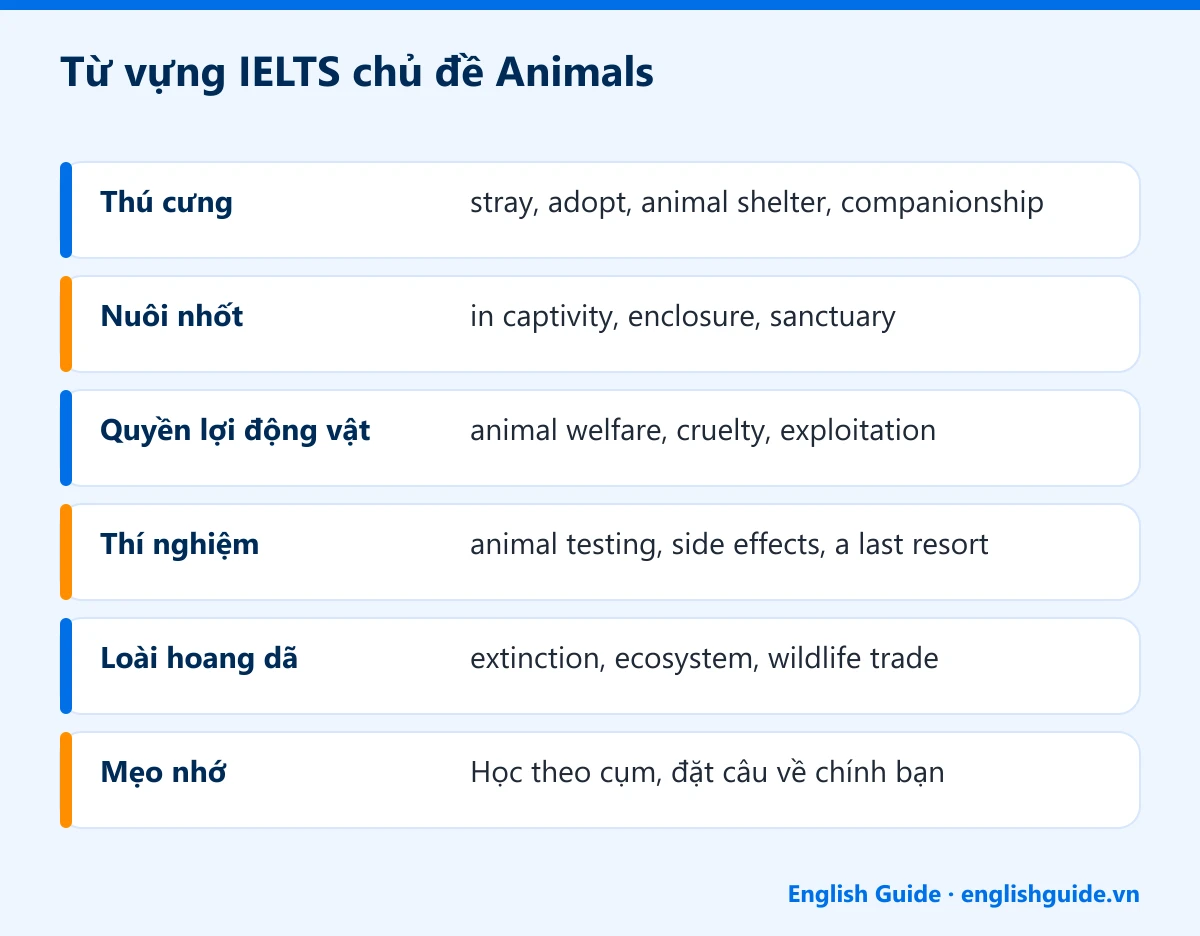
Chủ đề Animals xuất hiện ở đâu trong IELTS
Speaking Part 1 (4–5 phút, theo mô tả phần thi Speaking của IELTS): câu hỏi đời thường như bạn có nuôi thú cưng không, thích con vật nào, hồi nhỏ có hay đi sở thú không.
Speaking Part 2: mô tả một con vật bạn biết rõ hoặc một lần bạn thấy động vật ngoài tự nhiên; bạn có 1 phút chuẩn bị rồi nói khoảng 2 phút.
Speaking Part 3 (4–5 phút): bàn rộng hơn, ví dụ có nên đóng cửa vườn thú không, nuôi thú cưng có lợi gì cho trẻ em.
Writing Task 2: đề về vườn thú, thí nghiệm trên động vật, ăn thịt hay ăn chay, các loài đang biến mất.
Theo trang giải thích điểm của IELTS, vốn từ được chấm qua tiêu chí Lexical Resource, một trong bốn tiêu chí có trọng số ngang nhau ở Speaking và ở mỗi bài Writing. Bảng mô tả band Writing (cập nhật 5/2023) ghi band 7 cần có khả năng dùng một số từ ít phổ biến hoặc thành ngữ, và cho thấy ý thức về văn phong và collocation. Với chủ đề này, nắm được sắc thái (zoo khác sanctuary, welfare khác rights) có ích hơn thuộc tên thật nhiều con vật.
Từ vựng IELTS chủ đề Animals theo 6 nhóm
Ký hiệu từ loại trong bảng: (n) danh từ, (v) động từ, (adj) tính từ, (phr) cụm từ. Ví dụ được viết theo kiểu câu có thể dùng lại trong bài thi.
Nhóm 1: Thế giới động vật
Từ, cụm từ | Từ loại | Nghĩa | Ví dụ |
|---|---|---|---|
wildlife | n | động vật hoang dã (không đếm được) | The forests of the Central Highlands are home to a rich variety of wildlife. |
flora and fauna | phr | hệ thực vật và động vật | National parks exist to protect the local flora and fauna. |
mammal / reptile | n | động vật có vú / bò sát | Elephants are the largest land mammals, while crocodiles are reptiles. |
carnivore / herbivore | n | động vật ăn thịt / ăn cỏ | Elephants are herbivores that spend much of the day feeding. |
domesticated / undomesticated | adj | đã / chưa được thuần hóa | Undomesticated animals can behave unpredictably around people. |
lifespan (life span) | n | tuổi thọ | Elephants have a long lifespan compared with most other mammals. |
Nhóm 2: Thú cưng
Từ, cụm từ | Từ loại | Nghĩa | Ví dụ |
|---|---|---|---|
keep a pet | phr | nuôi thú cưng | Many apartment buildings do not allow residents to keep pets. |
companionship | n | sự bầu bạn | For elderly people living alone, a cat can provide real companionship. |
stray | adj / n | (chó, mèo) đi lạc, vô chủ | Stray dogs are a common sight in some neighbourhoods. |
animal shelter | n | trại cứu hộ động vật | We found our dog at an animal shelter on the edge of town. |
adopt | v | nhận nuôi | Some families prefer to adopt a pet rather than buy one from a breeder. |
nutrients | n | chất dinh dưỡng | Puppies need the right nutrients to develop strong bones. |
a varied, high-quality diet | phr | chế độ ăn đa dạng, chất lượng | A varied, high-quality diet keeps older pets healthy for longer. |
neglect / abandon | v | bỏ bê / bỏ rơi | Some puppies are abandoned once they stop being small and cute. |
Nhóm 3: Vườn thú và nuôi nhốt
Từ, cụm từ | Từ loại | Nghĩa | Ví dụ |
|---|---|---|---|
in captivity | phr | trong điều kiện nuôi nhốt | Some animals rarely breed in captivity. |
captive breeding | n | nhân giống trong điều kiện nuôi nhốt | Captive breeding has saved several species from disappearing. |
enclosure | n | khu nuôi có rào chắn | Many modern zoos are replacing small cages with spacious enclosures. |
keep in cages | phr | nhốt trong lồng, chuồng | Keeping large animals in cages for life is hard to defend. |
sanctuary | n | khu cứu hộ, nơi bảo vệ động vật | Rescued elephants can live far more freely in a sanctuary. |
release into the wild | phr | thả về tự nhiên | Not every rescued animal can survive after being released into the wild. |
the closure of zoos | phr | việc đóng cửa vườn thú | Campaigners have called for the closure of zoos with poor welfare standards. |
Nhóm 4: Quyền lợi động vật
Từ, cụm từ | Từ loại | Nghĩa | Ví dụ |
|---|---|---|---|
animal rights | n | quyền của động vật | Animal rights campaigners argue that animals should not be used for human benefit at all. |
animal welfare | n | phúc lợi, điều kiện sống của động vật | Stricter laws are needed to protect animal welfare on farms. |
animal cruelty | n | sự ngược đãi động vật | Animal cruelty should be treated as a serious offence. |
mistreat / abuse / torture | v | ngược đãi / hành hạ / tra tấn | Animals used in circuses are sometimes mistreated during training. |
exploit / exploitation | v / n | bóc lột, khai thác | The exploitation of animals for entertainment is increasingly criticised. |
immoral / unethical | adj | trái đạo đức | Many people find it immoral to kill animals for their fur. |
factory farming | n | chăn nuôi công nghiệp | Factory farming keeps food cheap, but the animals have little room to move. |
Nhóm 5: Thí nghiệm trên động vật
Từ, cụm từ | Từ loại | Nghĩa | Ví dụ |
|---|---|---|---|
animal testing | n | thử nghiệm trên động vật | Animal testing remains one of the most divisive issues in science. |
laboratory | n | phòng thí nghiệm | Mice are the animals most often seen in a medical laboratory. |
medical research | n | nghiên cứu y học | Much medical research still relies on studies involving animals. |
cure | v, n | chữa khỏi / cách chữa | Researchers hope these studies will help cure serious diseases. |
side effects | n | tác dụng phụ | New drugs must be checked for side effects before they are given to patients. |
human survival | phr | sự sống còn của con người | Supporters say that some of this research is vital to human survival. |
cosmetics | n | mỹ phẩm | Some countries have banned the testing of cosmetics on animals. |
alternative methods | phr | phương pháp thay thế | Computer models and lab-grown cells offer alternative methods. |
justify | v | biện minh | It is difficult to justify harming animals for the sake of beauty products. |
Nhóm 6: Bảo vệ động vật hoang dã
Các từ deforestation, habitat, poaching, endangered species, biodiversity và conservation đã có ví dụ ở bài từ vựng IELTS chủ đề Environment, bạn nên học kèm vì hai chủ đề này hay đi cặp với nhau. Bảng dưới đây chỉ thêm những từ bài đó chưa có.
Từ, cụm từ | Từ loại | Nghĩa | Ví dụ |
|---|---|---|---|
extinct / extinction | adj / n | tuyệt chủng / sự tuyệt chủng | Without protection, more species could become extinct. |
on the brink of extinction | phr | bên bờ tuyệt chủng | Several large mammals are now on the brink of extinction. |
illegal wildlife trade | n | buôn bán động vật hoang dã trái phép | The illegal wildlife trade is a major threat to rhinos and pangolins. |
ecosystem | n | hệ sinh thái | Removing a single predator can upset the balance of an entire ecosystem. |
human-wildlife conflict | n | xung đột giữa người và động vật hoang dã | Human-wildlife conflict tends to grow as farms expand into forests. |
Phát âm các từ chủ đề Animals dễ đọc sai
Phiên âm theo giọng Anh. Pronunciation là một tiêu chí riêng của Speaking, nên đừng bỏ qua trọng âm.
Từ | Phiên âm | Lưu ý |
|---|---|---|
captivity | /kæpˈtɪvəti/ | trọng âm ở âm tiết thứ hai |
carnivore | /ˈkɑːnɪvɔː/ | trọng âm ở âm tiết đầu |
herbivore | /ˈhɜːbɪvɔː/ | giọng Anh đọc rõ âm h |
cruelty | /ˈkruːəlti/ | hai âm tiết đầu đọc nhanh, gần như liền nhau |
extinction | /ɪkˈstɪŋkʃən/ | có âm /k/ trước đuôi -tion |
sanctuary | /ˈsæŋktʃuəri/ | trọng âm ở âm tiết đầu |
fauna | /ˈfɔːnə/ | au đọc là /ɔː/, không đọc /au/ |
Collocation chủ đề Animals nên dùng
Collocation là những từ thường đi với nhau. Dùng đúng cặp từ giúp câu tự nhiên hơn so với dịch từng chữ từ tiếng Việt.
Collocation | Nghĩa | Ví dụ |
|---|---|---|
treat animals humanely | đối xử nhân đạo với động vật | Farms should be required to treat animals humanely. |
raise concerns about | làm dấy lên lo ngại về | Cramped cages raise concerns about animal welfare. |
recreate a natural environment | tái tạo môi trường tự nhiên | Good zoos try to recreate a natural environment for each species. |
educate the public about | giáo dục công chúng về | Zoos can educate the public about rare animals. |
strict regulations on | quy định nghiêm ngặt về | There should be strict regulations on the sale of exotic pets. |
subject animals to | bắt động vật chịu (đau đớn, thử nghiệm) | Some experiments subject animals to severe pain. |
a medical breakthrough | bước đột phá y học | Some medical breakthroughs depended on research using animals. |
a last resort | biện pháp cuối cùng | Animal testing should be a last resort. |
Một số lỗi người Việt hay mắc:
animals rights → animal rights (animal đứng trước danh từ, không thêm s).
a wildlife, wildlifes → wildlife (không đếm được). Muốn nói từng con, dùng wild animals.
The animals have feelings (khi nói chung) → Animals have feelings (không dùng the).
test animals (thử xem con vật thế nào) khác test products on animals (thử sản phẩm trên động vật).
Thành ngữ có con vật: dùng khi nói, hạn chế khi viết
Những thành ngữ dưới đây mang tính thân mật, hợp với Speaking khi đúng ngữ cảnh. Chúng thường không nói về động vật, nên đừng cố chèn vào câu trả lời về thú cưng. Bảng mô tả band Writing xếp việc dùng không phù hợp các cụm học thuộc vào band 4; muốn có thêm cụm dùng được, xem bài idioms cho IELTS Speaking.
Thành ngữ | Nghĩa | Ví dụ (Speaking) |
|---|---|---|
the elephant in the room | vấn đề ai cũng biết nhưng tránh nói tới | Money was the elephant in the room at our family meeting. |
let the cat out of the bag | lỡ làm lộ bí mật | My brother let the cat out of the bag about the surprise party. |
hold your horses | khoan đã, đừng vội | Hold your horses, I haven't decided which course to take yet. |
take the bull by the horns | mạnh dạn đối mặt với việc khó | I finally took the bull by the horns and booked my IELTS test. |
Câu It's raining cats and dogs nay nghe khá lỗi thời; nói it's pouring sẽ tự nhiên hơn.
Đề Writing Task 2 chủ đề Animals hay gặp
Các đề dưới đây do EG tự diễn đạt để luyện tập, bám theo những hướng ra đề phổ biến về động vật:
Dạng đề | Đề luyện tập |
|---|---|
Agree/disagree | Keeping animals in zoos is cruel, and all zoos should be closed. To what extent do you agree or disagree? |
Discussion | Some people think animal testing is necessary for medical progress, while others believe it should be banned. Discuss both views and give your opinion. |
Advantages/disadvantages | More and more families are keeping pets in city apartments. Do the advantages of this outweigh the disadvantages? |
Two-part question | Some people avoid eating meat for ethical reasons. Why do they make this choice? Is this a positive development? |
Đoạn mẫu Writing Task 2 dùng từ vựng Animals
Đề: đề Discussion về thí nghiệm trên động vật ở bảng trên. Đoạn thân bài dưới đây nêu lý lẽ của phe ủng hộ rồi đưa ra ý kiến của người viết; từ vựng của bài được in đậm.
Those who defend animal testing point out that many medical breakthroughs would have been impossible without it. New medicines must be checked for dangerous side effects before they reach patients, and studying living organisms in a laboratory remains one way of doing so safely. However, this argument does not justify every experiment. Testing cosmetics on animals, for instance, subjects them to pain merely for the sake of beauty products, which many people would consider immoral. Moreover, in an era of advanced technology, computer models and lab-grown cells offer increasingly reliable alternative methods. In my view, therefore, governments should introduce strict regulations on animal research and treat it as a last resort, allowing it only when no other way of protecting human health exists.
Đoạn văn trình bày lý lẽ của một phía, dùng However để giới hạn lý lẽ đó, đưa ví dụ cụ thể (mỹ phẩm), rồi kết bằng quan điểm cá nhân. Từ vựng không cần hiếm; điều quan trọng là dùng đúng cụm (subject animals to, a last resort) và đúng văn phong.
Câu trả lời Speaking mẫu chủ đề Animals
Part 1
Do you have a pet?
Not at the moment, although we had a dog when I was growing up. He was a stray that my father found near our coffee farm, and he quickly became part of the family. I'd love to have another one, but I live in a small rented room now, and it wouldn't be fair to keep a pet in such a tiny space.
Part 3
Should zoos be closed?
Not entirely, I don't think. Good zoos can educate the public, and captive breeding has helped some species survive. But keeping large animals in captivity just to entertain visitors is hard to justify. My province offers an interesting example: Yok Don National Park stopped offering elephant rides back in 2018, and the idea now is for tourists to watch the animals in a more natural setting. I think that's the direction we should be moving in, towards sanctuaries rather than small enclosures.
Do children benefit from having a pet?
Absolutely. Looking after a pet teaches kids responsibility, since an animal has to be fed whether they feel like it or not. It also helps them develop empathy. The only risk is that some parents buy a puppy on impulse, and when the novelty wears off, the animal ends up neglected or even abandoned. So I'd say a family should only get a pet if the adults are ready to take charge as well.
Để ý cách mỗi câu trả lời Part 3 nêu quan điểm, đưa lý do hoặc ví dụ rồi cân nhắc mặt còn lại. Cách triển khai chi tiết có ở bài IELTS Speaking Part 3.
Bài tập từ vựng Animals có đáp án
Bài 1: Điền từ vào đoạn văn
Từ gợi ý (thừa một từ): breeding, captivity, educate, enclosures, justify, released, stray, welfare
Supporters of zoos argue that these places (1) ___ the public about rare animals, especially children who might never see them otherwise. They also run captive (2) ___ programmes that can stop a species from disappearing. Critics, however, believe that life in (3) ___ is stressful, because even spacious (4) ___ cannot replace a forest or a savannah. They also doubt that entertainment can ever (5) ___ taking an animal from its home. A fair compromise may be to set strict (6) ___ standards and to ensure that, where possible, animals are (7) ___ into the wild.
Bài 2: Chọn từ, cụm từ gần nghĩa nhất với phần in đậm
The new law aims to stop people from mistreating farm animals. (A. abusing · B. feeding · C. selling)
Many people find killing animals for fur immoral. (A. expensive · B. unethical · C. illegal)
This bird is on the brink of extinction. (A. increasing slowly · B. about to die out · C. moving north)
Scientists hope this drug will cure the disease. (A. successfully treat · B. spread · C. study)
Đáp án
Bài 1: 1. educate · 2. breeding · 3. captivity · 4. enclosures · 5. justify · 6. welfare · 7. released (từ thừa: stray)
Bài 2: 1-A · 2-B · 3-B · 4-A
Học và dùng từ vựng Animals sao cho nhớ lâu
Đừng học chủ đề này một cách tách biệt. Từ về thí nghiệm dùng lại được ở chủ đề Health, từ về chăn nuôi dùng được ở chủ đề Food, từ về loài hoang dã đi với chủ đề Environment. Mỗi ngày học một nhóm 6–8 từ, đặt một câu về chính cuộc sống của bạn (con vật nhà bạn nuôi, lần đi Vườn quốc gia Yok Đôn nếu có), rồi dùng lại trong một câu trả lời Speaking có ghi âm. Phương pháp ôn lặp lại có ở bài cách học từ vựng IELTS.
Nếu muốn có giáo viên chữa lỗi dùng từ trong bài viết và bài nói, khóa IELTS Master 5.0–5.5 của EG có 80 giờ học, lớp 8–15 học viên, chấm Writing và Speaking chi tiết. Học tại Cơ sở Buôn Ma Thuột học phí 9.900.000đ (khoảng 124.000đ/giờ); học online cùng giáo viên 7.140.000đ (khoảng 89.000đ/giờ). Học viên ôn từ vựng giữa các buổi trên nền tảng EG LMS. Chưa rõ trình độ, bạn có thể bắt đầu bằng bài kiểm tra trình độ miễn phí.
Câu hỏi thường gặp
Animal rights và animal welfare khác nhau thế nào?
Animal welfare nói về điều kiện sống của động vật: con người vẫn có thể nuôi và sử dụng chúng, miễn là chăm sóc tử tế. Animal rights đi xa hơn: động vật có quyền không bị con người sử dụng. Dùng đúng hai từ này giúp lập luận của bạn chính xác hơn.
Zoo và sanctuary khác nhau ra sao?
Zoo là nơi nuôi động vật để công chúng đến tham quan. Sanctuary là nơi cứu hộ và chăm sóc động vật, ưu tiên cuộc sống của chúng hơn là việc trưng bày, nên khách thường bị hạn chế tiếp xúc.
Không thích động vật thì trả lời Speaking thế nào?
Cứ nói thật và giải thích lý do, ví dụ bạn dị ứng lông mèo hoặc từng sợ chó. Giám khảo chấm 4 tiêu chí ngôn ngữ, không chấm việc bạn có yêu động vật hay không.