Kiến thức
Từ vựng IELTS chủ đề Science: 5 nhóm từ, collocation, đoạn mẫu Writing, Speaking và bài tập
16 phút đọc
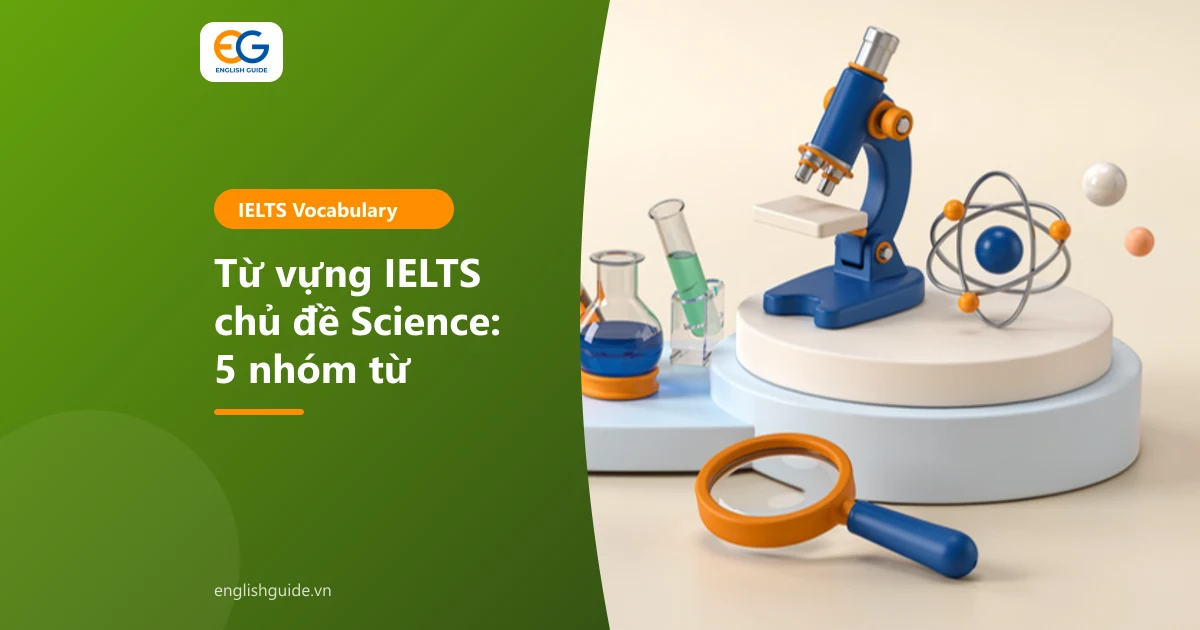
Từ vựng IELTS chủ đề Science là nhóm từ và cụm từ để nói, viết về nghiên cứu khoa học, phát minh, khám phá vũ trụ, chuyện học và làm nghề khoa học, cùng những tranh luận đạo đức quanh khoa học. Bạn không cần giỏi các môn tự nhiên: đề IELTS hỏi khoa học có vai trò gì với đời sống, không hỏi kiến thức chuyên ngành. Bài này chia hơn 40 từ, cụm từ thành 5 nhóm, mỗi mục có từ loại, nghĩa và ví dụ đặt trong ngữ cảnh bài thi.
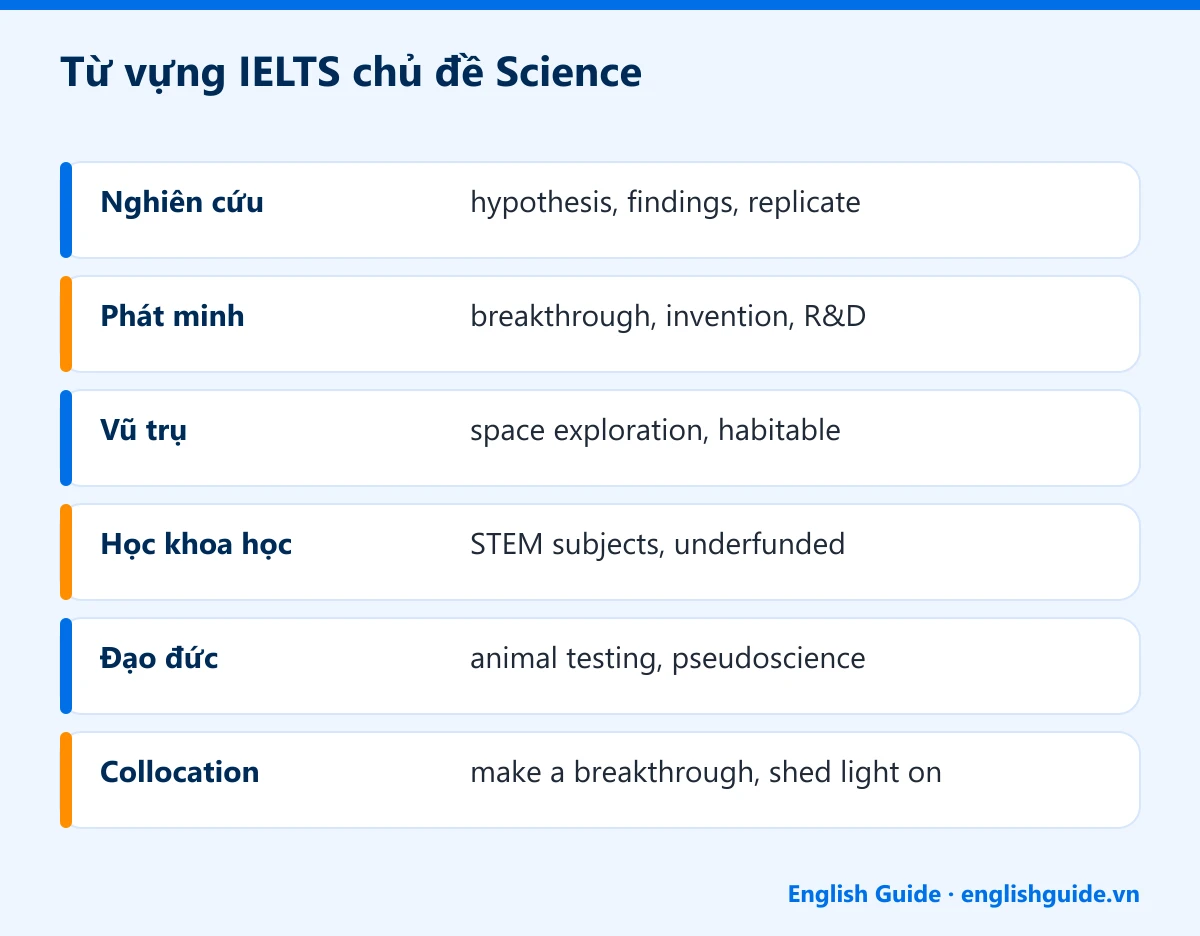
Phần sau có collocation, đề Writing Task 2 hay gặp, đoạn mẫu, câu trả lời Speaking và bài tập có đáp án. Từ vựng về thiết bị, internet và AI đã có ở bài từ vựng IELTS chủ đề Technology; về y tế, bệnh tật ở chủ đề Health; về ô nhiễm, khí hậu ở chủ đề Environment. Bài này không lặp lại các nhóm đó mà tập trung vào chính hoạt động làm khoa học.
Chủ đề Science xuất hiện ở đâu trong IELTS
Speaking Part 1 (4–5 phút, theo trang mô tả phần thi Speaking của IELTS): câu hỏi về trải nghiệm quen thuộc, ví dụ hồi đi học bạn có thích môn khoa học không, có hay xem chương trình khoa học không.
Speaking Part 2: bạn có 1 phút chuẩn bị rồi nói khoảng 2 phút. Đề có thể yêu cầu tả một môn khoa học từng học, một phát minh hữu ích, một điều thú vị bạn biết về thiên nhiên hay vũ trụ.
Speaking Part 3 (4–5 phút): câu hỏi trừu tượng hơn, như vì sao ít người trẻ theo nghề nghiên cứu, có nên chi tiền cho khám phá vũ trụ, vì sao nhiều người tin tin đồn khoa học.
Writing Task 2: đề về kinh phí nghiên cứu, thử nghiệm trên động vật, khám phá vũ trụ, cách dạy khoa học ở trường.
Reading Academic: theo trang mô tả phần thi Reading, bài đọc lấy từ sách, tạp chí chuyên ngành, báo và tài liệu trên mạng, viết cho người đọc không chuyên. Gặp bài về một phát hiện hay một nghiên cứu, bạn nắm sẵn nhóm từ như hypothesis, findings, evidence sẽ đọc nhanh hơn.
Ở Writing và Speaking, vốn từ được chấm qua tiêu chí Lexical Resource, một trong bốn tiêu chí có trọng số ngang nhau. Bảng mô tả band Writing (bản cập nhật 05/2023) ghi ở band 7 của Task 2: "There is some ability to use less common and/or idiomatic items. An awareness of style and collocation is evident, though inappropriacies occur." Nói gọn: band 7 cần một số từ ít phổ biến và biết từ nào đi với từ nào. Với chủ đề Science, điều này nghĩa là viết carry out research thay vì "make a research", make a breakthrough thay vì "create a breakthrough".
Từ vựng IELTS chủ đề Science theo 5 nhóm
Ký hiệu từ loại: (n) danh từ, (v) động từ, (adj) tính từ, (phr) cụm từ. Ví dụ được viết theo kiểu câu dùng lại được trong bài thi.
Nhóm 1: Nghiên cứu và phương pháp khoa học
Từ, cụm từ | Từ loại | Nghĩa | Ví dụ |
|---|---|---|---|
hypothesis (số nhiều: hypotheses) | n | giả thuyết | The researchers tested the hypothesis that coffee plants grow better in partial shade. |
conduct an experiment | phr | tiến hành thí nghiệm | The class conducted a simple experiment to see how quickly ice melts in salty water. |
laboratory (lab) | n | phòng thí nghiệm | Many rural schools still lack a properly equipped laboratory. |
findings | n | kết quả nghiên cứu (thường ở số nhiều) | The findings suggest that short daily practice works better than one long weekly session. |
evidence | n (không đếm được) | bằng chứng | There is little evidence that this supplement improves memory. |
empirical | adj | dựa trên quan sát, thực nghiệm | Good policies should be based on empirical data rather than personal beliefs. |
peer-reviewed | adj | đã qua bình duyệt của giới chuyên môn | Journalists should rely on peer-reviewed studies, not on a single press release. |
replicate | v | lặp lại (thí nghiệm) và cho cùng kết quả | A result is far more convincing when other teams can replicate it. |
trial and error | phr | thử và sai | Early aircraft designers learned largely through trial and error. |
Nhóm 2: Khám phá, phát minh và ứng dụng
Từ, cụm từ | Từ loại | Nghĩa | Ví dụ |
|---|---|---|---|
discovery / discover | n / v | sự khám phá / khám phá (cái vốn đã tồn tại) | The discovery of penicillin changed the treatment of infections. |
invention / invent | n / v | phát minh / phát minh ra (cái mới tạo ra) | The invention of the printing press made books affordable for ordinary people. |
scientific breakthrough | n | đột phá khoa học | A scientific breakthrough often comes after years of failed attempts. |
groundbreaking / pioneering | adj | mang tính đột phá / tiên phong | Her pioneering work on plant genetics helped farmers grow hardier crops. |
research and development (R&D) | n | nghiên cứu và phát triển | Firms that invest in R&D are better placed to compete in global markets. |
patent | n / v | bằng sáng chế / đăng ký sáng chế | The company patented its new water filter before selling it abroad. |
practical application | n | ứng dụng thực tế | Some research has no obvious practical application when it is first published. |
basic (fundamental) research | n | nghiên cứu cơ bản | Basic research may look useless today but can lead to major inventions decades later. |
commercialise | v | thương mại hóa | Universities are encouraged to commercialise their research through small start-ups. |
Nhóm 3: Vũ trụ và khám phá không gian
Từ, cụm từ | Từ loại | Nghĩa | Ví dụ |
|---|---|---|---|
space exploration | n | khám phá vũ trụ | Supporters of space exploration argue that it inspires young people to study science. |
satellite | n | vệ tinh | Weather satellites provide data that helps forecasters predict storms. |
astronaut | n | phi hành gia | Astronauts train for years before their first mission. |
launch | v / n | phóng / vụ phóng (tàu, vệ tinh) | Launching a single rocket costs an enormous amount of money. |
the solar system | n | hệ Mặt Trời | Scientists are still learning about the moons in our solar system. |
extraterrestrial life | n | sự sống ngoài Trái Đất | So far, no convincing evidence of extraterrestrial life has been found. |
habitable | adj | có thể sinh sống được | Astronomers search for distant planets that might be habitable. |
colonise | v | lập khu định cư (ở hành tinh khác) | Some believe humans will colonise Mars one day, but the challenges are huge. |
Nhóm 4: Học khoa học và nghề nghiên cứu
Từ, cụm từ | Từ loại | Nghĩa | Ví dụ |
|---|---|---|---|
STEM subjects | n | các môn khoa học, công nghệ, kỹ thuật, toán | Girls should be encouraged to take STEM subjects from an early age. |
researcher / research scientist | n | nhà nghiên cứu | Young researchers often work on short contracts with modest pay. |
research funding / research grant | n | kinh phí / khoản tài trợ nghiên cứu | Without stable research funding, long-term projects are often abandoned. |
underfunded | adj | thiếu kinh phí | Many university laboratories are underfunded and rely on outdated equipment. |
career prospects | n | triển vọng nghề nghiệp | Students may avoid science degrees if they believe the career prospects are poor. |
scientific literacy | n | hiểu biết khoa học cơ bản | Scientific literacy helps citizens judge the claims they see online. |
curiosity / curious | n / adj | sự tò mò / tò mò | Good teachers turn children's curiosity into questions they can test. |
theoretical | adj | nặng lý thuyết | Many students lose interest because science lessons are too theoretical. |
Nhóm 5: Khoa học, xã hội và đạo đức
Từ, cụm từ | Từ loại | Nghĩa | Ví dụ |
|---|---|---|---|
ethical / ethics | adj / n | thuộc đạo đức / đạo đức (nghề nghiệp) | Experiments on human embryos raise serious ethical questions. |
animal testing | n | thử nghiệm trên động vật | Animal testing for cosmetics has been banned in a number of countries. |
genetic engineering / genetically modified (GM) | n / adj | kỹ thuật di truyền / biến đổi gen | GM crops can resist certain pests, but some consumers remain cautious. |
cloning | n | nhân bản vô tính | The cloning of animals is still highly controversial. |
pseudoscience | n | ngụy khoa học | Pseudoscience often uses scientific-sounding words to sell useless products. |
conspiracy theory | n | thuyết âm mưu | Conspiracy theories spread faster when people distrust experts. |
sceptical (of / about) | adj | hoài nghi | It is healthy to be sceptical of claims that are not backed by evidence. |
misconception | n | quan niệm sai | A common misconception is that a scientific theory is just a guess. |
public trust in science | phr | lòng tin của công chúng vào khoa học | Clear, honest communication is key to maintaining public trust in science. |
Collocation chủ đề Science nên dùng
Collocation là những từ thường đi cùng nhau. Chủ đề Science có nhiều cặp động từ và danh từ cố định; dịch từng chữ từ tiếng Việt rất dễ sai.
Collocation | Nghĩa | Ví dụ |
|---|---|---|
carry out / conduct research (into) | tiến hành nghiên cứu (về) | Several universities are carrying out research into how bees find their way home. |
make a breakthrough | tạo ra bước đột phá | The team finally made a breakthrough after ten years of work. |
shed light on | làm sáng tỏ | The study sheds light on why some people learn languages faster than others. |
push the boundaries of knowledge | mở rộng giới hạn hiểu biết | Space missions push the boundaries of human knowledge. |
advance our understanding of | nâng cao hiểu biết về | Modern telescopes have greatly advanced our understanding of the universe. |
draw a conclusion | rút ra kết luận | It is too early to draw a conclusion from such a small sample. |
put a theory to the test | kiểm chứng một lý thuyết | Experiments allow scientists to put a theory to the test. |
back up a claim with evidence | dùng bằng chứng để chứng minh một nhận định | Any argument in an essay is stronger if you back up your claim with evidence. |
reap the benefits of | hưởng thành quả của | Ordinary people often reap the benefits of research decades later. |
be at the forefront of | đi đầu trong | A country can only stay at the forefront of innovation if it trains enough scientists. |
a giant leap forward | một bước tiến lớn | The first moon landing was a giant leap forward for space exploration. |
Lưu ý văn phong: a giant leap forward nghe tự nhiên khi nói. Trong Writing Task 2, các cụm trung tính như carry out research, shed light on, advance our understanding of an toàn hơn. Tránh "do an experience" (experience là trải nghiệm) và "a research" (research thường không đếm được).
Đề Writing Task 2 chủ đề Science hay gặp
Các đề dưới đây do EG tự diễn đạt để luyện tập, bám theo những hướng ra đề phổ biến về khoa học:
Dạng đề | Đề luyện tập |
|---|---|
Agree/disagree | Some people think that spending large sums of money on space exploration is a waste when there are urgent problems on Earth. To what extent do you agree or disagree? |
Advantages/disadvantages | Scientific research is increasingly paid for by private companies rather than by governments. Do the advantages of this outweigh the disadvantages? |
Discussion | Some people believe that testing medicines on animals is necessary for scientific progress, while others think it is cruel and should be banned. Discuss both views and give your opinion. |
Problem/solution | In many countries, fewer students are choosing to study science at university. What are the causes of this, and what can be done to solve the problem? |
Two-part question | Many people today do not trust what scientists say. Why is this happening? What can be done to change it? |
Đoạn mẫu Writing Task 2 dùng từ vựng Science
Đề: đề agree/disagree về khám phá vũ trụ ở bảng trên. Đoạn thân bài dưới đây đi theo hướng không đồng ý; từ vựng của bài được in đậm.
Admittedly, launching a single rocket can cost as much as building many new schools, and that money could clearly help people in need today. However, I would argue that space exploration is a long-term investment rather than a luxury. Weather satellites, for instance, give farmers early warning of storms, while research carried out for space missions has found practical applications in materials, medicine and communications. More importantly, such projects push the boundaries of human knowledge and inspire young people to take up STEM subjects, which every economy needs. Rather than abandoning space research altogether, governments should give it a reasonable share of research funding while making sure that urgent problems on Earth are not neglected.
Đoạn văn mở bằng câu nhượng bộ (Admittedly…), chuyển hướng bằng However, rồi đưa hai lý do có ví dụ cụ thể. Từ vựng không cần hiếm; điểm cộng nằm ở việc dùng đúng cụm (push the boundaries of, practical applications) và đúng chỗ.
Câu trả lời Speaking mẫu chủ đề Science
Part 1
Did you enjoy science subjects at school?
Some of them, yes. I was hopeless at physics because it felt far too theoretical, but I loved biology. Our teacher once took us to a coffee farm on the edge of town to compare the soil in different fields, and that trip made me realise science isn't only about formulas. It's about being curious and asking the right questions.
Do you watch science programmes or read science news?
Now and then. I sometimes watch short documentaries about the solar system before bed, which I find oddly relaxing. I'm a bit sceptical of science news on social media, though, because the headlines often exaggerate the findings.
Part 3
Why do some people believe false scientific claims?
I think it's partly because real science is slow and full of uncertainty, while pseudoscience offers simple, confident answers. If an advert says a drink can cure almost anything, that sounds far more attractive than "the evidence is mixed". Also, many people never learned how to judge a source. So I'd say scientific literacy should start at school, for example by asking students to check where a claim comes from before they share it.
Should research be paid for by governments or by private companies?
Ideally both, but for different kinds of research. Companies are good at turning ideas into products, because they need a profit. Basic research, though, like studying distant planets, may have no commercial value for decades, so it's unlikely to attract private money. That's where public funding is essential; otherwise we'd only study things that can be sold quickly.
Để ý cách mỗi câu trả lời Part 3 nêu quan điểm, giải thích lý do rồi đưa ví dụ hoặc giải pháp. Cách triển khai chi tiết có ở bài IELTS Speaking Part 3.
Bài tập từ vựng Science có đáp án
Bài 1: Điền từ thích hợp
Từ gợi ý: hypothesis, replicate, underfunded, sceptical, breakthrough, habitable
Before the experiment began, each group wrote down its ___ about which seeds would grow fastest.
The result was not accepted until two other laboratories managed to ___ it.
Because the department is badly ___, five researchers have to share one old microscope.
You should be ___ of any product that claims to be "proven by science" without showing any studies.
After years of failure, the team finally made a ___ that changed the whole field.
Astronomers are looking for planets that might be ___ for humans.
Bài 2: Chọn từ đúng
The (discovery / invention) of the telephone changed the way people communicate.
Marie Curie is famous for the (discovery / invention) of radium.
There is no (science / scientific) evidence that this method works.
He did an (experience / experiment) to test how light affects plant growth.
My cousin wants to become a (science / scientist) when she grows up.
These ideas are interesting but still largely (theory / theoretical).
Bài 3: Nối động từ với cụm phù hợp
Động từ | Cụm |
|---|---|
1. conduct | a. light on the problem |
2. make | b. a breakthrough |
3. draw | c. an experiment |
4. shed | d. a claim with evidence |
5. back up | e. a conclusion |
Đáp án
Bài 1: 1. hypothesis · 2. replicate · 3. underfunded · 4. sceptical · 5. breakthrough · 6. habitable
Bài 2: 1. invention (điện thoại là thứ con người tạo ra) · 2. discovery (radium vốn có trong tự nhiên) · 3. scientific · 4. experiment · 5. scientist · 6. theoretical
Bài 3: 1-c · 2-b · 3-e · 4-a · 5-d
Học và dùng từ vựng Science sao cho nhớ lâu
Thay vì học theo bảng chữ cái, hãy gom từ theo từng cuộc tranh luận hay gặp: có nên chi tiền cho vũ trụ, nhà nước hay doanh nghiệp nên trả tiền nghiên cứu, vì sao người trẻ ngại theo ngành khoa học, giới hạn đạo đức của thí nghiệm. Mỗi cuộc tranh luận chuẩn bị 5–6 từ, cụm từ và một ví dụ gần gũi, như vệ tinh thời tiết giúp nhà nông ở Tây Nguyên biết trước mưa bão. Khi gặp đề, bạn có sẵn cả ý lẫn từ. Cách ôn lặp lại để nhớ lâu có ở bài cách học từ vựng IELTS; nếu muốn mở rộng sang chủ đề gần, xem thêm từ vựng IELTS chủ đề Art, chủ đề hay được đặt cạnh khoa học trong đề Part 3.
Nếu muốn có giáo viên chữa lỗi dùng từ trong bài viết và bài nói, khóa IELTS Master 5.0–5.5 của EG có 80 giờ học, lớp 8–15 học viên, chấm Writing và Speaking chi tiết. Học tại Cơ sở Buôn Ma Thuột học phí 9.900.000đ (khoảng 124.000đ/giờ); học online cùng giáo viên 7.140.000đ (khoảng 89.000đ/giờ). Giữa các buổi, học viên ôn từ vựng trên nền tảng EG LMS. Chưa rõ trình độ, bạn có thể bắt đầu bằng bài kiểm tra trình độ miễn phí.
Câu hỏi thường gặp
Science, scientific và scientist khác nhau thế nào?
Science (n) là khoa học, scientific (adj) là thuộc về khoa học, scientist (n) là nhà khoa học. Viết scientific evidence, scientific research; không viết "science evidence". Science vẫn đứng trước danh từ khác được trong vài cụm quen dùng như science teacher, science fiction.
Discovery và invention khác nhau ra sao?
Discover là tìm ra thứ vốn đã tồn tại (một nguyên tố, một hành tinh, một quy luật). Invent là tạo ra thứ trước đó chưa có (máy in, điện thoại). Nhầm hai từ này là lỗi dùng từ hay gặp trong bài Speaking.
Research có đếm được không?
Trong bài thi, nên coi research là danh từ không đếm được: do research, carry out research, a lot of research. Muốn nói một công trình cụ thể, dùng a study, a research project hoặc a piece of research.
Có cần kiến thức khoa học chuyên sâu để làm đề Science không?
Không. Bài thi chấm theo bốn tiêu chí về ngôn ngữ và cách trả lời đề, không có tiêu chí kiến thức chuyên môn. Một ví dụ đời thường, giải thích rõ ràng, có giá trị hơn số liệu bạn không chắc chắn.