Kiến thức
Từ vựng IELTS chủ đề Technology: 5 nhóm từ, collocation, đoạn mẫu Writing và Speaking
14 phút đọc
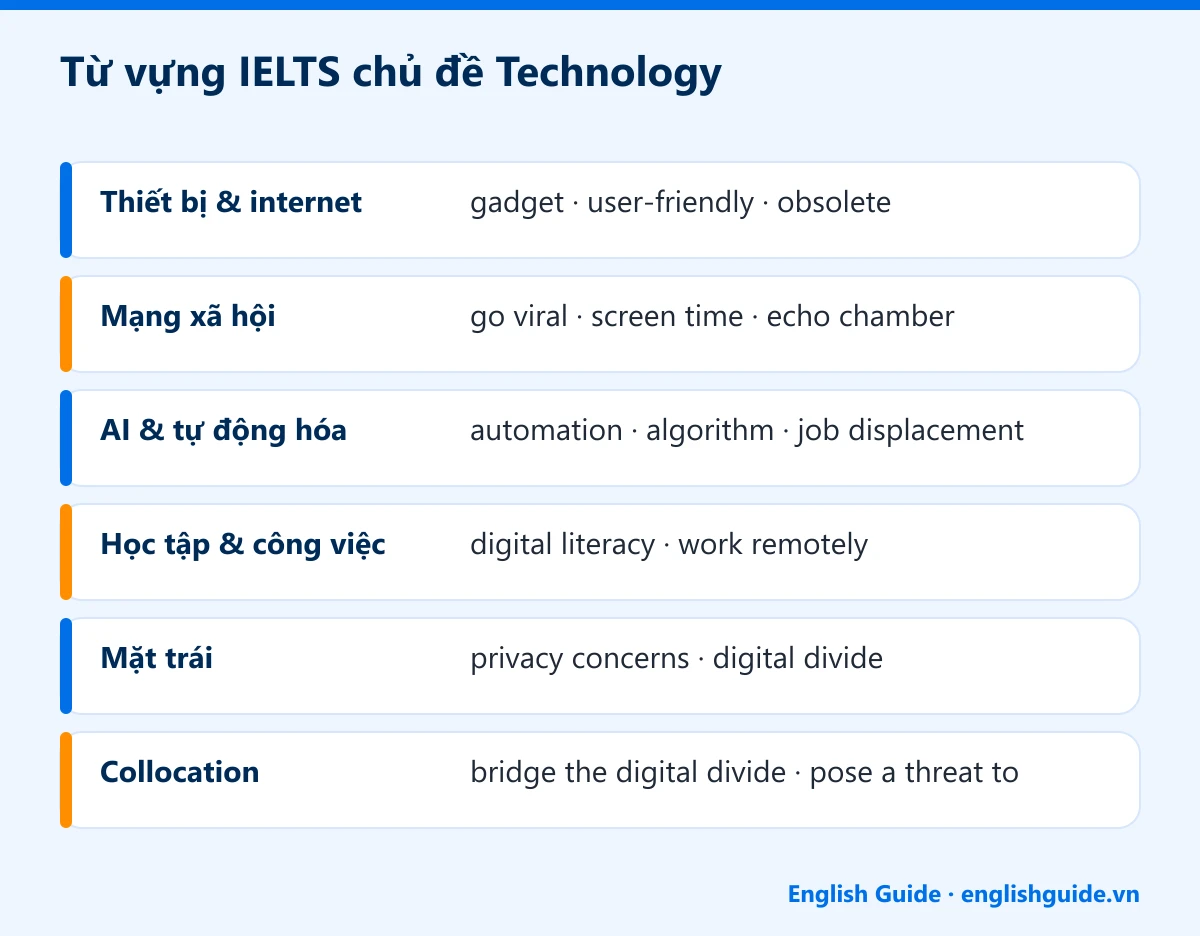
Từ vựng IELTS chủ đề Technology xoay quanh 5 nhóm ý: thiết bị và internet, mạng xã hội, trí tuệ nhân tạo và tự động hóa, công nghệ trong học tập và công việc, và mặt trái của công nghệ. Đây là chủ đề hay gặp ở Speaking (từ câu hỏi về điện thoại ở Part 1 đến thảo luận về AI ở Part 3) và ở Writing Task 2. Bài này gom những từ, cụm từ dùng được ngay, mỗi mục có từ loại, nghĩa và ví dụ đặt trong ngữ cảnh bài thi.
Cuối bài có collocation, đề Task 2 hay gặp, đoạn mẫu Writing, câu trả lời Speaking và bài tập có đáp án.
Chủ đề Technology xuất hiện ở đâu trong IELTS
Speaking Part 1 (4–5 phút, theo mô tả phần thi Speaking của IELTS): câu hỏi về thói quen hằng ngày như dùng điện thoại, ứng dụng yêu thích, đọc tin tức trên mạng.
Speaking Part 2: mô tả một thiết bị, một website hay một ứng dụng hữu ích; bạn có 1 phút chuẩn bị rồi nói trong khoảng 2 phút.
Speaking Part 3 (4–5 phút): bàn sâu hơn, ví dụ công nghệ thay đổi cách giao tiếp thế nào, AI ảnh hưởng tới việc làm ra sao.
Writing Task 2: đề về mạng xã hội, học online, robot thay người lao động, quyền riêng tư.
Theo trang giải thích điểm của IELTS, vốn từ được chấm qua tiêu chí Lexical Resource, một trong bốn tiêu chí có trọng số ngang nhau ở Speaking và ở mỗi bài Writing. Bảng mô tả band Writing ghi band 7 cần dùng được một số từ ít phổ biến và cho thấy ý thức về văn phong và collocation. Vì vậy, học cả cụm từ đi liền nhau có ích hơn học từng từ rời.
Từ vựng IELTS chủ đề Technology theo 5 nhóm
Ký hiệu từ loại trong bảng: (n) danh từ, (v) động từ, (adj) tính từ, (phr) cụm từ. Các ví dụ được viết theo kiểu câu có thể dùng lại trong bài thi.
Nhóm 1: Thiết bị và internet
Từ, cụm từ | Từ loại | Nghĩa | Ví dụ |
|---|---|---|---|
gadget | n | thiết bị, đồ công nghệ nhỏ | My father loves buying new kitchen gadgets but rarely reads the manuals. |
cutting-edge | adj | tiên tiến nhất | The hospital has invested in cutting-edge scanning equipment. |
user-friendly | adj | dễ sử dụng | The banking app is so user-friendly that my grandmother pays her bills with it. |
high-speed internet access | phr | truy cập internet tốc độ cao | Many rural schools still lack high-speed internet access. |
obsolete | adj | lỗi thời, không còn dùng được | Phones become obsolete within a few years once software updates stop. |
browse | v | lướt, duyệt (web) | I usually browse news sites on my phone over breakfast. |
stay connected (with) | phr | giữ liên lạc | Video calls help me stay connected with relatives who live abroad. |
Nhóm 2: Mạng xã hội
Từ, cụm từ | Từ loại | Nghĩa | Ví dụ |
|---|---|---|---|
social media platform | phr | nền tảng mạng xã hội | Many small businesses now sell directly through social media platforms. |
go viral | phr | lan truyền rất nhanh | A funny clip can go viral overnight and reach millions of viewers. |
online presence | n | sự hiện diện trên mạng | A strong online presence helps local shops attract younger customers. |
influencer | n | người có sức ảnh hưởng trên mạng | Some influencers promote products they have never actually used. |
scroll through | v | lướt (bảng tin) | I sometimes scroll through my feed for an hour without noticing. |
screen time | n | thời gian dùng màn hình | Parents should set clear limits on their children's screen time. |
echo chamber | n | "buồng vang": chỉ gặp ý kiến giống mình | Algorithms can trap users in an echo chamber of opinions they already share. |
Nhóm 3: AI và tự động hóa
Từ, cụm từ | Từ loại | Nghĩa | Ví dụ |
|---|---|---|---|
artificial intelligence (AI) | n | trí tuệ nhân tạo | Artificial intelligence is already used to detect diseases in medical scans. |
automation | n | sự tự động hóa | Automation has reduced the need for manual labour in many factories. |
automate | v | tự động hóa | Banks have automated routine tasks such as checking documents. |
algorithm | n | thuật toán | Streaming services rely on algorithms to recommend films. |
displace workers | phr | khiến người lao động mất chỗ làm | Self-service checkouts may displace some cashiers. |
job displacement | n | tình trạng mất việc do bị thay thế | Governments should prepare for job displacement caused by AI. |
labour-intensive | adj | cần nhiều nhân công | Coffee harvesting remains labour-intensive work in many regions. |
Nhóm 4: Công nghệ trong học tập và công việc
Từ, cụm từ | Từ loại | Nghĩa | Ví dụ |
|---|---|---|---|
online learning / e-learning | n | học trực tuyến | Online learning lets students in remote areas join classes with experienced teachers. |
digital literacy | n | năng lực sử dụng công nghệ số | Digital literacy should be taught from primary school. |
tech-savvy | adj | rành công nghệ | Younger employees tend to be more tech-savvy than their older colleagues. |
work remotely | phr | làm việc từ xa | Many companies now allow staff to work remotely two days a week. |
video conferencing | n | họp trực tuyến | Video conferencing saves firms a great deal of travel time. |
boost productivity | phr | tăng năng suất | Shared calendars and task apps can boost productivity in small teams. |
streamline | v | tinh gọn (quy trình) | Online forms have streamlined the process of applying for a passport. |
Nhóm 5: Mặt trái của công nghệ
Từ, cụm từ | Từ loại | Nghĩa | Ví dụ |
|---|---|---|---|
addictive / addiction | adj / n | gây nghiện / sự nghiện | Many mobile games are deliberately designed to be addictive. |
sedentary lifestyle | phr | lối sống ít vận động | Excessive screen time contributes to a sedentary lifestyle. |
privacy concerns | phr | lo ngại về quyền riêng tư | Facial recognition cameras raise serious privacy concerns. |
data breach | n | vụ rò rỉ dữ liệu | A single data breach can expose the personal details of millions of customers. |
cybercrime | n | tội phạm mạng | Online banking has created new opportunities for cybercrime. |
misinformation | n | thông tin sai lệch | Health misinformation can spread quickly on social media. |
digital divide | n | khoảng cách số giữa nhóm có và không có công nghệ | Online learning may widen the digital divide between urban and rural students. |
social isolation | n | sự cô lập xã hội | Spending too much time online can lead to social isolation. |
Collocation chủ đề Technology nên dùng
Collocation là những từ thường đi với nhau. Dùng đúng cặp từ giúp câu tự nhiên hơn hẳn so với dịch từng chữ từ tiếng Việt.
Collocation | Nghĩa | Ví dụ |
|---|---|---|
rapid technological advances | những tiến bộ công nghệ nhanh chóng | Rapid technological advances have changed the way we shop. |
keep pace with | theo kịp | Older workers sometimes struggle to keep pace with new software. |
harness the power of | khai thác sức mạnh của | Schools could harness the power of AI to personalise learning. |
be heavily reliant on | phụ thuộc nhiều vào | Many drivers are heavily reliant on navigation apps. |
bridge the digital divide | thu hẹp khoảng cách số | Free Wi-Fi in public libraries can help bridge the digital divide. |
pose a threat to | đe dọa | Fake videos pose a threat to public trust in the media. |
spread misinformation | lan truyền tin sai | Fake accounts are often used to spread misinformation. |
embrace new technology | đón nhận công nghệ mới | Farmers who embrace new technology can monitor their crops more closely. |
a double-edged sword | con dao hai lưỡi | Social media is a double-edged sword for teenagers. |
glued to the screen | dán mắt vào màn hình | Kids are often glued to the screen during family meals. |
Lưu ý văn phong: a double-edged sword và glued to the screen hợp với Speaking. Trong Writing Task 2, nên ưu tiên cụm trung tính như be heavily reliant on, pose a threat to, bridge the digital divide.
Đề Writing Task 2 chủ đề Technology hay gặp
Các đề dưới đây do EG tự diễn đạt để luyện tập, bám theo những hướng ra đề phổ biến về công nghệ:
Dạng đề | Đề luyện tập |
|---|---|
Agree/disagree | Some people think that artificial intelligence will do more harm than good to the job market. To what extent do you agree or disagree? |
Advantages/disadvantages | More and more students are taking courses online instead of attending classes in person. Do the advantages of this outweigh the disadvantages? |
Discussion | Some believe children should have their own smartphone from an early age, while others think they should wait until they are older. Discuss both views and give your opinion. |
Problem/solution | Many young people spend several hours a day on social media. What problems does this cause, and what can be done about it? |
Two-part question | More people are working from home than ever before. Why is this happening? Is it a positive or negative development? |
Bài mẫu hoàn chỉnh cho một đề công nghệ, kèm dàn ý và phân tích, có ở bài bài mẫu IELTS Writing Task 2 chủ đề Technology.
Đoạn mẫu Writing Task 2 dùng từ vựng Technology
Đề: đề agree/disagree về AI và việc làm ở bảng trên. Đoạn thân bài dưới đây đi theo hướng đồng ý một phần; từ vựng của bài được in đậm.
It is true that automation has already displaced many workers in labour-intensive industries, and artificial intelligence is likely to accelerate this trend. Tasks such as processing invoices or answering routine customer questions can now be automated at a fraction of the cost of human labour. However, history suggests that rapid technological advances also create new kinds of employment. Someone has to design, monitor and repair these systems, and businesses that harness the power of AI often expand and hire more staff. The real danger, therefore, lies not in the technology itself but in a lack of digital literacy. If governments invest in retraining programmes, job displacement is more likely to be temporary than permanent.
Đoạn văn mở bằng ý nhượng bộ, đưa ví dụ cụ thể, rồi chuyển hướng bằng However. Từ vựng không cần quá hiếm; điều quan trọng là dùng đúng collocation (displace workers, harness the power of) và đúng ngữ cảnh.
Câu trả lời Speaking mẫu chủ đề Technology
Part 1
Do you use your phone a lot?
Probably more than I should, to be honest. I use it for almost everything: chatting with friends, checking the news, even paying for coffee. Recently I've started turning off notifications in the evening, because I noticed I was scrolling through social media for hours without really enjoying it.
Do you prefer reading on paper or on a screen?
For anything long, paper, definitely. Reading on a screen is convenient, but my eyes get tired quickly and I'm easily distracted by messages popping up. For short articles, though, my phone is far more practical, because I can read them while I'm waiting for the bus.
Part 3
Has technology made people less sociable?
In some ways, yes. You often see families in a restaurant where everyone is glued to the screen instead of talking to each other. But I think it's a double-edged sword. For people who live far from home, say students from the Central Highlands studying in big cities, video calls are a real lifeline. So the technology itself isn't the problem; it's how we manage our screen time.
Should students be allowed to use AI tools for their homework?
I'd say yes, but with clear rules. AI can explain a difficult grammar point or give instant feedback on a draft, which is really useful when a teacher isn't around. The risk is that students become heavily reliant on it and stop thinking for themselves. Teachers could ask students to explain their answers aloud, so that the tool supports learning rather than replacing it.
Để ý cách mỗi câu trả lời Part 3 nêu quan điểm, đưa ví dụ rồi cân nhắc mặt còn lại. Cách triển khai chi tiết có ở bài IELTS Speaking Part 3.
Bài tập từ vựng Technology có đáp án
Bài 1: Điền từ thích hợp
Từ gợi ý: obsolete, user-friendly, go viral, digital divide, sedentary, streamline
Without proper guidance, many older people find online banking far from ___.
Giving free laptops to low-income students could help narrow the ___.
Children who spend every evening on screens risk developing a ___ lifestyle.
Within a few years, most smartphones become ___ because they no longer receive updates.
A post can ___ within hours if it touches people's emotions.
Digital tools can ___ paperwork, so teachers have more time to teach.
Bài 2: Nối động từ với danh từ phù hợp
Động từ | Danh từ |
|---|---|
1. bridge | a. productivity |
2. pose | b. misinformation |
3. spread | c. the digital divide |
4. boost | d. a threat |
5. raise | e. privacy concerns |
Bài 3: Chọn từ đúng
Many companies now allow staff to work (remote / remotely).
(Technology / Technological) advances have changed the way we work.
Excessive use of social media can lead to social (isolation / isolate).
Online games are often designed to be (addicted / addictive).
Đáp án
Bài 1: 1. user-friendly · 2. digital divide · 3. sedentary · 4. obsolete · 5. go viral · 6. streamline
Bài 2: 1-c · 2-d · 3-b · 4-a · 5-e
Bài 3: 1. remotely · 2. Technological · 3. isolation · 4. addictive
Học và dùng từ vựng Technology sao cho nhớ lâu
Đừng cố học hết các bảng trong một ngày. Mỗi ngày học một nhóm 6–8 từ, đặt một câu về chính cuộc sống của bạn (chiếc điện thoại bạn dùng, ứng dụng học tập, công việc của gia đình), rồi dùng lại trong một câu trả lời Speaking có ghi âm. Phương pháp ôn lặp lại có ở bài cách học từ vựng IELTS; bạn cũng có thể học theo cách tương tự với từ vựng IELTS chủ đề Environment, chủ đề hay đi cặp với Technology trong các đề về tương lai, đô thị.
Nếu muốn có giáo viên chữa lỗi dùng từ trong bài viết và bài nói, khóa IELTS Master 5.0–5.5 của EG có 80 giờ học, lớp 8–15 học viên, chấm Writing và Speaking chi tiết. Học tại Cơ sở Buôn Ma Thuột học phí 9.900.000đ (khoảng 124.000đ/giờ); học online cùng giáo viên 7.140.000đ (khoảng 89.000đ/giờ). Học viên ôn từ vựng giữa các buổi trên nền tảng EG LMS. Chưa rõ trình độ, bạn có thể bắt đầu bằng bài kiểm tra trình độ miễn phí.
Câu hỏi thường gặp
Technology, technological và technique khác nhau thế nào?
Technology (n) là công nghệ. Technological (adj) là thuộc về công nghệ, ví dụ technological advances. Technique (n) là kỹ thuật, cách làm một việc, ví dụ a memory technique. Hai từ cuối hay bị nhầm khi viết nhanh.
Có được viết tắt AI trong Writing không?
Được. Cách an toàn là viết đầy đủ artificial intelligence (AI) ở lần đầu, các lần sau dùng AI để tránh lặp từ dài.
Internet viết hoa hay viết thường?
Cả the Internet và the internet đều gặp trong tài liệu chính thống; nhiều từ điển và cẩm nang văn phong hiện nay viết thường. Chọn một cách và dùng thống nhất trong cả bài.
Cần học bao nhiêu từ cho một chủ đề?
Không có con số cố định. Dùng thành thạo khoảng 20–30 từ và cụm từ cho mỗi chủ đề lớn, biết đặt chúng vào câu đúng ngữ cảnh, có ích hơn thuộc lòng một danh sách dài mà không dùng được.