Kiến thức
Từ vựng IELTS chủ đề Sport: 5 nhóm từ, collocation, idiom, đoạn mẫu Writing và Speaking
18 phút đọc
Từ vựng IELTS chủ đề Sport xoay quanh 5 nhóm ý: các loại hình thể thao, thi đấu và luật chơi, vận động viên và tập luyện, khán giả, truyền thông và tiền bạc, và vai trò của thể thao với quốc gia, cộng đồng. Đây là chủ đề hay gặp ở Speaking (từ câu hỏi về môn bạn thích ở Part 1 đến chuyện lương cầu thủ ở Part 3) và ở Writing Task 2 (đầu tư cho thể thao, đăng cai sự kiện quốc tế). Bài này gom những từ, cụm từ dùng được ngay, mỗi mục có từ loại, nghĩa và câu ví dụ đặt trong ngữ cảnh bài thi.
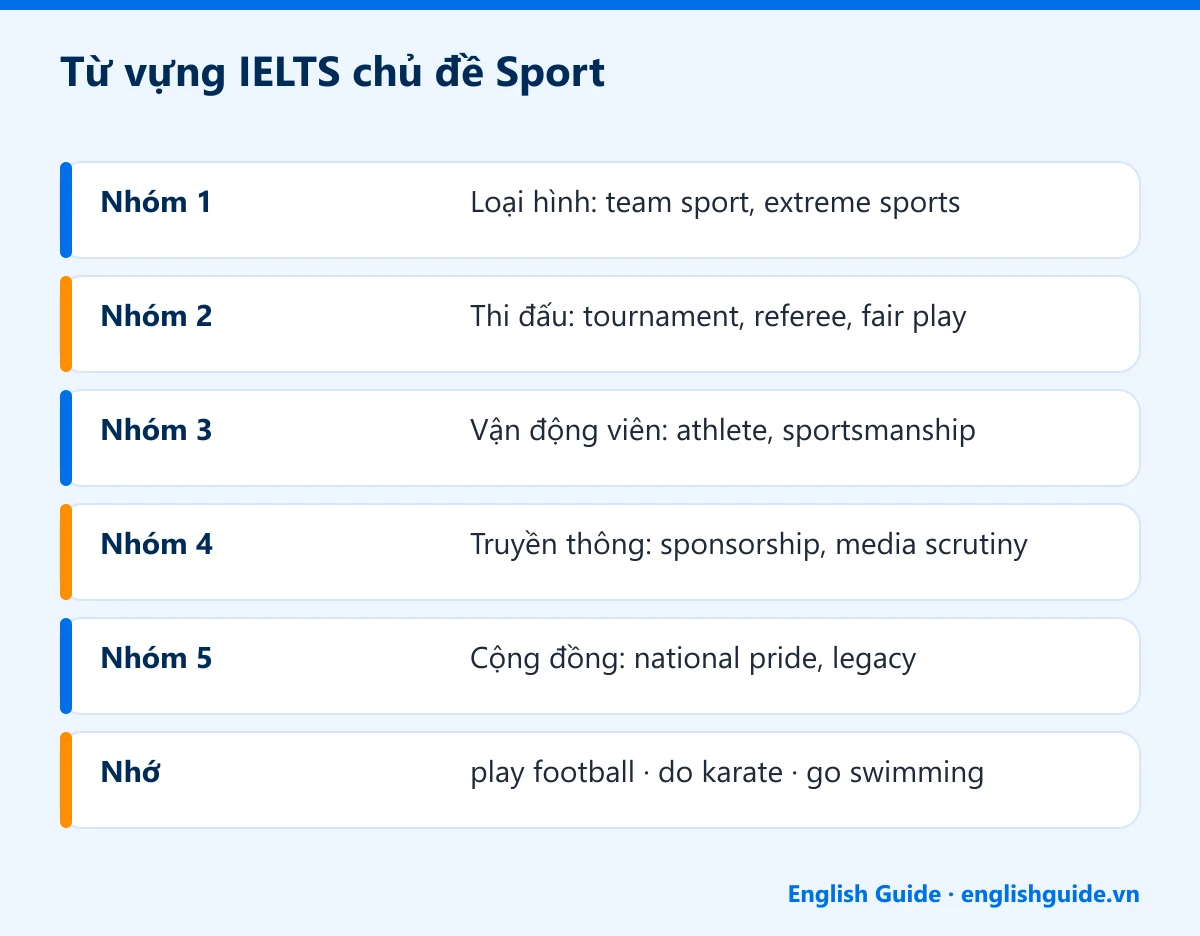
Nhóm từ về thể lực và tập luyện cho khỏe (fitness, work out, physical activity) đã có ở bài từ vựng IELTS chủ đề Health, nên bài này tập trung vào thể thao như một hoạt động thi đấu, giải trí và xã hội. Cuối bài có collocation, idiom, đề Task 2 hay gặp, đoạn mẫu Writing, câu trả lời Speaking và bài tập có đáp án.
Chủ đề Sport xuất hiện ở đâu trong IELTS
Speaking Part 1 (4–5 phút, theo mô tả phần thi Speaking của IELTS): câu hỏi ngắn như bạn có thích thể thao không, hồi đi học chơi môn gì, thích xem hay thích chơi hơn.
Speaking Part 2: mô tả một môn thể thao bạn muốn thử, một trận đấu bạn đã xem hoặc một vận động viên bạn ngưỡng mộ; bạn có 1 phút chuẩn bị rồi nói trong khoảng 2 phút.
Speaking Part 3 (4–5 phút): bàn rộng hơn, ví dụ vận động viên có được trả quá cao không, vì sao người ta mê xem bóng đá, có nên ép trẻ thi đấu từ nhỏ.
Writing Task 2: đề về lương vận động viên, ngân sách cho thể thao đỉnh cao hay thể thao phong trào, đăng cai sự kiện quốc tế, cấm thể thao mạo hiểm, thể thao điện tử.
Theo trang giải thích điểm của IELTS, vốn từ được chấm qua tiêu chí Lexical Resource, một trong bốn tiêu chí có trọng số ngang nhau ở Speaking và ở mỗi bài Writing. Ở band 7, bảng mô tả band Writing yêu cầu có khả năng dùng một số từ ít phổ biến hoặc mang tính thành ngữ (less common and/or idiomatic items) và cho thấy ý thức về văn phong và collocation, dù đôi chỗ còn chưa phù hợp. Nói cách khác, biết "set a record" hay "a level playing field" có giá trị hơn thuộc lòng thật nhiều tên môn thể thao.
Từ vựng IELTS chủ đề Sport theo 5 nhóm
Ký hiệu từ loại trong bảng: (n) danh từ, (v) động từ, (adj) tính từ, (phr) cụm từ, (phr v) cụm động từ. Câu ví dụ được viết theo kiểu có thể dùng lại trong bài thi.
Nhóm 1: Các loại hình thể thao
Từ, cụm từ | Từ loại | Nghĩa | Ví dụ |
|---|---|---|---|
team sport | n | môn thể thao đồng đội | Team sports such as football teach children how to cooperate under pressure. |
individual sport | n | môn thể thao cá nhân | I prefer individual sports like table tennis because I can practise whenever I want. |
spectator sport | n | môn thể thao thu hút đông người xem | Football is a huge spectator sport in Vietnam; whole streets go quiet during big matches. |
extreme sports | n | thể thao mạo hiểm | Extreme sports such as paragliding appeal to people who enjoy taking risks. |
martial arts | n | võ thuật | Many parents send their children to martial arts classes to build self-discipline. |
grassroots sport | n | thể thao phong trào, thể thao cộng đồng | Grassroots sport gives ordinary people, not just elite athletes, a chance to play. |
take up (a sport) | phr v | bắt đầu chơi (một môn) | I took up running last year to clear my head after long days at school. |
e-sports | n | thể thao điện tử | Whether e-sports should count as real sport is still hotly debated. |
Nhóm 2: Thi đấu và luật chơi
Từ, cụm từ | Từ loại | Nghĩa | Ví dụ |
|---|---|---|---|
tournament | n | giải đấu | Our school holds a football tournament between classes every spring. |
opponent | n | đối thủ | She spent hours watching videos of her opponent before the final. |
referee | n | trọng tài | The referee sent off two players for dangerous tackles. |
qualify for | v | giành quyền tham dự | The team failed to qualify for the World Cup by a single point. |
draw | n / v | trận hòa / hòa | The match ended in a goalless draw. |
fair play | n | tinh thần thi đấu trung thực | Coaches should value fair play above winning at all costs. |
performance-enhancing drugs | n | chất tăng cường thành tích (doping) | Athletes caught using performance-enhancing drugs should face long bans. |
ban | v / n | cấm / lệnh cấm | Some countries have banned certain dangerous combat sports. |
strict safety regulations | phr | quy định an toàn chặt chẽ | Extreme sports should be allowed only under strict safety regulations. |
Nhóm 3: Vận động viên và quá trình tập luyện
Từ, cụm từ | Từ loại | Nghĩa | Ví dụ |
|---|---|---|---|
athlete | n | vận động viên | Top athletes often train twice a day, six days a week. |
professional / amateur | adj, n | chuyên nghiệp / nghiệp dư | Very few amateur players ever make the jump to professional level. |
coach | n / v | huấn luyện viên / huấn luyện | A good coach notices weaknesses that players cannot see in themselves. |
undergo rigorous training | phr | trải qua quá trình tập luyện khắt khe | Olympic gymnasts undergo rigorous training from early childhood. |
talent | n | tài năng | Schools should identify sporting talent early and give it proper support. |
sportsmanship | n | tinh thần thể thao (thắng không kiêu, thua không nản) | Shaking hands with the winner after a defeat shows real sportsmanship. |
role model | n | hình mẫu | Successful athletes are role models for millions of young fans. |
at one's peak | phr | ở đỉnh cao phong độ | Most footballers are at their peak in their late twenties. |
retire | v | giải nghệ | Many athletes struggle to find a new career after they retire. |
Nhóm 4: Khán giả, truyền thông và tiền bạc
Từ, cụm từ | Từ loại | Nghĩa | Ví dụ |
|---|---|---|---|
spectator | n | khán giả (xem trực tiếp tại sân) | Thousands of spectators queued for hours to get into the stadium. |
fan base | n | lượng người hâm mộ | The club has built a huge fan base across Asia. |
broadcasting rights | n | bản quyền phát sóng | Television companies pay enormous sums for broadcasting rights. |
sponsorship | n | sự tài trợ | Sponsorship from sportswear brands makes up a large share of a star's income. |
commercialisation | n | sự thương mại hóa | The commercialisation of sport has turned some football clubs into global brands. |
astronomical salaries | phr | mức lương "trên trời" | Top footballers earn astronomical salaries compared with nurses or teachers. |
media scrutiny | n | sự soi xét của truyền thông | Young stars are under constant media scrutiny, both on and off the pitch. |
invasion of privacy | n | sự xâm phạm đời tư | Photographing an athlete's children outside their home is a clear invasion of privacy. |
Nhóm 5: Thể thao, quốc gia và cộng đồng
Từ, cụm từ | Từ loại | Nghĩa | Ví dụ |
|---|---|---|---|
national pride | n | niềm tự hào dân tộc | A gold medal can be a powerful source of national pride. |
patriotism | n | lòng yêu nước | International matches often bring out strong feelings of patriotism. |
national anthem | n | quốc ca | The players stood in silence while the national anthem was played. |
host | v | đăng cai | Hosting the Olympic Games can cost a country billions of dollars. |
international prestige | n | uy tín, vị thế quốc tế | Governments often bid for major events to gain international prestige. |
legacy | n | di sản để lại (sau một sự kiện) | A well-planned tournament leaves a lasting legacy of new facilities and better roads. |
gender equality | n | bình đẳng giới | Equal prize money is an important step towards gender equality in sport. |
social cohesion | n | sự gắn kết xã hội | Local leagues can strengthen social cohesion in rural communities. |
team spirit | n | tinh thần đồng đội | Losing together can build team spirit as much as winning does. |
Collocation chủ đề Sport nên dùng
Collocation là những từ thường đi với nhau. Với chủ đề thể thao, lỗi hay gặp nhất của người Việt là dịch thẳng từng chữ: "làm kỷ lục", "thắng đội bạn". Bảng dưới đây gom những cặp từ chuẩn nên thuộc.
Collocation | Nghĩa | Ví dụ |
|---|---|---|
compete in (a championship / an event) | thi đấu tại (giải, nội dung) | She competed in her first national championship at sixteen. |
win a medal / win a title | giành huy chương / danh hiệu | The swimmer won three medals at the regional games. |
set / break a record | lập / phá kỷ lục | He broke the national record for the 100 metres last season. |
defend a title | bảo vệ danh hiệu | The champion failed to defend her title this year. |
play by the rules | chơi đúng luật | Children should learn to play by the rules, even when nobody is watching. |
a level playing field | sân chơi công bằng | Regular drug testing helps create a level playing field for all competitors. |
cheer on | cổ vũ (ai đó) | Families lined the streets to cheer on the runners. |
sign a sponsorship deal | ký hợp đồng tài trợ | After the final, she signed a sponsorship deal with a shoe brand. |
invest in sports facilities | đầu tư cơ sở vật chất thể thao | The city plans to invest in sports facilities for teenagers. |
the pressure to win | áp lực phải thắng | The pressure to win can take the fun out of sport for young children. |
Hai lỗi rất hay gặp ở bài nói của học viên: dùng sai động từ đi với tên môn, và nhầm win với beat.
Động từ | Dùng với | Ví dụ |
|---|---|---|
play | môn có bóng, môn đối kháng có điểm số | play football, play badminton, play chess |
do | võ thuật và nhiều môn tập cá nhân không dùng bóng | do karate, do yoga, do gymnastics |
go | hoạt động có đuôi -ing | go swimming, go cycling, go jogging |
Chưa đúng | Nên dùng | Ghi chú |
|---|---|---|
Vietnam won Thailand 2–0. | Vietnam beat Thailand 2–0. | win + trận, giải, huy chương; beat + đối thủ |
He made a new record. | He set a new record. | kỷ lục đi với set hoặc break |
The audience at the stadium was huge. | The crowd at the stadium was huge. | audience dùng cho buổi diễn, truyền hình; ở sân dùng crowd hoặc spectators |
She is a good sport man. | She is a talented sportsperson. | sportsperson trung tính; sportsman, sportswoman viết liền |
Idiom gốc thể thao: dùng khi nói, hạn chế khi viết
Tiếng Anh có nhiều thành ngữ bắt nguồn từ thể thao nhưng được dùng cho mọi chuyện trong đời sống. Dùng một câu đúng lúc trong Speaking nghe rất tự nhiên; trong Writing Task 2 thì nên tránh vì văn phong học thuật.
Idiom | Nghĩa | Ví dụ khi nói |
|---|---|---|
move the goalposts | thay đổi yêu cầu, luật chơi giữa chừng | My manager keeps moving the goalposts, so I never know when a task is finished. |
on the ball | nhanh nhạy, nắm việc tốt | Our class monitor is really on the ball; she never misses a deadline. |
throw in the towel | bỏ cuộc | I nearly threw in the towel after my first mock speaking test. |
the ball is in someone's court | đến lượt ai đó quyết định, hành động | I've sent my application, so the ball is in their court now. |
a whole new ball game | một chuyện hoàn toàn khác | Teaching teenagers is a whole new ball game compared with teaching adults. |
Đề Writing Task 2 chủ đề Sport hay gặp
Các đề dưới đây do EG tự diễn đạt để luyện tập, bám theo những hướng ra đề phổ biến về thể thao:
Dạng đề | Đề luyện tập |
|---|---|
Agree/disagree | Professional athletes earn far more than people in essential jobs such as nursing or teaching. This is unfair. To what extent do you agree or disagree? |
Advantages/disadvantages | Many countries compete to host major international sporting events. Do the advantages of this outweigh the disadvantages? |
Discussion | Some people think governments should spend money on training top athletes, while others believe it should go to sports facilities for ordinary people. Discuss both views and give your opinion. |
Two-part question | Many children stop playing sport once they reach secondary school. Why is this? What can be done to encourage them to stay active? |
Agree/disagree | Some people believe dangerous sports should be banned. To what extent do you agree or disagree? |
Opinion | Competitive video gaming should be recognised as a sport in the same way as football or tennis. Do you agree or disagree? |
Đoạn mẫu Writing Task 2 dùng từ vựng Sport
Đề: đề advantages/disadvantages về đăng cai sự kiện thể thao quốc tế ở bảng trên. Đoạn thân bài dưới đây cân nhắc hai mặt rồi đưa ra điều kiện; từ vựng của bài được in đậm.
Supporters of bidding for major tournaments argue that they bring international prestige and a sense of national pride that few other events can match. When a country hosts the Olympic Games, millions of viewers around the world see its cities and culture, which can boost tourism for years afterwards. However, the costs are often underestimated. New stadiums are expensive to build and maintain, and some stand almost empty once the spectators have gone home. The most successful hosts are those that plan a long-term legacy from the start, for example by turning the athletes' village into public housing and opening venues to local clubs. In other words, hosting is worthwhile only when the investment also supports grassroots sport and the wider community, rather than a few weeks of global attention.
Đoạn văn mở bằng lập luận của phía ủng hộ, đưa ví dụ cụ thể, chuyển hướng bằng However rồi kết lại bằng một điều kiện rõ ràng. Từ vựng không cần quá hiếm; điểm cộng nằm ở chỗ dùng đúng cặp từ (host the Olympic Games, plan a long-term legacy) và đúng ngữ cảnh.
Câu trả lời Speaking mẫu chủ đề Sport
Part 1
Do you prefer playing sport or watching it?
Playing, without a doubt. Watching a match on TV is fun, but I get restless after half an hour. I play badminton with my neighbours most evenings, usually doubles, so it's more about having a laugh than winning. I only really watch sport when there's a big game, like when the national team is playing.
Did you do much sport at school?
Not as much as I'd have liked. We had PE twice a week, but it was mostly running laps around the schoolyard. The highlight of the year was the football tournament between classes. Our class never won, but the whole school came out to cheer on the players, so it felt like a real event.
Thêm câu hỏi Part 1 về sở thích và cách trả lời có ở bài IELTS Speaking Part 1 chủ đề Hobbies.
Part 3
Do you think top athletes are paid too much?
In a sense, yes. It does seem strange that a footballer can earn more in a week than a nurse earns in several years. But their careers are short; most of them retire in their thirties, and only a tiny number ever reach that level. A lot of the money also comes from sponsorship and broadcasting rights, so it reflects how much the public is willing to pay to watch them. For me, the real problem is that so little of that money reaches grassroots sport.
Why do international sporting events bring people together?
I think it's because sport gives people a shared emotion without needing a shared language. When the national team plays, you see complete strangers in cafés hugging each other after a goal. In my town, some cafés put big screens on the pavement and everyone watches together. For ninety minutes, differences in age or background just don't matter. That kind of social cohesion is quite rare in everyday life.
Để ý cách mỗi câu trả lời Part 3 nêu quan điểm, đưa ví dụ rồi cân nhắc mặt còn lại. Cách triển khai chi tiết có ở bài IELTS Speaking Part 3.
Bài tập từ vựng Sport có đáp án
Bài 1: Điền từ vào đoạn văn
Từ gợi ý: spectators, sportsmanship, tournament, cheer on, opponent, team spirit, take up
Last month, our district organised a five-a-side football (1) ___ for teenagers. More than two hundred (2) ___ came to watch, and many families brought drums to (3) ___ their children. The final was tense, and when our team lost, the captain walked over to shake hands with every (4) ___, a fine example of (5) ___. The coach said afterwards that losing together had done more for (6) ___ than any training session. Since then, several younger kids have asked to (7) ___ football at the local club.
Bài 2: Chọn cách diễn đạt gần nghĩa nhất (paraphrase)
Top players earn astronomical salaries. (A) extremely high wages (B) fixed monthly wages (C) unfair bonuses
The cyclist was banned from competing for two years. (A) encouraged (B) prohibited (C) selected
The event brought the country international prestige. (A) global respect (B) foreign debt (C) more tourists
Local football leagues can strengthen social cohesion. (A) increase competition (B) bring communities closer together (C) reduce costs
She was under constant media scrutiny. (A) close examination by the press (B) support from fans (C) pressure from her coach
Bài 3: Điền play, do hoặc go
___ judo
___ cycling
___ volleyball
___ gymnastics
___ jogging
Đáp án
Bài 1: 1. tournament · 2. spectators · 3. cheer on · 4. opponent · 5. sportsmanship · 6. team spirit · 7. take up
Bài 2: 1-A · 2-B · 3-A · 4-B · 5-A
Bài 3: 1. do · 2. go · 3. play · 4. do · 5. go
Học và dùng từ vựng Sport sao cho nhớ lâu
Đừng học hết các bảng trong một buổi. Mỗi ngày chọn một nhóm 6–8 từ, đặt một câu về chính bạn (môn bạn chơi, trận đấu bạn nhớ, câu lạc bộ ở trường), rồi dùng lại trong một câu trả lời Speaking có ghi âm. Học theo cụm (set a record, defend a title) thay vì từng từ rời; cách học này được giải thích kỹ ở bài collocation trong IELTS, còn phương pháp ôn lặp lại có ở bài cách học từ vựng IELTS.
Nếu muốn có giáo viên chữa lỗi dùng từ trong bài viết và bài nói, khóa IELTS Master 5.0–5.5 của EG có 80 giờ học, lớp 8–15 học viên, chấm Writing và Speaking chi tiết. Học tại Cơ sở Buôn Ma Thuột học phí 9.900.000đ (khoảng 124.000đ/giờ); học online cùng giáo viên 7.140.000đ (khoảng 89.000đ/giờ). Giữa các buổi, học viên ôn từ vựng trên nền tảng EG LMS. Chưa rõ trình độ, bạn có thể bắt đầu bằng bài kiểm tra trình độ miễn phí.
Câu hỏi thường gặp
Nên viết sport hay sports?
Trong tiếng Anh-Anh, sport (không đếm được) chỉ thể thao nói chung: I love sport. Tiếng Anh-Mỹ thường dùng sports: I love sports. Khi làm tính từ ghép, cả hai đều dùng sports: sports facilities, a sports centre. Chọn một cách và dùng thống nhất trong bài.
Match, game, competition và tournament khác nhau thế nào?
Match là một trận đấu cụ thể (tiếng Anh-Mỹ hay gọi là game). Game còn có nghĩa là trò chơi hoặc một ván trong trận. Competition là cuộc thi nói chung, còn tournament là giải đấu gồm nhiều trận, nhiều đội hoặc nhiều người.
Athlete, player và sportsperson dùng khi nào?
Athlete là vận động viên nói chung, đặc biệt hay dùng cho điền kinh. Player dùng cho người chơi một môn cụ thể: a football player, a tennis player. Sportsperson là từ trung tính về giới, thay cho sportsman hoặc sportswoman.
Có nên dùng idiom thể thao trong Writing Task 2 không?
Không nên. Idiom như throw in the towel hợp với Speaking. Trong Writing, chọn cách diễn đạt trung tính: give up, a fair system, reach a decision.